
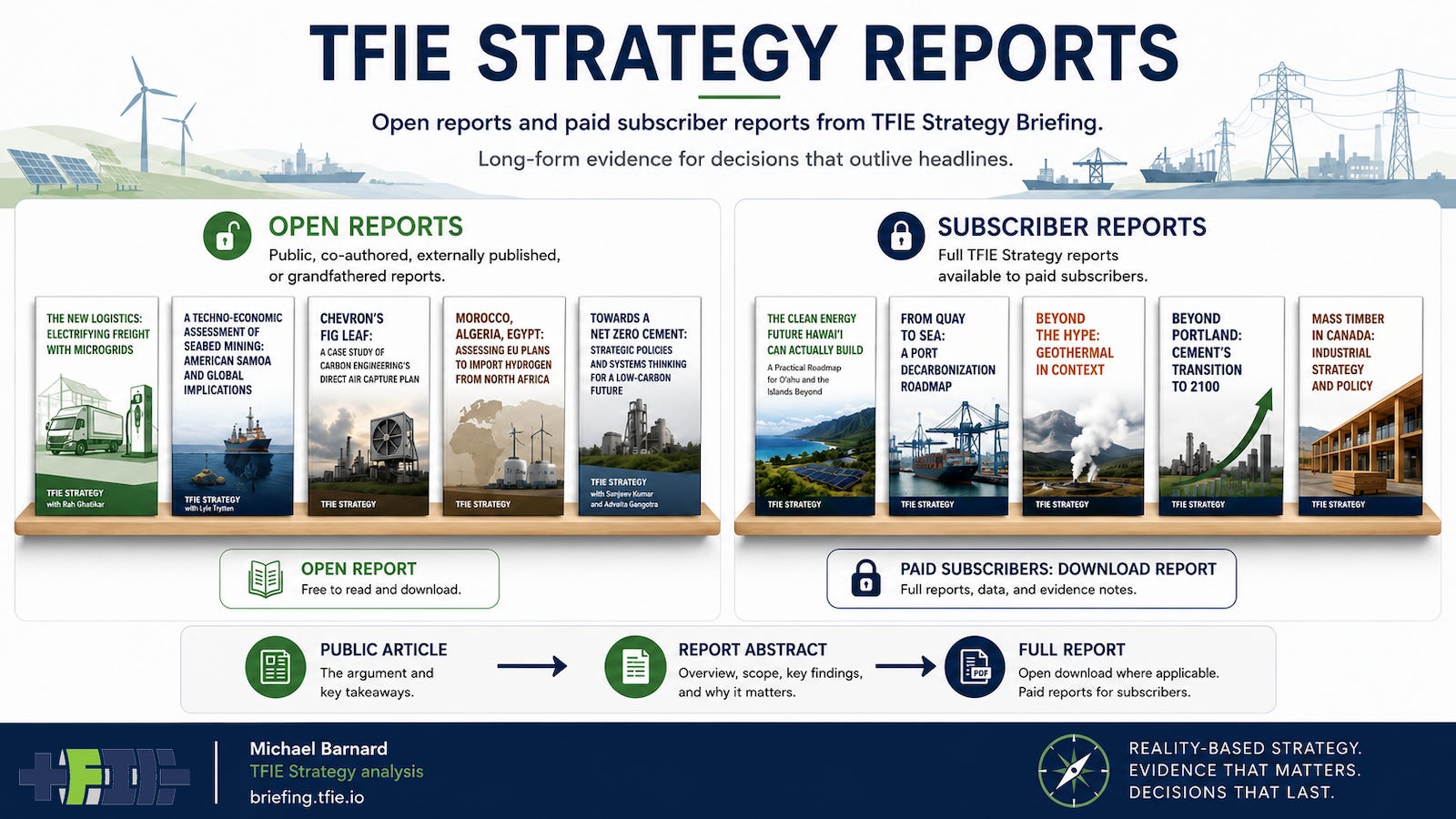
TFIE Strategy Reports are longer-form analyses behind selected public articles, pathway reviews, and strategy work. They cover decarbonization strategy, technology diligence, infrastructure sequencing, transition roadmaps, and market formation across energy, industry, transportation, grids, ports, fuels, and climate-tech capital allocation.
Some reports remain open because they were co-authored, externally published, public-domain, or originally released for public use. Subscriber reports are part of the paid professional layer of Michael Barnard’s TFIE Strategy Briefing.
Open Reports
These reports remain open because they were co-authored, externally published, public-domain, or grandfathered from earlier public release.
The Bus Is Not the System — Metropolitan Transit Governance
Why does Glasgow have so many bus companies, and what does that reveal about how transit should be governed as fleets electrify? This report examines where competition belongs, why depots and grid connections change the problem, and how authorities can avoid locking short operating contracts into long-lived infrastructure.
The New Logistics: Electrifying Freight With Microgrids
Co-authored with Rish Ghatikar, this report examines how freight electrification can be paired with microgrids, charging strategy, logistics planning, and grid-aware infrastructure. It treats truck charging not as a simple charger deployment problem, but as a system design problem involving depots, corridors, local power constraints, resilience, and operational sequencing.
A Techno-Economic Assessment Of Seabed Mining: American Samoa And Global Implications
Co-authored with Lyle Trytten, this assessment tests seabed mining against deepwater engineering, vessel logistics, robotics, riser and recovery systems, nodule processing, metals markets, environmental governance, and bankability. The report separates mineral-resource claims from the harder question of whether those resources can become reliable, economic supply.
Chevron’s Fig Leaf: A Case Study Of Carbon Engineering’s Direct Air Capture Plan
This case study examines Carbon Engineering’s direct air capture claims, fossil-fuel alignment, energy requirements, carbon accounting, and role in climate-policy narratives. It treats direct air capture not as a generic climate solution, but as a pathway that must be judged against cost, energy use, lifecycle value, and the incentives of its owners and customers.
Morocco, Algeria, Egypt: Assessing EU Plans To Import Hydrogen From North Africa
This report examines European hydrogen import plans from North Africa, including renewable electricity opportunity cost, infrastructure requirements, regional development implications, export assumptions, and local energy priorities. It asks whether green hydrogen exports serve North African decarbonization and development, or mainly European demand narratives.
Towards A Net Zero Cement: Strategic Policies And Systems Thinking For A Low-Carbon Future
This externally published cement decarbonization work examines the full policy and systems landscape for reducing cement emissions. It covers materials efficiency, clinker substitution, supplementary cementitious materials, industrial heat, carbon capture niches, demand reduction, standards, procurement, and the importance of treating cement as a system, not just a kiln problem.
Subscriber Reports
Subscriber reports are part of the paid professional layer of TFIE Strategy Briefing. Each report has a public abstract, while the full report is available to paid subscribers.
The Clean Energy Future Hawaiʻi Can Actually Build
This report presents a practical clean-energy roadmap for Oʻahu and the islands beyond. It focuses on electrification, renewables, storage, demand flexibility, district cooling, grid services, resilience, and the specific constraints of island energy systems. The emphasis is on what Hawaiʻi can actually build, not on generic energy-transition slogans.
From Quay To Sea: A Port Decarbonization Roadmap
This port and maritime decarbonization roadmap connects shore power, vessel electrification, port operations, fuel choices, logistics, grid capacity, and infrastructure sequencing. It treats ports as industrial energy systems and transition gateways, where ships, cargo, fuels, electricity, land use, and policy all meet.
Beyond The Hype: Geothermal In Context
This report places geothermal in context across electricity, heat, drilling risk, resource quality, first-of-a-kind claims, and competing pathways. It distinguishes mature geothermal niches from speculative next-generation claims, and tests geothermal against cost, scalability, maintainability, deployment speed, and alternatives that are also improving.
Beyond Portland: Cement’s Transition To 2100
This long-horizon report examines cement’s transition through 2100, including clinker reduction, supplementary cementitious materials, electrified heat, carbon capture niches, alternative binders, demand reduction, standards, and construction-system change. It focuses on the realistic levers that can reduce emissions in one of the world’s most stubborn industrial sectors.
Mass Timber In Canada: Industrial Strategy And Policy
This report examines mass timber as a Canadian industrial strategy opportunity, not just a building-material substitution story. It covers manufacturing capacity, building codes, forestry supply chains, policy, procurement, embodied carbon, regional development, and the conditions under which mass timber can deliver real climate and economic value.
Subscribe
Free posts carry the public argument. Paid subscribers get the professional layer: reports, scorecards, evidence notes, denominator checks, update triggers, and decision-grade context.