

Access: Paid subscriber report
This report is part of the paid professional layer of Michael Barnard’s TFIE Strategy Briefing. The abstract, context, and related public analysis are available publicly. The full report is available to paid subscribers.
The report was originally published through TFIE Strategy and introduced in CleanTechnica as a white paper based on a series of public explorations, extended and edited into a coherent roadmap for Oʻahu and the islands beyond. CleanTechnica described it as asking whether Hawaiʻi, with no continental grid behind it and a long dependence on imported fuels, can build an energy system that is cleaner, more resilient, more affordable over time, and better aligned with island realities.
Provenance
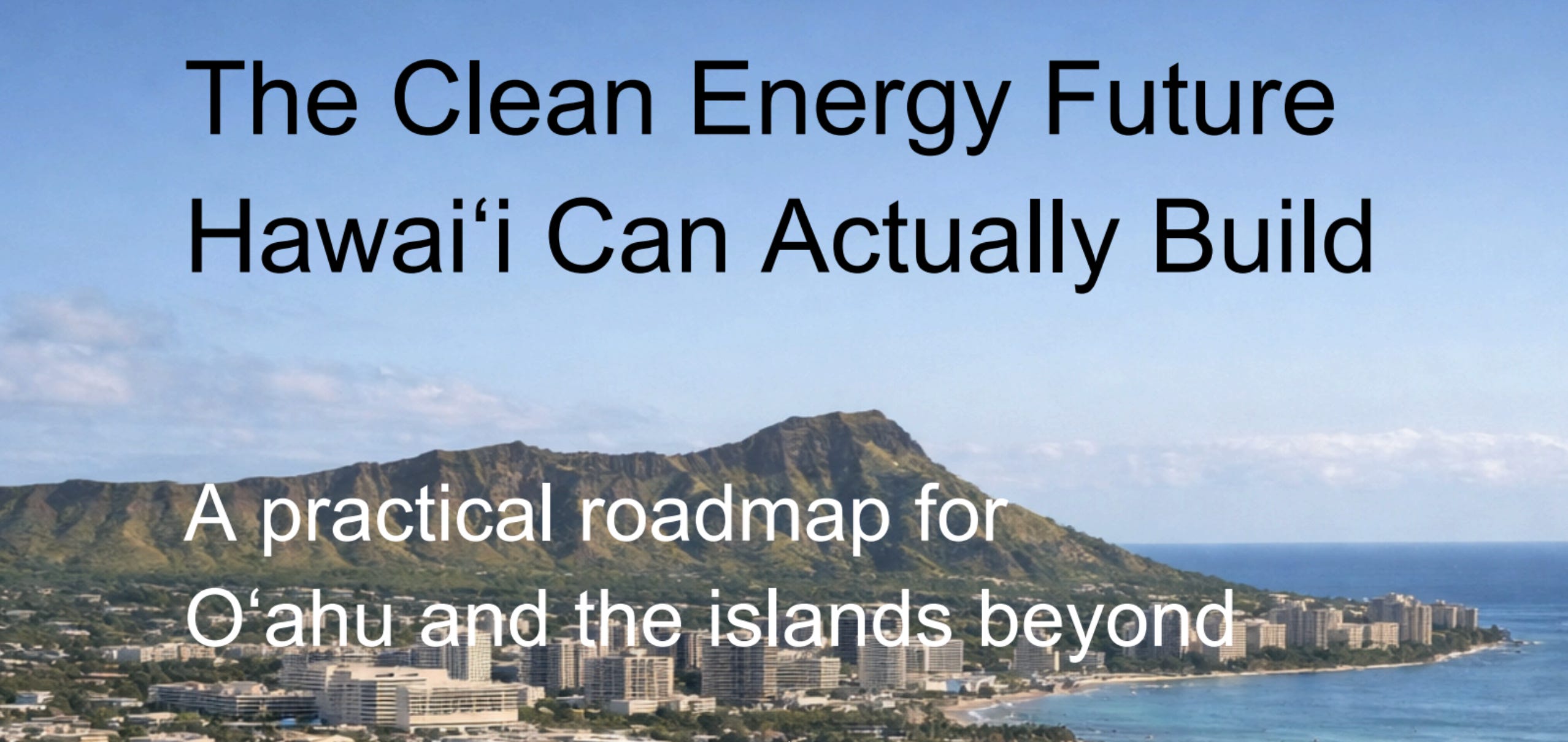
Report title: The Clean Energy Future Hawaiʻi Can Actually Build: A Practical Roadmap for Oʻahu and the Islands Beyond
Author: Michael Barnard
Publishing context: TFIE Strategy white paper
Original public gloss: CleanTechnica, April 2026
Access model: Paid subscriber report
Current archive: TFIE Strategy Briefing Reports
Recognition
This report grew out of a long public analysis process on Hawaiʻi’s energy transition. Island systems sharpen energy thinking because they expose the tradeoffs more clearly than continental grids do. Imported fuel dependence, no neighboring grid, land constraints, cooling demand, military and tourism loads, shipping and aviation exclusions, local resilience, and public affordability all matter at the same time.
The public CleanTechnica work created the foundation. The TFIE Strategy report turns that article series into a structured roadmap: practical enough to be built, specific enough to test, and disciplined enough to separate island energy realities from mainland assumptions.
Why this report matters
Hawaiʻi is often treated as a clean-energy edge case. It is more useful than that. It is a systems test.
If an isolated island economy can replace oil-fired electricity with a practical mix of solar, wind, storage, demand flexibility, district cooling, grid services, modest reserve fuels, and electrification, the lessons travel. They apply to other island systems, remote grids, military sites, ports, resort economies, and regions where imported fuels remain a major cost and resilience problem.
The report’s value is not a fantasy of total energy autarky. It is a buildable pathway that respects what islands can and cannot do.
Key questions
What problem is this report testing?
Whether Hawaiʻi can build a cleaner, more resilient, and more affordable energy system without relying on fossil bridge fuels, hydrogen optimism, or mainland-style assumptions that do not fit island constraints.
What must the pathway beat?
It must beat oil dependence, LNG detours, hydrogen-for-energy narratives, fragile fuel imports, high retail electricity costs, grid constraints, and solutions that shift cost or risk onto residents.
What is the core systems challenge?
Hawaiʻi needs reliable electricity with no continental backup. That means balancing local renewables, storage, grid-forming resources, demand flexibility, district cooling, interconnection constraints, land use, resilience, and rare-event reserves.
Why focus on Oʻahu?
Oʻahu concentrates much of the state’s population, load, infrastructure, and fuel dependence. A credible Oʻahu roadmap becomes the hard test for island decarbonization.
Who is this report for?
Policy makers, utility planners, energy regulators, infrastructure investors, island governments, resilience planners, clean-energy advocates, military-energy strategists, and anyone working on practical island decarbonization.
Short answers
Hawaiʻi does not need a fossil bridge arriving in the 2030s.
A new LNG pathway risks locking in infrastructure, fuel exposure, and climate delay just as solar, batteries, grid modernization, and flexible demand are becoming more practical.
The core pathway is electrification plus local clean electricity.
Solar, storage, wind where appropriate, grid services, distributed energy, flexible demand, and efficient cooling carry much of the practical load.
Not every energy use belongs in the same model.
Overseas aviation, international shipping, and military demand need to be separated from the island electricity system so the actual grid transition is not obscured by imported-fuel categories.
District cooling and demand flexibility matter.
Cooling demand is not a side issue in Hawaiʻi. It is a grid resource, affordability lever, and resilience issue when handled well.
Rare-event reserves are different from everyday fuel dependence.
A small reserve fuel role for rare events is not the same as building a new fossil fuel system and calling it a transition bridge.
Key findings
Hawaiʻi’s clean-energy pathway is more practical when electricity, aviation, shipping, and military fuel demand are separated clearly.
Oʻahu can move toward a cleaner electricity system through solar, storage, flexibility, cooling efficiency, grid services, and limited reserve fuels.
LNG is a poor bridge strategy if it arrives late and competes with cheaper, cleaner, modular alternatives.
Hydrogen is not a central energy carrier for Hawaiʻi’s electricity transition.
District cooling, demand flexibility, and grid-forming resources deserve more attention than fuel-switching narratives.
Island systems need resilience, affordability, and build sequencing, not generic mainland technology menus.
Update note
The report remains current as a practical island-energy roadmap. Technology costs, policy details, and utility planning will continue to change, but the central logic still holds: Hawaiʻi’s transition should be built around local clean electricity, storage, flexibility, efficient cooling, grid services, and careful reserve planning rather than late fossil bridges or hydrogen-for-energy detours.
Related public analysis
The Clean Energy Future Hawaiʻi Can Actually Build: New TFIE Strategy White Paper
CleanTechnica article introducing the report and its island-energy roadmap framing.
Hawaii’s LNG Detour: Why A Fossil Bridge Arriving In The 2030s Makes No Sense
CleanTechnica article on why LNG is a weak bridge strategy for Hawaiʻi’s electricity system.
Download the report
The full report is available below for paid TFIE Strategy Briefing subscribers. Subscribers can continue to the download; free readers can subscribe for access to this report and the wider archive of reports, scorecards, evidence notes, denominator checks, update triggers, and decision-grade context.
