

This case study aged well. Carbon Engineering’s pathway always pointed toward fossil-aligned use cases, especially enhanced oil recovery, and Oxy’s acquisition confirmed the market logic.
Access: Open report
This report remains freely available as an open report. It grew out of Michael Barnard’s multi-part CleanTechnica assessment of Carbon Engineering’s direct air capture, enhanced oil recovery, and air-to-fuel claims. CleanTechnica later published the case study as a report on Carbon Engineering’s air-to-fuel and enhanced oil recovery technology.
Provenance
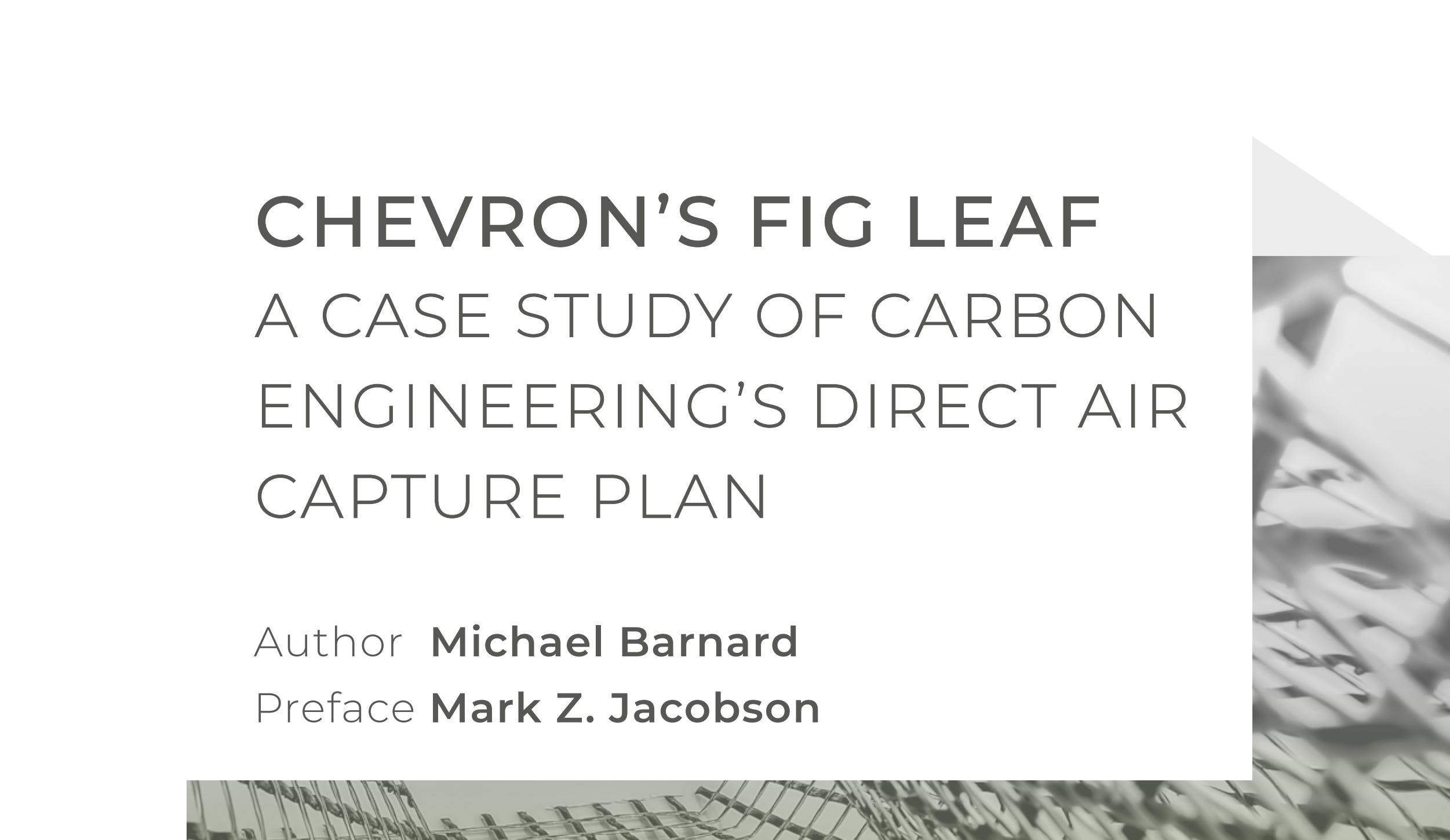
Report title: Chevron’s Fig Leaf: A Case Study Of Carbon Engineering’s Direct Air Capture Plan
Author: Michael Barnard
Foreword: Mark Z. Jacobson
Original publication context: CleanTechnica report / Carbon Engineering assessment series
Access model: Open report
Current archive: TFIE Strategy Briefing Reports
Recognition
This report builds on a long CleanTechnica series assessing Carbon Engineering’s claims, technology pathway, fossil-fuel alignment, enhanced oil recovery use case, and air-to-fuel economics. Mark Z. Jacobson of Stanford contributed the foreword to the collected case study, which gave the report an additional expert framing around climate value, energy use, and system alternatives.
The work also benefited from public technical challenge and follow-on analysis. Later articles revisited Carbon Engineering’s proposed fuel pathways and compared them with direct electrification, including freight use cases where direct battery-electric pathways were dramatically more efficient.
Why this report matters
Direct air capture is often presented as a neutral climate tool. This report examines a specific commercial pathway and asks a harder question: what is the system actually for?
Carbon Engineering’s approach was not just a machine for removing CO₂ from air. It involved large energy inputs, fossil-fuel relationships, enhanced oil recovery relevance, and synthetic fuel claims that had to be tested against direct electrification, lifecycle emissions, cost, scale, and opportunity cost. The report is useful because it separates the abstract appeal of carbon removal from the real-world incentives and economics of a specific corporate pathway.
Key questions
What problem is this report testing?
Whether Carbon Engineering’s direct air capture and air-to-fuel pathway represented a meaningful climate solution, or a fossil-aligned technology with weak system value.
What must the pathway beat?
It must beat direct electrification, renewables, efficiency, conventional emissions reductions, geological storage alternatives, and the opportunity cost of spending capital and clean energy on air-to-fuel pathways.
What is the core system concern?
Capturing CO₂ from ambient air is energy-intensive. Turning that CO₂ into liquid fuels adds more energy demand, infrastructure, and conversion losses. The result has to be compared against using clean electricity directly.
Why does ownership and customer alignment matter?
A carbon-removal technology used for enhanced oil recovery or fossil-fuel reputation management does not have the same climate value as a durable negative-emissions pathway with verified permanent storage.
Who is this report for?
Policy makers, investors, climate advocates, journalists, carbon-removal buyers, and anyone assessing direct air capture claims against energy, emissions, cost, scale, and alternatives.
Short answers
Direct air capture is not automatically climate-positive.
The climate value depends on energy source, lifecycle emissions, storage permanence, end use of CO₂, cost, scale, and what the pathway displaces.
Air-to-fuel is a weak use case for scarce clean energy.
The report and follow-on analysis found Carbon Engineering’s fuel pathway far inferior to using electricity directly in electric vehicles. CleanTechnica’s later summary described the air-to-fuel route as far more costly and more emissions-intensive than direct electrification.
Enhanced oil recovery is not durable carbon removal.
Using captured CO₂ to produce more oil changes the system boundary. The climate claim has to count the oil produced, the energy used, and the emissions that follow.
Scale matters.
Carbon Engineering’s claims had to be tested against the huge volumes of air, energy, equipment, and capital required to make a material dent in atmospheric CO₂. The original assessment series emphasized that the pathway was orders of magnitude away from climate-relevant scale.
The comparator matters.
A technology can look interesting until it is compared against direct electrification, wind, solar, heat pumps, efficiency, and avoided fossil-fuel use.
Key findings
Carbon Engineering’s pathway was energy-intensive and highly sensitive to system boundaries.
Air-to-fuel claims performed poorly against direct electrification.
Enhanced oil recovery weakened the climate-value proposition.
Fossil-fuel company alignment mattered because it shaped likely use cases and incentives.
Direct air capture should be judged by verified net removal, permanence, energy source, cost, and opportunity cost.
The report remains a useful case study in testing carbon-management claims against system alternatives.
Update note
The report remains relevant as a case study in carbon-removal diligence. The direct air capture market has continued to attract capital, policy support, and corporate climate demand, but the core test remains unchanged: a pathway must prove net climate value, permanence, cost discipline, energy realism, and superiority to available alternatives. As predicted, Carbon Engineering’s only natural market was enhanced oil recovery and it was purchased by Oxy for that purpose.
Download the report

Reuse note
This is an open report. Please cite Michael Barnard as author and preserve the original CleanTechnica publishing context where relevant.
Subscribe
Free posts carry the public argument. Paid subscribers get the professional layer: reports, scorecards, evidence notes, denominator checks, update triggers, and decision-grade context.