

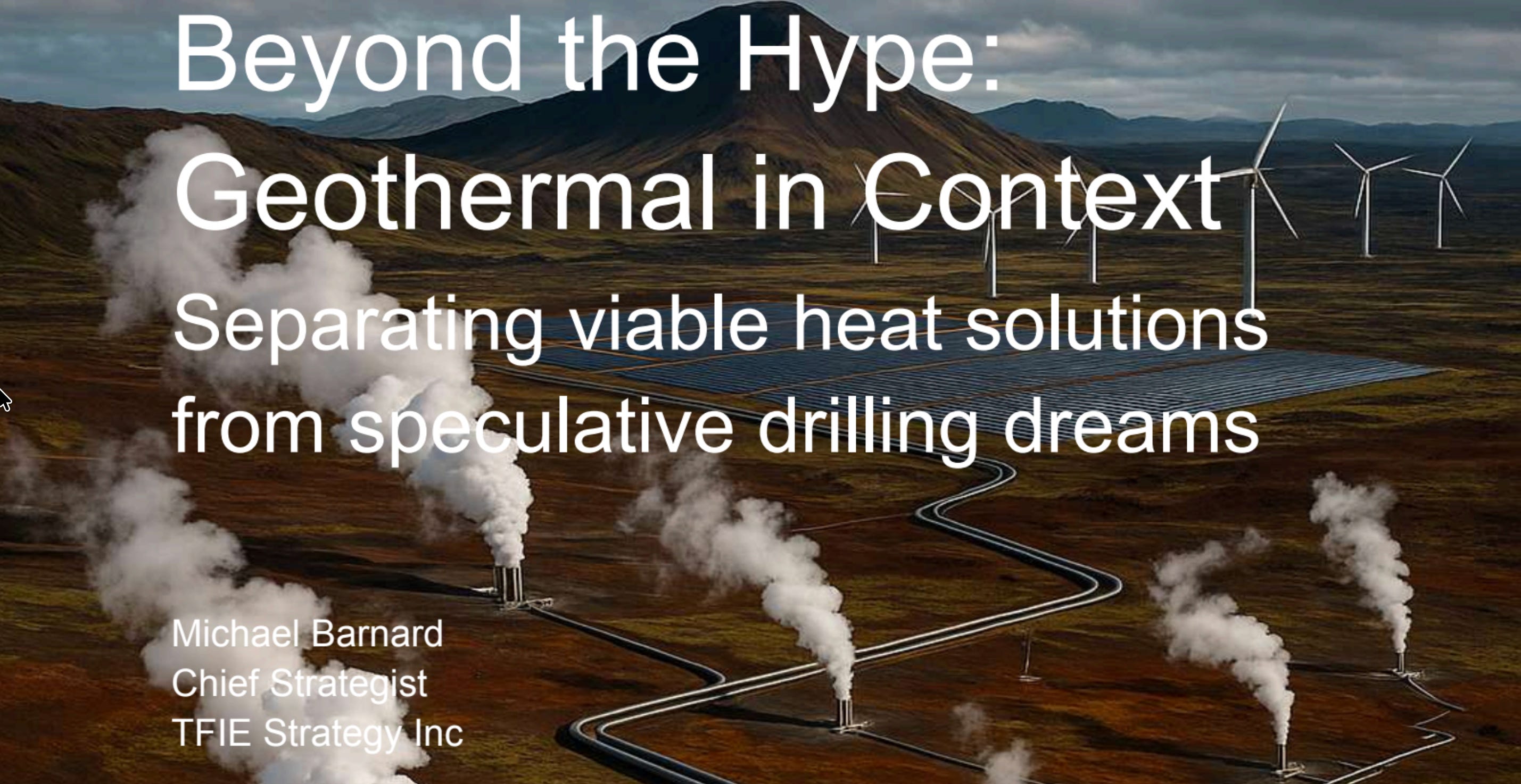
This report separates geothermal heat, district heating, and ground-source heat pumps from the more speculative electricity narratives around EGS, closed-loop systems, superhot rock, and advanced drilling. The professional question is not whether geothermal is useful, but where it survives comparator discipline against heat pumps, solar, wind, storage, transmission, project-finance risk, and learning-rate claims.
Access: Paid subscriber report. The abstract and context are public. The full report and supporting materials are available to paid subscribers.
This report is part of the paid professional layer of Michael Barnard’s TFIE Strategy Briefing. The abstract, context, and related public analysis are available publicly. The full report is available to paid subscribers.
The report was originally published by TFIE Strategy in September 2025 after a dozen in-depth CleanTechnica articles, weeks of research, lengthy discussions with experts, and public testing of claims around geothermal’s role in the energy transition.
Provenance
Report title: Beyond The Hype: Geothermal In Context
Author: Michael Barnard
Publishing context: TFIE Strategy report
Original public gloss: CleanTechnica, September 2025
Access model: Paid subscriber report
Current archive: TFIE Strategy Briefing Reports
Recognition
This report grew out of a public research process on geothermal’s real role in the transition. The starting question was not whether geothermal is interesting. It is. The question was where geothermal actually fits across heat, electricity, drilling risk, resource quality, learning rates, first-of-a-kind claims, and alternatives that are also improving.
The CleanTechnica article introducing the report notes that the work was sharpened in public through article publication, LinkedIn discussion, and feedback from engineers, scientists, investors, policymakers, and advocates.
Why this report matters
Geothermal is having another moment. That makes it worth assessing carefully, not dismissing reflexively.
The report separates established geothermal heat applications from speculative deep-drilling and electricity narratives. Heat is often where geothermal has its clearest value. Electricity claims, especially for enhanced geothermal systems, closed-loop systems, superhot rock, and advanced drilling, have to survive drilling cost, reservoir risk, maintenance, project finance, learning-rate claims, and the comparator reality of solar, wind, storage, transmission, and heat pumps.
The professional question is not whether geothermal can work. It can. The question is where it is scaling, where it is niche-valid, where it is progressing, and where activity is being mistaken for durable market formation.
Key questions
What problem is this report testing?
Where geothermal fits in the energy transition once heat, electricity, resource quality, drilling risk, first-of-a-kind claims, and comparator pathways are separated.
What must geothermal beat?
It must beat or complement heat pumps, district heating, industrial heat electrification, solar, wind, batteries, transmission, demand flexibility, gas backup, and existing geothermal heat applications.
Where is geothermal strongest?
Geothermal is strongest where it directly supplies useful heat, district heating, ground-source heat-pump value, or high-quality hydrothermal resources with proven operating economics.
Where is the hype concentrated?
The hype is concentrated in deep electricity claims: enhanced geothermal systems, closed-loop geothermal, superhot rock, plasma or millimeter-wave drilling, and learning-curve narratives that borrow too much from solar, wind, and batteries.
Who is this report for?
Investors, policymakers, utilities, district heating planners, infrastructure strategists, climate-tech analysts, journalists, geothermal advocates, and organizations assessing firm clean power or industrial heat claims.
Short answers
Geothermal heat is more credible than many geothermal electricity claims.
District heat, ground-source heat pumps, and good hydrothermal resources have clearer applications than many next-generation electricity proposals.
Enhanced geothermal does not automatically get a solar-style learning curve.
A later CleanTechnica follow-on specifically challenged the idea that enhanced geothermal can follow solar’s cost trajectory, because drilling, geology, subsurface uncertainty, and bespoke project risk do not behave like factory-made panels.
Closed-loop geothermal still has to prove bankability.
Elegant sealed-loop diagrams do not remove drilling risk, heat-transfer limits, capital cost, output uncertainty, or first-of-a-kind delivery risk.
Cooling and district systems matter.
Geothermal is not only about electricity. The report context includes useful heat and cooling applications, including geothermal-adjacent district cooling and urban heat-system opportunities.
The comparator matters.
Geothermal’s role must be assessed against alternatives that are improving: batteries, grid flexibility, transmission, heat pumps, district energy, industrial electrification, and conventional geothermal.
Key findings
Geothermal’s most credible roles are often in heat, district systems, ground-source heat pumps, and high-quality hydrothermal resources.
Next-generation geothermal electricity claims require separate treatment from mature geothermal heat applications.
Enhanced geothermal systems face drilling, geology, induced seismicity, cost, and repeatability challenges.
Closed-loop geothermal has promise in principle but must prove heat transfer, output, completion risk, and bankability.
Superhot rock and advanced drilling concepts remain speculative relative to near-term transition needs.
Geothermal learning-rate claims should be tested against drilling and subsurface reference classes, not solar modules.
Geothermal can be useful without becoming the central firm-power solution imagined in many policy and venture narratives.
Update note
The report remains current as a geothermal pathway review. Since publication, the market has continued to generate announcements, investments, and next-generation claims. The evidence still supports a differentiated view: geothermal heat and good hydrothermal resources remain credible; next-generation electricity pathways require stronger proof of repeatability, cost discipline, output, and bankability.
Download the report
The full report is available below for paid TFIE Strategy Briefing subscribers. Subscribers can continue to the download; free readers can subscribe for access to this report and the wider archive of reports, scorecards, evidence notes, denominator checks, update triggers, and decision-grade context.