

Access: Paid subscriber report
This report is part of the paid professional layer of Michael Barnard’s TFIE Strategy Briefing. The abstract, context, and related public analysis are available publicly. The full report is available to paid subscribers.
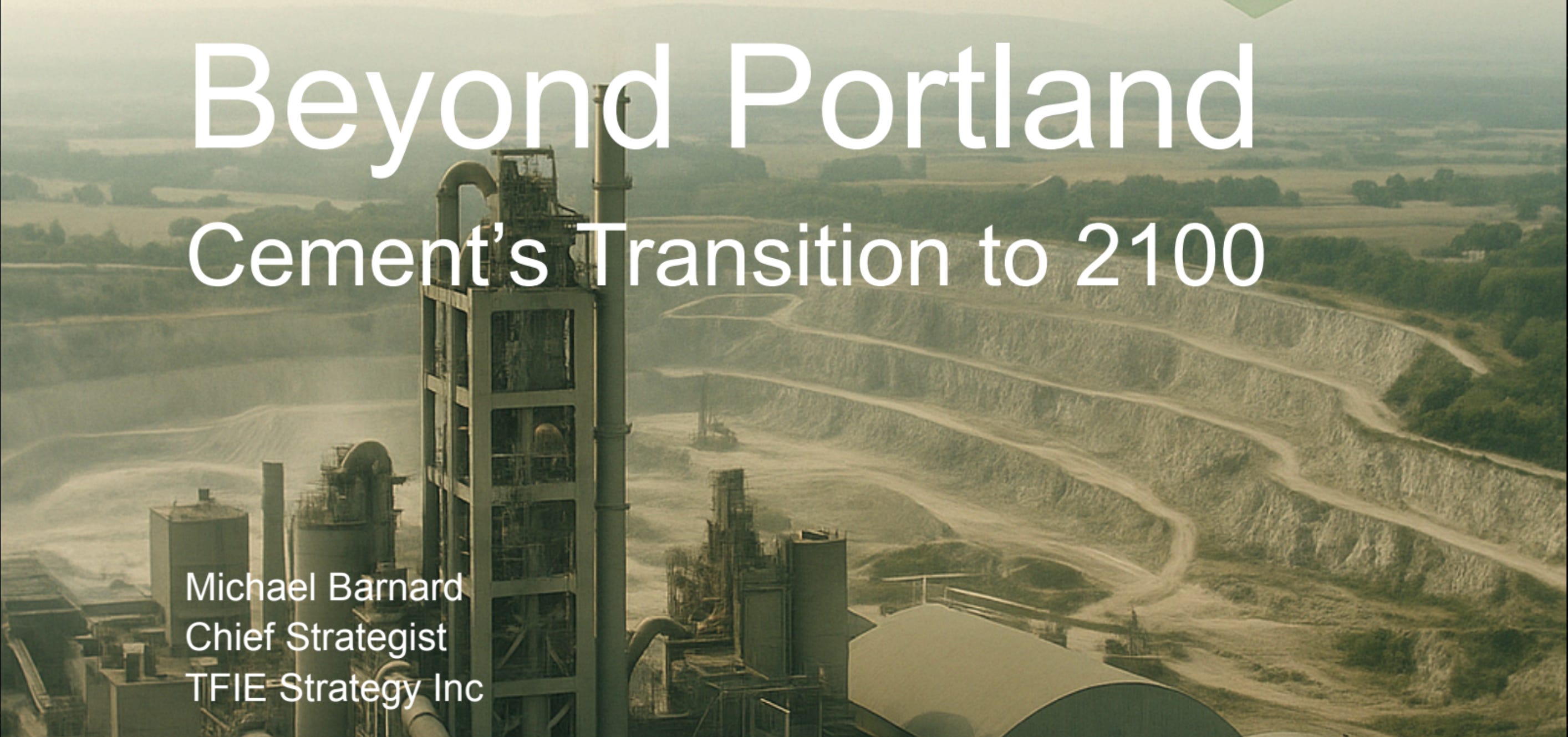
The report was introduced in CleanTechnica as Beyond Portland: Cement’s Transition to 2100, a TFIE Strategy white paper that brings together years of technical, economic, and policy analysis on cement demand, displacement, clinker reduction, electrified heat, alternative binders, carbon capture niches, and construction-system change.
Provenance
Report title: Beyond Portland: Cement’s Transition To 2100
Author: Michael Barnard
Publishing context: TFIE Strategy white paper
Original public gloss: CleanTechnica, October 2025
Access model: Paid subscriber report
Current archive: TFIE Strategy Briefing Reports
Recognition
This report grew out of a long public analysis process on cement and concrete decarbonization. The earlier CleanTechnica work included a decade-by-decade projection of cement displacement and decarbonization through 2100, first published publicly in 2024, with attention to demand reduction, China’s infrastructure buildout maturing, population growth slowing, engineered timber, finite element analysis, geopolymers, clinker substitution, and other levers.
The later TFIE Strategy report turns that public analysis into a long-horizon transition report. It should sit beside the externally published cement policy paper as the deeper TFIE pathway review: less about policy categories alone and more about the demand, supply, material, energy, technology, and substitution trajectory through the rest of the century.
Why this report matters
Cement is often treated as a stubborn industrial emissions problem that must be solved plant by plant, kiln by kiln, with carbon capture waiting at the end. That framing is too narrow.
Cement demand is not fixed. Clinker content is not fixed. Construction practice is not fixed. Building materials are not fixed. Energy sources are not fixed. Standards, procurement, engineering design, urbanization, infrastructure maturity, and substitutes all shape the size of the problem before a capture unit ever appears.
Beyond Portland matters because it asks what cement’s transition looks like when displacement, demand, materials, heat, chemistry, and carbon management are modeled together through 2100.
Key questions
What problem is this report testing?
How cement demand, cement displacement, and cement decarbonization could evolve through 2100 when the full set of realistic levers is considered.
What must cement decarbonization beat?
It must beat business-as-usual Portland cement, clinker-heavy construction, slow standards reform, high-carbon heat, excessive material use, and overreliance on expensive end-of-pipe carbon capture.
What is the core systems challenge?
Cement emissions come from both limestone chemistry and heat. But the volume of cement required is shaped by construction choices, infrastructure maturity, urbanization, population, design optimization, material substitution, and standards.
Why look to 2100?
Cement is tied to long-lived infrastructure, urbanization, building stock, and industrial capacity. A 2030 or 2050 snapshot misses the transition from growth, to substitution, to declining demand, to residual hard-to-abate emissions.
Who is this report for?
Policy makers, cement and concrete firms, construction-sector strategists, infrastructure planners, investors, public procurement teams, standards bodies, industrial decarbonization analysts, and materials innovators.
Short answers
Cement’s future is not just lower-carbon cement.
It is also less cement in many applications. Design optimization, mass timber, alternative materials, reuse, renovation, and infrastructure maturity can reduce demand before technology has to decarbonize every ton.
Clinker reduction is central.
Calcined clays, LC3-style blends, geopolymers, alkali-activated materials, slag where available, recycled concrete, and other supplementary cementitious materials can reduce process emissions and lower the carbon intensity of cementitious materials. The CleanTechnica gloss specifically highlights alternative binders including calcined clays, geopolymers, alkali-activated slag, and recycled concrete pathways.
Electrified heat changes the kiln problem.
High-temperature electric heating technologies can reduce fossil-fuel combustion emissions and make remaining process CO₂ easier to isolate, but they do not eliminate the limestone chemistry problem.
Carbon capture has a narrower role than many forecasts assume.
If demand reduction, clinker substitution, alternative binders, better engineering, and material substitution reduce the problem, CCS should be reserved for residual emissions where it is genuinely needed and cost-effective.
China changes the denominator.
China’s infrastructure buildout has dominated global cement demand. As that buildout matures, global projections that assume continued cement growth can badly overstate long-term demand. The earlier projection explicitly emphasized China’s infrastructure buildout reaching a mature phase as one reason future cement demand can decline.
Key findings
Cement decarbonization is a system transition, not only a kiln retrofit problem.
Demand reduction and displacement are major levers, not side cases.
China’s infrastructure maturity changes the long-term cement demand denominator.
Clinker reduction remains one of the most important near- and medium-term pathways.
Alternative binders, mass timber, design optimization, and material efficiency reduce the amount of cement that must be decarbonized.
Electrified heat can reduce combustion emissions and improve process-CO₂ management.
Carbon capture should be treated as a residual-emissions tool, not the default strategy.
Cement’s transition through 2100 is more plausible when demand, materials, heat, chemistry, and policy are modeled together.
Update note
The report remains current as a long-horizon cement transition pathway. Since the earlier projection work, demand-side analysis has become more important, not less. Industry and independent forecasts increasingly recognize that cement and clinker demand may not follow older growth assumptions indefinitely. That strengthens the report’s core framing: the realistic cement transition depends on reducing the size of the problem before paying to solve every remaining ton.
Related public analysis
Cement Decarbonization Policy Makers Need To Understand All Levers
CleanTechnica article summarizing the peer-reviewed cement policy paper co-authored by Sanjeev Kumar, Ankita Gangotra, and Michael Barnard.
Reassessing Steel: How Falling Cement Use Alters Future Projections
Follow-on CleanTechnica analysis connecting cement demand assumptions with long-term steel demand.
Download the report
The full report is available below for paid TFIE Strategy Briefing subscribers. Subscribers can continue to the download; free readers can subscribe for access to this report and the wider archive of reports, scorecards, evidence notes, denominator checks, update triggers, and decision-grade context.