

Access: Open report
This report remains freely available as an open report. It was externally published in Current Sustainable/Renewable Energy Reports and co-authored by Sanjeev Kumar, Ankita Gangotra, and Michael Barnard. CleanTechnica published a public gloss in March 2025 summarizing the paper and its policy implications for cement decarbonization.
Provenance
Report title: Towards A Net Zero Cement: Strategic Policies And Systems Thinking For A Low-Carbon Future
Authors: Sanjeev Kumar, Ankita Gangotra, and Michael Barnard
Publishing context: Externally published peer-reviewed paper in Current Sustainable/Renewable Energy Reports
Original publication context: Cement decarbonization policy and systems-thinking analysis
Access model: Open report
Current archive: TFIE Strategy Briefing Reports
Recognition
This paper grew from an extended period of cement and concrete analysis I published in CleanTechnica, including the decade-by-decade cement displacement and decarbonization projection through 2100. Dr. Sanjeev Kumar saw an opportunity to turn that body of work into a peer-reviewed policy paper, and invited me to collaborate. He also brought in Dr. Ankita Gangotra, whose industrial decarbonization work at the World Resources Institute added important policy and systems expertise. CleanTechnica’s gloss credits Sanjeev Kumar’s expertise in structures, materials, building materials, climate, and decarbonization, and Ankita Gangotra’s work on cement and steel decarbonization.
The result was a paper focused on policy levers, not a single silver-bullet technology. That matters because cement decarbonization is a system problem: demand, clinker, standards, procurement, supplementary cementitious materials, industrial heat, alternative processes, workforce, communities, and carbon management all interact.
Why this report matters
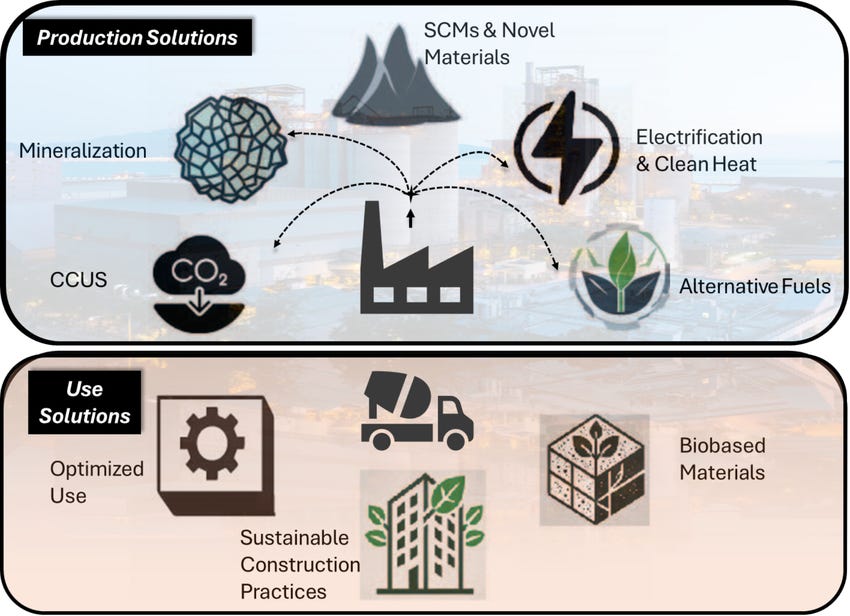
Cement is one of the world’s largest industrial emissions sources, responsible for roughly 7-8% of global carbon emissions according to the CleanTechnica gloss. The temptation is to treat it as a kiln problem or a carbon-capture problem. That is too narrow. Cement’s transition depends on lowering demand where possible, reducing clinker, changing materials and standards, electrifying or otherwise decarbonizing heat, using carbon capture only where it makes sense, and creating policy signals that pull low-carbon materials into real markets.
The report is useful because it brings policy discipline to a sector where many pathways exist, but none can carry the burden alone.
Key questions
What problem is this report testing?
How policy can accelerate cement decarbonization without pretending that one technology, one plant design, or one procurement rule can solve the whole sector.
What must cement decarbonization beat?
It must beat business-as-usual clinker-heavy cement, high-carbon construction practices, slow standards reform, weak procurement signals, and overreliance on carbon capture where cheaper levers exist.
What is the core systems issue?
Cement emissions come from both process chemistry and energy use, while cement demand is shaped by construction practices, materials standards, infrastructure demand, urbanization, and substitutes.
Who is this report for?
Policy makers, standards bodies, cement and concrete firms, construction-sector strategists, public procurement teams, industrial decarbonization analysts, and investors assessing low-carbon materials pathways.
Short answers
Cement decarbonization requires multiple levers.
The paper identifies policy areas across pricing, incentives, regulation, materials substitution, circularity, collaboration, public procurement, workforce development, and community engagement. CleanTechnica’s gloss states that the paper identified nine crucial policy areas to enable cement decarbonization and accelerate transformation.
Clinker is central.
Cement’s carbon footprint largely stems from clinker production, where heating limestone releases CO₂. Lowering the clinker ratio through supplementary cementitious materials, calcined clay, LC3-style blends, and alternative materials is one of the core levers.
Carbon pricing helps, but it is not enough.
Carbon taxes and cap-and-trade can create pressure to reduce emissions, but political durability, border adjustments, procurement standards, and material specifications matter as much as the price signal.
Public procurement matters.
Governments buy enormous amounts of concrete through infrastructure. Low-carbon procurement can create demand before private markets move at scale.
Policy has to treat cement as a system.
The useful frame is not “new kiln” or “CCS plant.” It is demand, materials, standards, finance, regulation, workforce, construction practice, and local acceptance.
Key findings
Cement decarbonization requires coordinated policy, not a single technology pathway.
Clinker reduction and supplementary cementitious materials are central near-term levers.
Carbon pricing can help, but needs complementary regulation, procurement, and standards reform.
Public procurement can create early markets for low-carbon cement and concrete.
Circular-economy strategies can reduce virgin material demand and improve resource efficiency.
Workforce development and community engagement affect whether new cement technologies can scale.
Carbon capture should be treated as one lever among many, not the default answer for the sector.
Update note
The paper remains current as a policy framework. Since publication, demand-side analysis has become even more important, with industry and independent projections increasingly recognizing that future cement and clinker demand may be lower than many older forecasts assumed. That makes systems thinking more important, not less: if demand, clinker, and substitution levers reduce the problem, policy should not overbuild around expensive end-of-pipe assumptions.
Related public analysis
Cement Decarbonization Policy Makers Need To Understand All Levers
CleanTechnica article summarizing the peer-reviewed paper, its policy logic, and its systems framing for cement decarbonization.
Cement Displacement & Decarbonization Decade By Decade Through 2100
CleanTechnica article presenting the long-horizon cement demand, displacement, and decarbonization projection that helped seed the later policy paper.
From Gray Glue to Green Foundations: Cement’s 2100 Transition
CleanTechnica article introducing the later TFIE Strategy white paper Beyond Portland: Cement’s Transition to 2100, which builds on the broader cement analysis.
Download the report
Reuse note
This is an open externally published paper. Please cite Sanjeev Kumar, Ankita Gangotra, and Michael Barnard as co-authors and preserve the original publication context in Current Sustainable/Renewable Energy Reports where relevant.
Subscribe
Free posts carry the public argument. Paid subscribers get the professional layer: reports, scorecards, evidence notes, denominator checks, update triggers, and decision-grade context.