

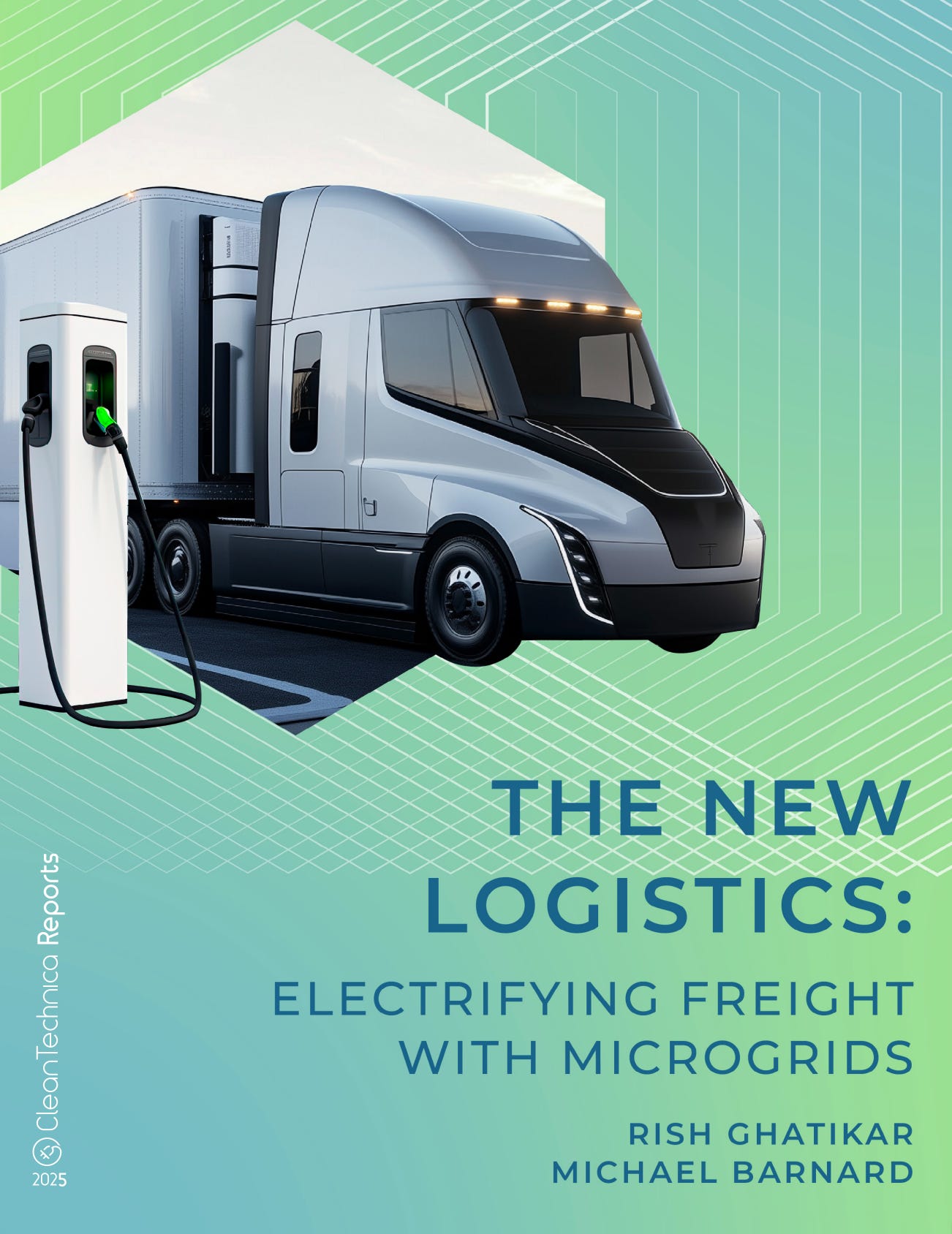
Access: Open report
This report remains freely available as an open report. It was co-authored by Rish Ghatikar and Michael Barnard and originally published through CleanTechnica in 2025 as a strategy paper on electrifying heavy road freight in the United States with microgrids. CleanTechnica describes it as an industry report about the electrification of heavy transport, focused on logistics depots, truck stops, charging microgrids, and the firms positioned to build and operate them.
Provenance
Report title: The New Logistics: Electrifying Freight With Microgrids
Authors: Rish Ghatikar and Michael Barnard
Publishing context: CleanTechnica industry report, 2025
Access model: Open report
Current archive: TFIE Strategy Briefing Reports
Recognition
This report was co-authored with Rish Ghatikar, whose experience in grid modernization, freight electrification, charging systems, and energy infrastructure shaped the report’s treatment of microgrids, truck charging, logistics operations, and grid-aware deployment. At the time of the CleanTechnica article introducing the report, Rish was described as an Open Charging Alliance Ambassador and visiting professor at the University of Southern Denmark, with prior roles connected to GM’s Energy division, the Electric Power Research Institute, and Berkeley National Laboratory.
The report grew out of a CleanTechnica article series by Rish Ghatikar and Michael Barnard on the strategy kernel for freight charging microgrids: diagnosis, guiding policy, and self-reinforcing actions for truck stops, depots, logistics firms, and the vendors that serve them.
Why this report matters
Freight electrification is often treated as a vehicle-and-charger problem. This report argues that it is more usefully treated as a logistics, grid, resilience, siting, modularity, and infrastructure-sequencing problem.
Heavy electric trucks can decarbonize road freight, but high-power charging at depots and truck stops creates local grid challenges that cannot be solved by simply installing chargers and waiting for utilities to catch up. Microgrids with storage, solar, grid connections, power management, and standardized modular buildouts can make charging available faster while improving resilience and economics.
Key questions
What problem is this report testing?
How to accelerate heavy road freight electrification when truck charging is constrained by local grid capacity, infrastructure lead times, fragmented stakeholders, and depot or truck-stop operating realities.
What must this pathway beat?
It must beat diesel logistics on reliability, utilization, operating cost, resilience, and rollout practicality, not just emissions.
Why microgrids?
Microgrids can bring together grid power, local generation, battery storage, energy management, and truck charging in a way that reduces the risk of waiting years for grid upgrades.
Who is the report for?
Large logistics firms, truck stop operators, depot owners, turnkey engineering and procurement vendors, utilities, infrastructure planners, and public agencies working around freight electrification.
What is the core strategic claim?
The winners will be firms that treat electric truck charging as repeatable infrastructure and logistics strategy, not as bespoke one-off charger projects.
Short answers
Freight electrification is technically feasible, but operationally constrained.
The main barrier is not whether electric trucks can work. It is whether charging infrastructure can be deployed at the right sites, at the right power levels, on schedules that match logistics needs.
Microgrids are a simplifying strategy.
They do not remove the grid from the problem. They make grid constraints a design input and allow sites to add charging, storage, generation, and controls in repeatable increments.
Standardization matters.
The report’s logic favours repeatable, modular site designs over bespoke engineering for every depot or truck stop. That is how large firms can scale quickly across many sites.
Location matters.
Not every depot or corridor is equally suitable for early deployment. The report and article series emphasize filtering by logistics demand, grid conditions, state policy, climate alignment, electricity emissions, and business value.
Stakeholders matter.
Truck charging microgrids touch logistics firms, utilities, truck stop owners, EPC firms, regulators, equipment vendors, and public funders. The strategy works only if those stakeholders are aligned around truck charging first.
Key findings
Truck charging is a logistics infrastructure problem before it is a charger problem.
Microgrids can reduce the timing risk of grid upgrades, but they still require utility coordination.
Large logistics firms and truck stop networks have the scale to turn charging microgrids into repeatable infrastructure.
The strongest strategy is modular, standardized, and focused on charging trucks, not chasing every possible microgrid value stream.
Deployment should start where logistics demand, grid conditions, electricity emissions, policy support, and commercial value line up.
Update note
The report remains directionally current. Battery costs, charging hardware, megawatt-charging standards, and freight electrification policy continue to evolve, but the core conclusion still holds: freight charging needs to be designed as grid-aware logistics infrastructure, not as isolated charger installation.
Download the report

Reuse note
This is an open report. Please cite Rish Ghatikar and Michael Barnard as co-authors and preserve the original CleanTechnica publishing context where relevant.
Subscribe
Free posts carry the public argument. Paid subscribers get the professional layer: reports, scorecards, evidence notes, denominator checks, update triggers, and decision-grade context.