

Access: Paid subscriber report
This report is part of the paid professional layer of Michael Barnard’s TFIE Strategy Briefing. The abstract, context, and related public analysis are available publicly. The full report is available to paid subscribers.
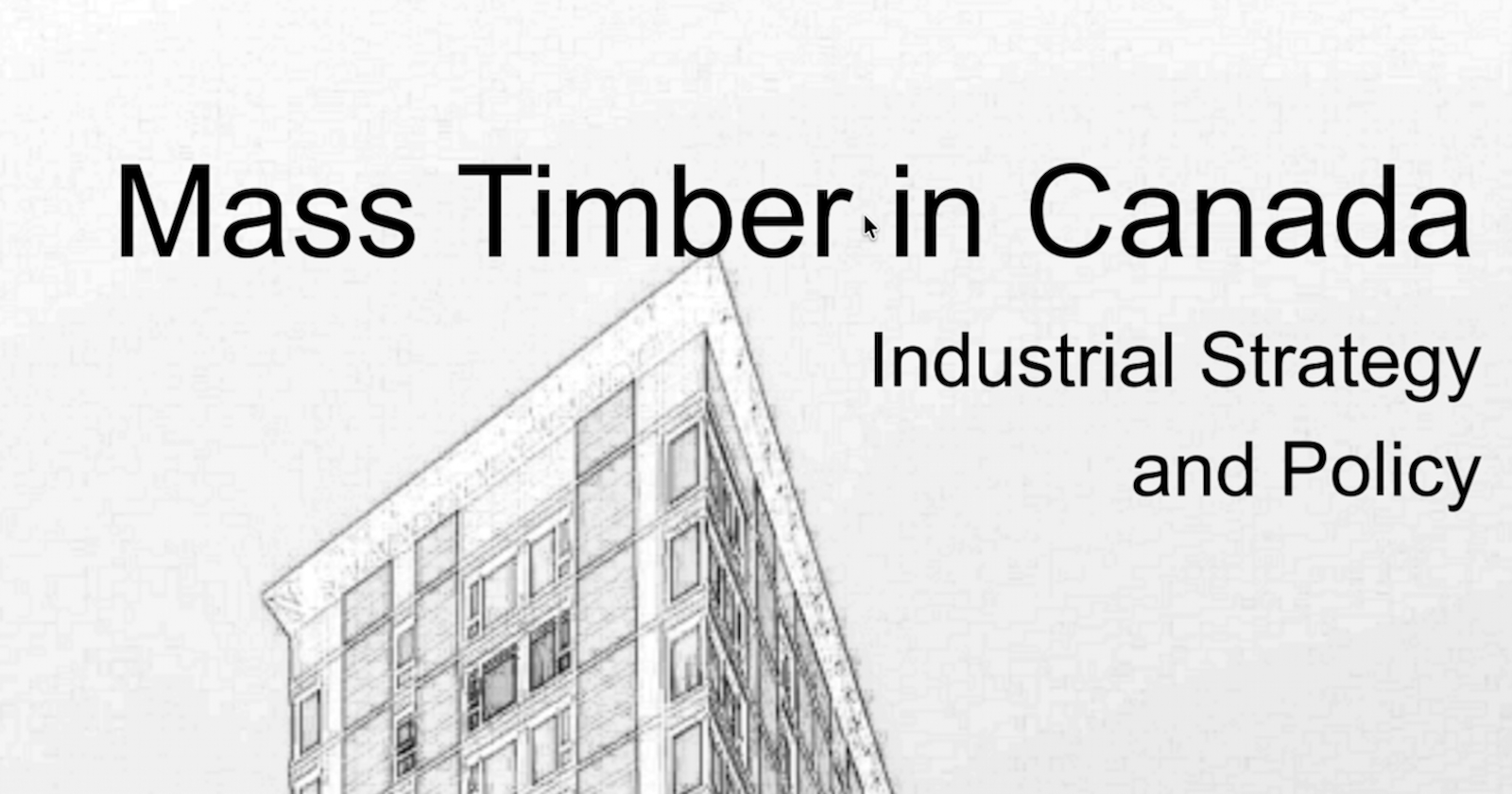
The report grew out of a CleanTechnica series on mass timber in Canada’s housing and climate future, later expanded into a TFIE Strategy report. The year-end reflection described Mass Timber in Canada: Industrial Strategy and Policy as a report that treated mass timber not as a branding exercise, but as an industrial system shaped by fiber availability, manufacturing scale, building codes, and trade dynamics.
Provenance
Report title: Mass Timber In Canada: Industrial Strategy And Policy
Author: Michael Barnard
Publishing context: TFIE Strategy report
Original public gloss: CleanTechnica mass timber series, 2025
Access model: Paid subscriber report
Current archive: TFIE Strategy Briefing Reports
Recognition
This report grew out of a multi-article public analysis process on mass timber’s role in Canada’s housing, industrial, and climate future. The series covered cross-laminated timber, modular construction, embodied carbon, vertical integration, forestry supply chains, electrified harvesting and processing, insurance, building codes, finance, workforce development, fire safety, global leaders, and export opportunities. Later articles in the series explicitly framed the work as examining mass timber in Canada’s housing and climate future.
The report turns that public series into an industrial-strategy view. The central point is not that wood is good and concrete is bad. It is that Canada has forestry resources, housing demand, manufacturing gaps, regional economic needs, climate goals, and export opportunities that can be aligned only if mass timber is treated like an industrial system.
Why this report matters
Canada sits at the intersection of housing shortages, aging construction labor, embodied-carbon pressure, forestry-sector transition, and industrial-policy opportunity. Mass timber can help address those problems, but only if it is scaled as manufacturing, not treated as boutique architecture.
The key comparison is not cabins versus towers. It is raw commodity export versus value-added industrial production. Canada can keep exporting logs and dimensional lumber, or it can build a more sophisticated mass timber sector with standardized designs, regional factories, predictable demand, code normalization, financing tools, and export capacity.
That is why the CleanTechnica article introducing the report’s core thesis argued that Canada must treat timber like cars, not cabins.
Key questions
What problem is this report testing?
Whether Canada can turn mass timber into a serious housing, climate, and industrial strategy rather than a collection of attractive but isolated projects.
What must mass timber beat?
It must beat conventional concrete and steel construction on speed, cost, carbon, repeatability, labor productivity, financing, insurance, code pathways, and supply-chain reliability.
What is the core systems challenge?
Mass timber requires alignment across forests, mills, panel factories, digital design, modular construction, building codes, insurance, procurement, financing, workforce training, and market demand.
Why does Canada matter?
Canada has major forestry resources, housing pressure, climate commitments, industrial regions that need value-added manufacturing, and proximity to North American export markets. The opportunity is real, but it will not scale automatically.
Who is this report for?
Policy makers, housing agencies, forestry firms, mass timber manufacturers, developers, insurers, lenders, construction firms, procurement teams, climate-policy analysts, and regional economic development organizations.
Short answers
Mass timber is an industrial strategy, not just a material substitution.
The report treats cross-laminated timber and related systems as a manufacturing, logistics, code, finance, and supply-chain challenge.
Housing policy can create demand.
Standardized designs, public procurement, pre-approved building types, offtake contracts, and regional factories can turn mass timber from project-by-project novelty into repeatable production.
Embodied carbon is a real advantage, but not the only one.
Speed, smaller crews, prefabrication, lighter structures, quieter sites, and factory learning all matter. CleanTechnica’s series explored labor and financing barriers as much as carbon claims.
The forestry supply chain matters.
Mass timber’s climate value depends on sustainable forestry, electrified harvesting, transport, and processing, and higher-value use of wood fiber. A later series article specifically added more attention to sustainable forestry and linked that work back into the mass timber report.
Codes, insurance, and financing are scaling constraints.
The engineering is increasingly proven, but adoption depends on whether regulators, insurers, lenders, developers, and builders normalize mass timber within mainstream construction.
Key findings
Mass timber should be treated as a Canadian industrial strategy, not a boutique building-material niche.
Canada’s housing shortage, forestry resources, and embodied-carbon goals create a real strategic opening.
Standardized designs, public procurement, and regional manufacturing can accelerate deployment.
Cross-laminated timber and modular construction can reduce construction time and labor pressure.
Building-code normalization, insurance familiarity, and lender confidence are central scaling requirements.
Sustainable forestry and electrified supply chains are necessary to preserve mass timber’s climate value.
Canada risks exporting raw material value while other countries capture higher-value manufactured products.
Mass timber can bend future demand for cement and steel when deployed in the right building segments.
Update note
The report remains current as an industrial-strategy pathway review. Mass timber continues to advance through projects, code updates, manufacturing investment, and policy attention, but the core conclusion remains unchanged: Canada’s opportunity depends less on proving that mass timber works and more on building the industrial system that lets it scale.
Download the report
The full report is available below for paid TFIE Strategy Briefing subscribers. Subscribers can continue to the download; free readers can subscribe for access to this report and the wider archive of reports, scorecards, evidence notes, denominator checks, update triggers, and decision-grade context.