

For the past week I’ve been working with a team of deep and broad decarbonization experts in the Netherlands. TenneT invited me and others to assist with its Target scenario for 2050, the scenario it uses to plan transmission upgrades and land requirements in a country where every square kilometer is spoken for and much of the land was engineered out of the sea.
The TenneT core team brought a lot to the room. Emiel van Druten, who led the scenario-planning work, has a decade of energy-modeling background across the Dutch economy and a sharp view of where the football will be. Emmanuel van Ruitenbeek brought aerospace engineering, a sustainability masters and European energy-trading experience. Tim Gaßmann brought power engineering, energy-planning depth and strong familiarity with the Energy Transition Model, the scenario tool at the center of the process.
A brief note on the Energy Transition Model. It is a free browser-based tool from Amsterdam’s Quintel that lets users build future energy systems from a large set of transparent sliders and assumptions. It is not perfect, but it is open, inspectable and useful in a way many black-box energy models are not. The Dutch planning teams have been using it for years, and the working sessions made clear that they understood the levers, interactions and failure modes well.
The external expert group was also strong. Heleen de Coninck brought climate-science, policy and technology-transition depth, including the experience of having been a Coordinating Lead Author for the IPCC Special Report on 1.5°C. Reinier Grimbergen brought applied-research and industrial-chemistry experience from TNO, DSM and European industrial decarbonization initiatives. Paul Martin brought decades of chemical-engineering experience in hydrogen, syngas and modular process plants, along with the clear-eyed skepticism that made him one of the co-founders of the Hydrogen Science Coalition.
The broader Dutch process is impressive, even where it has shortcomings. The Netherlands is building 2050 scenarios that include the power sector, energy demand, utilities, industrial sectors and many major corporations operating in the country. The process is not magic. It still has internal inconsistencies and political boundary conditions. But the seriousness of the exercise stands out. The Target scenario needed to be cleansed of unlikely extremes, one of them being the persistence of a very large share of fossil refining in a country that currently acts as a major refinery hub for Europe.
That is where the maritime and aviation fuel question came back into focus. The Netherlands receives very large crude carriers into its ports and feeds several major refineries. Ground transport in the high-electrification scenario was broadly understood to electrify, with only a small residual hydrogen assumption for heavy goods vehicles that should continue to shrink. But aviation and shipping energy remained a harder question.
I’ve been working on both for years, including TFIE Strategy Briefing pathway reviews of aviation fuel demand through 2100 and maritime fuel demand through 2100. My broad view remains unchanged: the future of both sectors is batteries where they fit and biofuels or other low-carbon liquids where they do not. But the merit order between aviation and shipping changed my view of which biofuels shipping will actually get.
Aviation will electrify more than most aviation debates admit. Battery-hybrid turboprops serving routes around 1,000 kilometers, with liquid fuel for reserve and diversion requirements, are a much stronger pathway than hydrogen aircraft. Those aircraft should have lower operating and maintenance costs because electric drivetrains are simpler and electrons are cheaper than sustainable aviation fuel. The result is not the disappearance of aviation. It is a split: regional and shorter routes become more electric, while long-haul flights become more expensive because they still require energy-dense liquid fuels.
Long-haul aircraft need kerosene. That molecule requirement matters. One of the cheapest routes to non-fossil kerosene is hydrogenated vegetable oil or related vegetable-oil pathways that can produce drop-in sustainable aviation fuel. The same broad feedstock pool can also produce diesel-like fuels that ships could burn. My prior assumption was that, because shipping demand would fall, shipping and aviation would compete for the same vegetable-oil feedstocks and shipping would use a lot of HVO.
That was too simple. Aviation has less fuel flexibility than shipping. Jet engines need kerosene-like fuels. Ships can burn a wider range of liquids, and shipowners can use more batteries, more hybridization, slower steaming and more operational changes. Aviation is also a higher-margin business than bulk shipping, and fuel is a smaller share of airline operating cost than maritime fuel is for many ship operators. That means aviation can bid more for the vegetable-oil feedstocks that make the cheapest biokerosene.
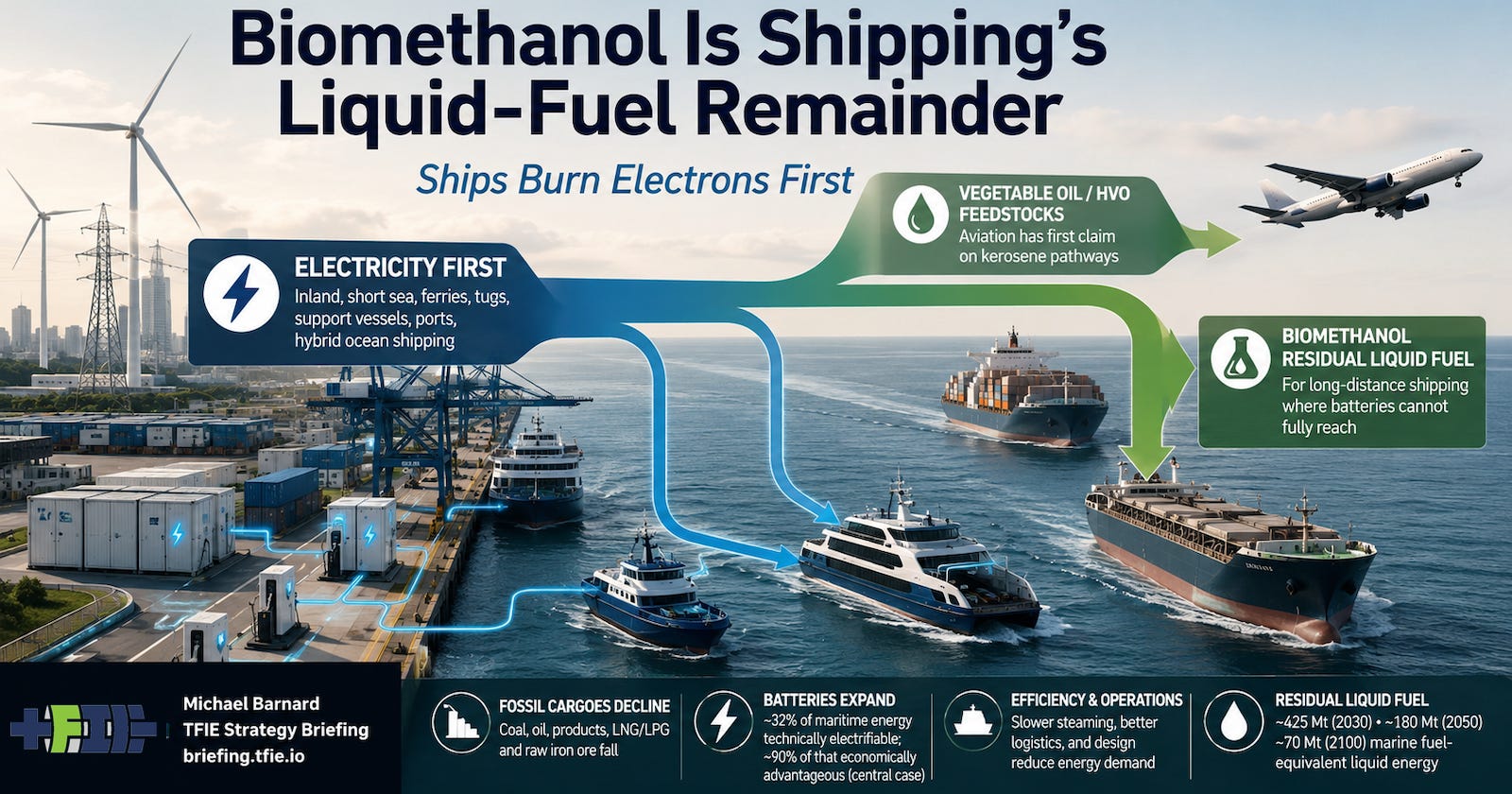
That is the core of the mea culpa. I had treated the HVO-versus-biomethanol question as if shipping were only choosing among fuels. The actual system is a merit-order competition across sectors. Aviation will bid vegetable-oil pathways away from shipping because aviation needs kerosene and has fewer substitutes. Shipping will be left with biomethanol or other residual liquids for the parts of its energy demand that batteries cannot reach.
But this is not the same as saying biomethanol becomes “the” shipping fuel. The better framing is that biomethanol takes the residual liquid-fuel slot. Shipping’s transition starts with a smaller fuel pool, much more electricity and less universal molecule substitution. Biomethanol matters because the remaining liquid-fuel problem is narrower, not because it preserves the old bunker-fuel system.
This sits inside a much smaller shipping fuel pool than most fuel debates assume. Shipping is not just container ships carrying finished goods. A large share of global tonnage exists because the fossil system exists. Coal, oil, petroleum products, LNG and LPG are cargoes, not just fuels. As the fossil system contracts, those cargo flows contract too. Raw iron ore is another exposed category. As steel demand matures, scrap rises, electric arc furnaces gain share and more iron reduction happens closer to ore bodies and renewables-rich regions, long-haul raw iron ore shipping shrinks as well. The TFIE steel transition projection is central to that maritime denominator.
Electrification is the second large lever. I’ve been bullish on marine batteries for a long time, and the evidence keeps moving in that direction. Inland shipping electrifies first. Ferries, tugs, tenders, service craft, port vessels, many offshore support vessels and a lot of short-sea shipping have known routes, repeated stops and practical charging opportunities. The maritime battery wedge is now harder to ignore because newer vessel-segment analysis starts from ship types and operating regimes rather than freight tonnage alone.
That matters because older maritime battery studies undercounted the electrification opportunity by looking too much at freight tonnage and deep-sea cargo. The newer Nature/npj Clean Energy framing is more useful because it looks at vessel segments and actual operating patterns. The central result is material: about 32% of maritime energy consumption is technically electrifiable, and roughly 90% of that electrifiable energy is economically advantageous under central assumptions. That is not a niche. It is a large battery wedge before residual liquid fuels are even considered.
The old freight-tonne lens undercounted batteries because it over-focused on deep-sea cargo and undercounted the wider fleet. A maritime energy model has to include ferries, tugs, inland vessels, offshore support vessels, service craft, passenger vessels and other segments that use energy even if they do not dominate ton-kilometers. That broader fleet view makes the battery share larger and makes the residual liquid-fuel pool smaller.
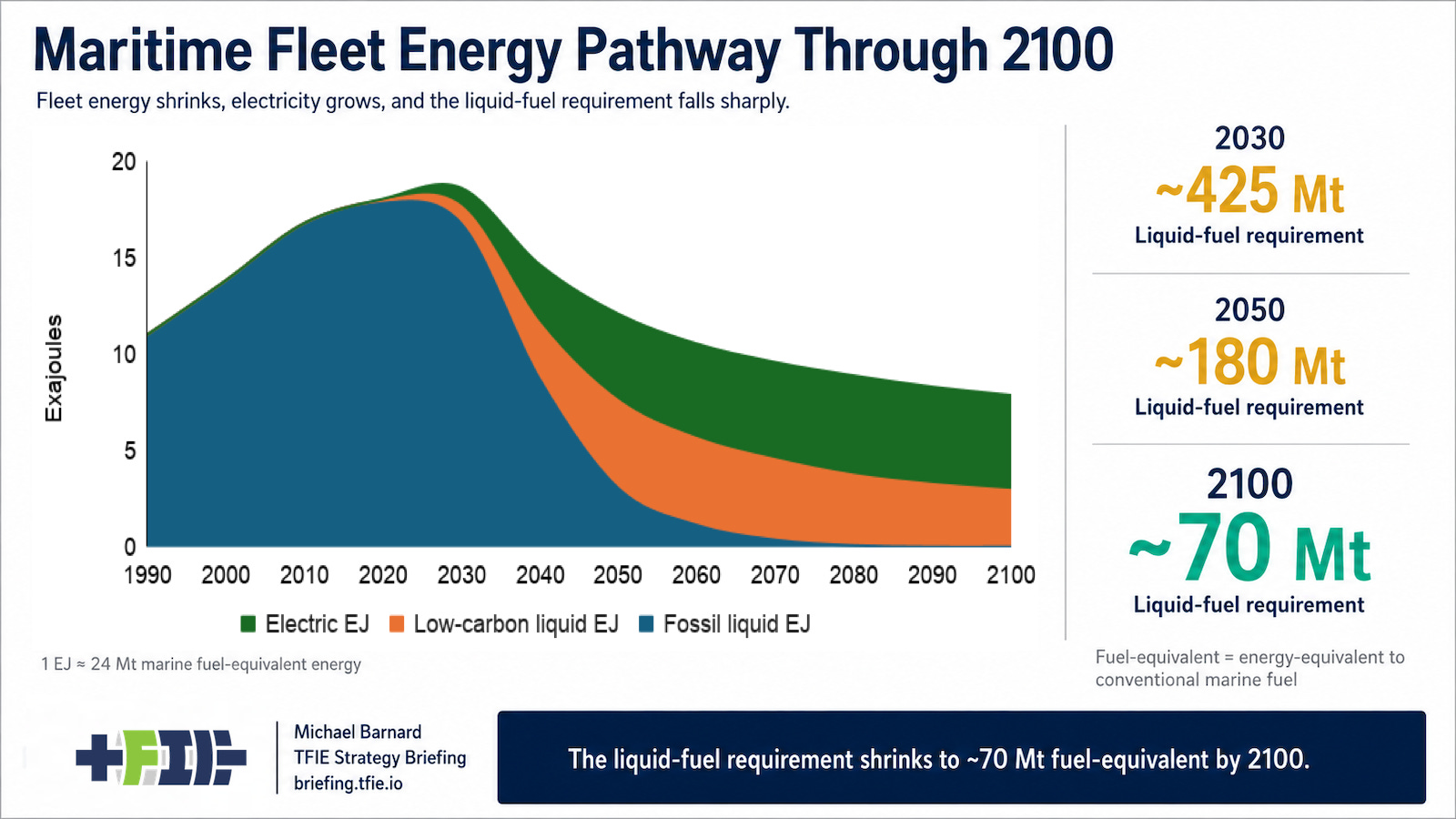
The current TFIE maritime pathway puts the residual liquid-fuel requirement at about 425 Mt fuel-equivalent in 2030, about 180 Mt in 2050 and about 70 Mt by 2100. That replaces the older framing of roughly 30 Mt VLSFO-equivalent or about 60 Mt of biomethanol. The newer number is better because the model is fleet-energy based rather than freight-tonnage based, and because it explicitly separates fossil liquids, low-carbon liquids and electricity instead of treating the problem as a simple fuel substitution exercise.
This is why the biomethanol answer matters, but should not be overstated. Biomethanol is not “the fuel of shipping” in the old bunker-fuel sense. It is a likely residual liquid fuel for the parts of shipping that still need dense molecules after every practical electron has been used. That is a narrower, more useful and more realistic claim.
The cost logic reinforces the point. HVO is easier for ships because it can blend into existing liquid-fuel systems and use much of the current bunkering infrastructure. Biomethanol requires new fuel handling, storage and bunkering arrangements, and its lower energy density means more physical fuel for the same delivered energy. If ships had first claim on HVO feedstocks, HVO would be attractive. They will not. Aviation will bid those feedstocks higher because aircraft need kerosene and have fewer practical substitutes.
That leaves shipping with biomethanol as the lower-cost residual molecule relative to synthetic fuels and hydrogen derivatives, but still an expensive fuel compared with electrons. Hydrogen-based synthetic fuels are mostly out of the running for scale. The hydrogen demand pathway makes the broader point: hydrogen remains important where chemistry requires it, but not as a cheap bulk energy carrier. The hydrogen cargo shipping review makes the maritime version of the same case. Hydrogen and e-fuels can fill narrow gaps, but they do not define the central shipping pathway.
The good news is that the shipping industry was not waiting for my prior view. Methanol-capable ships have entered the order book in meaningful numbers. LNG dual-fuel orders remain a much larger dead-end problem because methane slip and upstream leakage undermine the climate case, but methanol orders at least point toward an industry preparing for alcohol fuels. The confusion remains, but the option value is better than an LNG lock-in.
The stronger good news is that expensive biomethanol accelerates the battery case. If biomethanol is several times the cost of fossil bunker fuel on an energy basis, and if battery costs continue falling while marine battery use keeps accumulating operational proof, shipowners will have a powerful incentive to hybridize. Once a ship has batteries, it will burn every cheap electron it can before it burns any expensive molecule.
That is the part the deep-sea sector still underestimates. Hybridization is not a green ornament. It is an operating-cost strategy. It allows ships to use shore power, port charging, canal charging, route-specific charging and perhaps containerized battery swaps where operations make sense. Every electron used displaces expensive liquid fuel. In a biomethanol world, the breakeven distance for batteries moves outward.
Canals become especially interesting. A ship transiting a canal is already moving slowly, stopping or passing through controlled infrastructure. The Suez Canal, Panama Canal and other chokepoints become potential electron-bunkering sites. Containerized batteries can be moved on and off ships the way other containers are moved, especially where the vessel already has handling time built into the route. Egypt exploring synthetic methanol is less compelling than Egypt building a renewables, battery and charging architecture for ships transiting the canal.
The same logic applies more broadly to ports. Ports become energy infrastructure. They will need grid capacity, shore power, battery buffering, charging systems and operational integration. That does not eliminate biomethanol. It narrows its job. The fuel is used where route length, duty cycle, energy density and charging constraints leave a real molecule requirement.
So the revised conclusion is not that biomethanol wins shipping. The revised conclusion is that biomethanol wins the residual liquid-fuel slot in shipping after aviation claims vegetable-oil feedstocks and batteries take a larger share of maritime energy. That is a much more constrained and useful result.
Liquid fuel demand falls further than the old fuel-substitution debate implies. Bulk fossil cargoes decline. Raw iron ore shipping declines. Batteries take inland, port, ferry, support-vessel and much short-sea demand. Container ships and other ocean vessels hybridize because electrons are cheaper than molecules. Ports become quieter, cleaner and more electrically integrated. Global trade continues, but the fuel system that supports it is much smaller and more selective.
That is the mea culpa I can live with. I was wrong to think biomethanol would not be a major shipping fuel. The missing piece was cross-sector merit-order competition. Aviation takes the vegetable-oil pathway because it needs kerosene and can pay. Shipping burns electrons first and biomethanol where batteries cannot reach.
Subscribe to TFIE Strategy Briefing for the professional layer behind maritime fuel claims: denominator tests, fuel-cost comparisons, battery wedges, merit-order logic and update triggers.
This article was originally published at CleanTechnica as “Mea Culpa: Biomethanol Will Be A Major Shipping Fuel.” It has been archived and lightly updated at TFIE Strategy Briefing.
How do you think biomethanol should be made: pyrolysis (-O2), gasification (+O2) or hydrogasification (+H2)?