

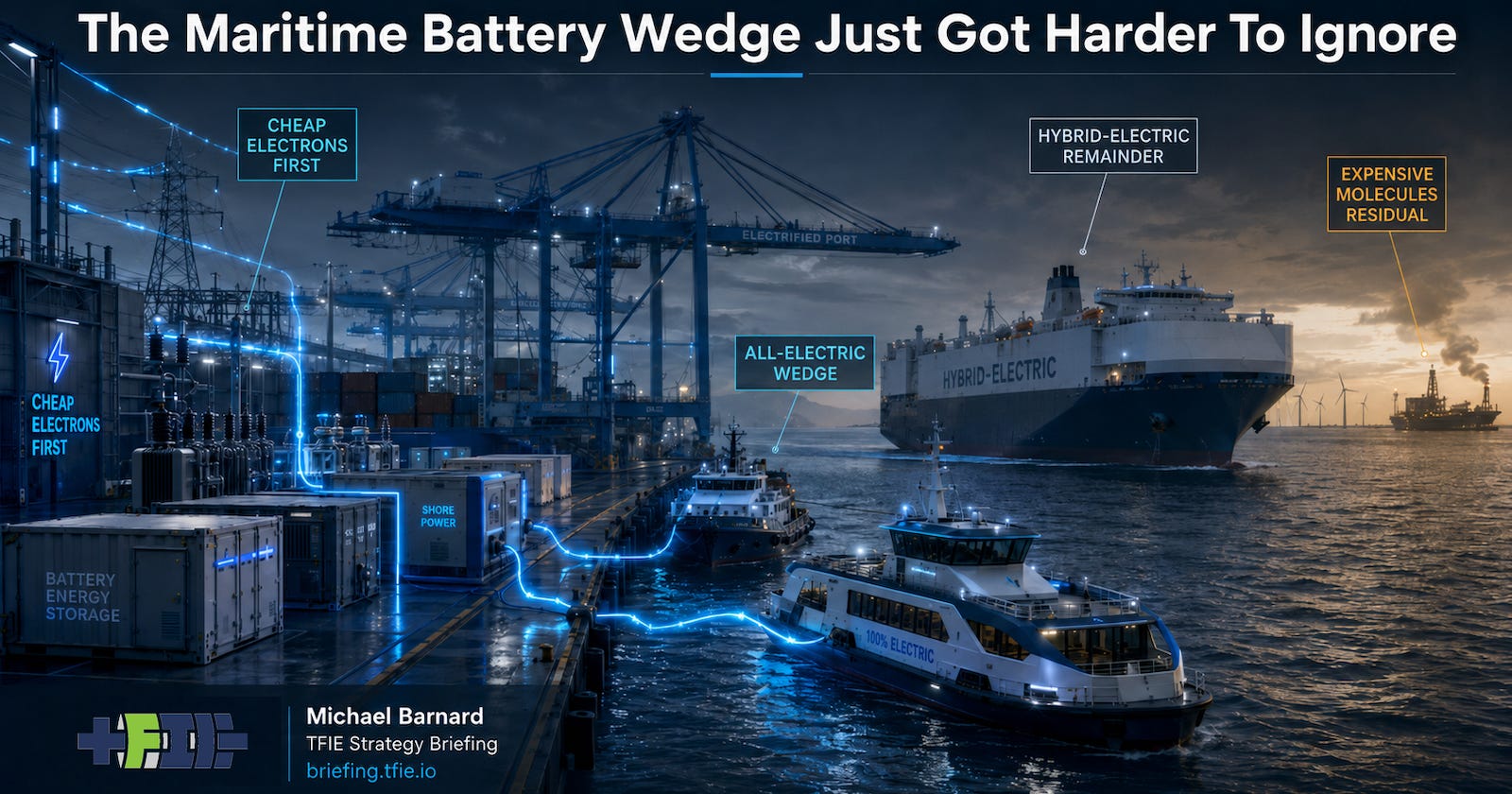
A useful paper has landed in the Nature family, and it should make the maritime fuel debate a little less vague. Mackenbach, Singhal, Zhao and colleagues have published Techno-economic feasibility of electrification for short sea shipping, and the result is not small. Their model finds that by 2030, roughly 30% of maritime energy consumption and nearly 20% of maritime greenhouse gas emissions sit inside the technically electrifiable wedge, with about 90% of that technically electrifiable fleet already economically advantageous under their central assumptions.
The paper is useful because it is not built around a single ferry route, a vendor case study or an announcement being treated as deployment. It has a supplementary workbook, vessel categories, technical filters, fuel assumptions, battery assumptions, port constraints and sensitivity cases. It does not claim that every ship becomes battery-electric, and it does not need to. It says a large part of maritime work is close enough, regular enough and well suited to electricity that batteries are already a serious answer by 2030.
That fits my own thesis on maritime electrification. Inland shipping electrifies. Ferries electrify. Tugs, service vessels, offshore support vessels and port craft electrify. Most short-sea shipping electrifies. Larger vessels hybridize, first around ports, canals, coastal approaches, national waters, hotel loads, maneuvering and peak shaving, then across longer route segments as battery costs keep falling and low-emissions fuels remain expensive. The paper supports that direction while leaving several conservative assumptions in place.
I opened the supplementary spreadsheet hoping not to find the usual maritime battery problem: stale battery costs. That problem has appeared often enough in the literature to be worth checking every time. Studies that looked reasonable when battery systems were $300/kWh to $500/kWh become misleading when LFP systems are moving through $100/kWh, $80/kWh and lower in large stationary tenders. I wrote about that recently in Most Maritime Shipping Battery Propulsion Studies Are Already Obsolete.
The Mackenbach et al. paper is better than the worst examples, while still not being cheap-LFP-forward. The supplementary workbook uses a high 2023 marine battery system cost and then applies a declining cost curve. The result is stronger because the paper finds a large electric wedge without assuming bargain-basement batteries everywhere. A model that is conservative on batteries and still finds a large technical and economic result is harder to dismiss.
The bigger denominator problem is fuel price. The paper’s sensitivity analysis includes marine gas oil, or MGO, with a base case of $700/t and a range from $350/t to $1,050/t. That is useful if the question is oil price volatility, and current bunker price data put MGO in roughly the same broad world as the paper’s baseline. The paper is not using an inflated fossil fuel price to make batteries look good.
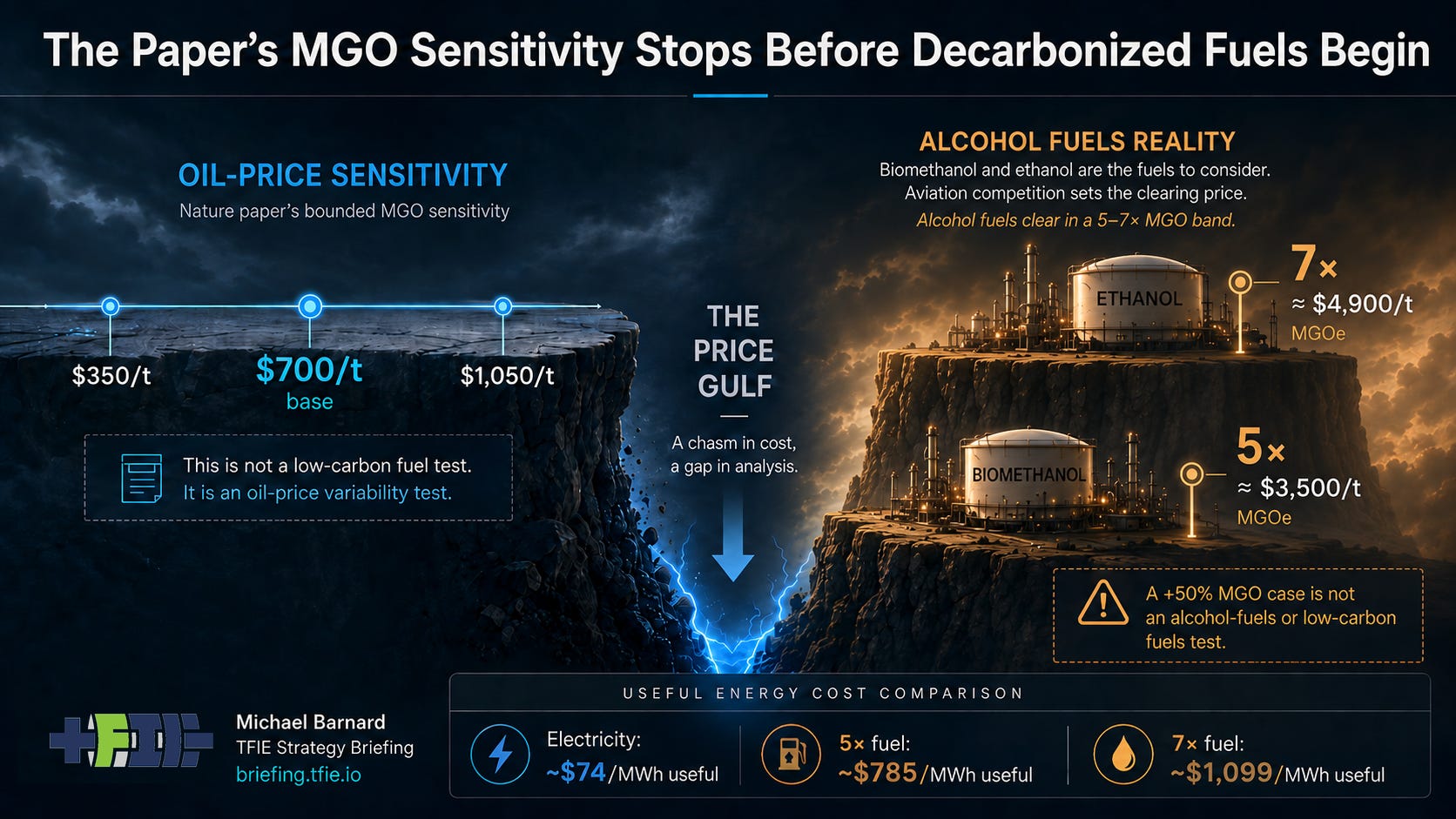
Shipping is not moving toward a world of “MGO plus or minus 50%.” It is moving toward a world where low-emissions fuels have to replace fossil marine fuels under regulation, carbon pricing, fuel standards, cargo-owner pressure and port policy. DNV’s 2025 methanol analysis puts biomethanol at about $2,500 per ton MGO-equivalent, roughly three times marine gas oil, and that is the lower part of the low-emissions-fuel problem, not the upper bound.
I changed part of my own view on this in Mea Culpa: Biomethanol Will Be A Major Shipping Fuel. I had been more bullish on HVO and biodiesel as the dominant marine fuels because they are drop-in or near-drop-in, energy dense and compatible with much existing bunkering infrastructure. I was underweighting merit-order competition with aviation. The same vegetable oils that can make marine diesel substitutes are also among the cheapest pathways to sustainable aviation fuel, and jets require kerosene in a way ships do not.
That leaves shipping with biomethanol as a much more likely major fuel than I had previously allowed, especially once HVO is pulled upward by aviation demand. In that article, I used biomethanol at $1,000 to $1,500 per ton, or roughly $2,200 to $3,300 for the same energy as a ton of HVO, with VLSFO at about $500 to $650 per ton. The practical result was shipping fuels in the 4–6× fossil range, before anyone assumes that hydrogen-based synthetic fuels can escape physics, capital costs and distribution costs. Synthetic fuels can exist at the margin, but they will not set the affordable center of the market.
That biomethanol correction changes the comparator for batteries. The old comparison was batteries against fossil marine fuel. The emerging comparison is batteries against biomethanol, HVO bid up by aviation, ammonia with handling and engine penalties, or synthetic fuels that start expensive and stay expensive. In the Nature paper’s own model, most technically feasible battery-electric segments are already economic at the base $700/t MGO price. At $840/t MGO, which is only a +20% case, the model reaches 100% of its technically feasible all-electric set. It does not need a 5× fuel case to get there.
Once fuel prices move into the low-emissions-fuel world, the paper’s all-electric screen stops being the limiting question. The next question is how much fuel-burning work can be displaced by electrons on vessels that do not pass the full-voyage battery-electric screen, especially when ships can use electricity in port, near port, in national waters, through canals and on repeated coastal segments before burning biomethanol or other expensive molecules for the residual.
The public takeaway is straightforward: the paper confirms a serious near-shore battery-electric wedge, and its own fuel sensitivity stops before the low-emissions-fuel world begins. The paid section does the work underneath that conclusion: testing the spreadsheet assumptions, translating MGO into useful-energy costs, separating the all-electric screen from the larger hybrid-electric opportunity, and checking the port-power constraint against a real port decarbonization roadmap.
