

COVID did not break aviation. It interrupted it, violently and temporarily, which is not the same thing at all. Any long-range projection built during or soon after that disruption needed to be tested once the actuals arrived. Aviation has now moved far enough through recovery that my earlier assumptions can be checked against the real denominator.
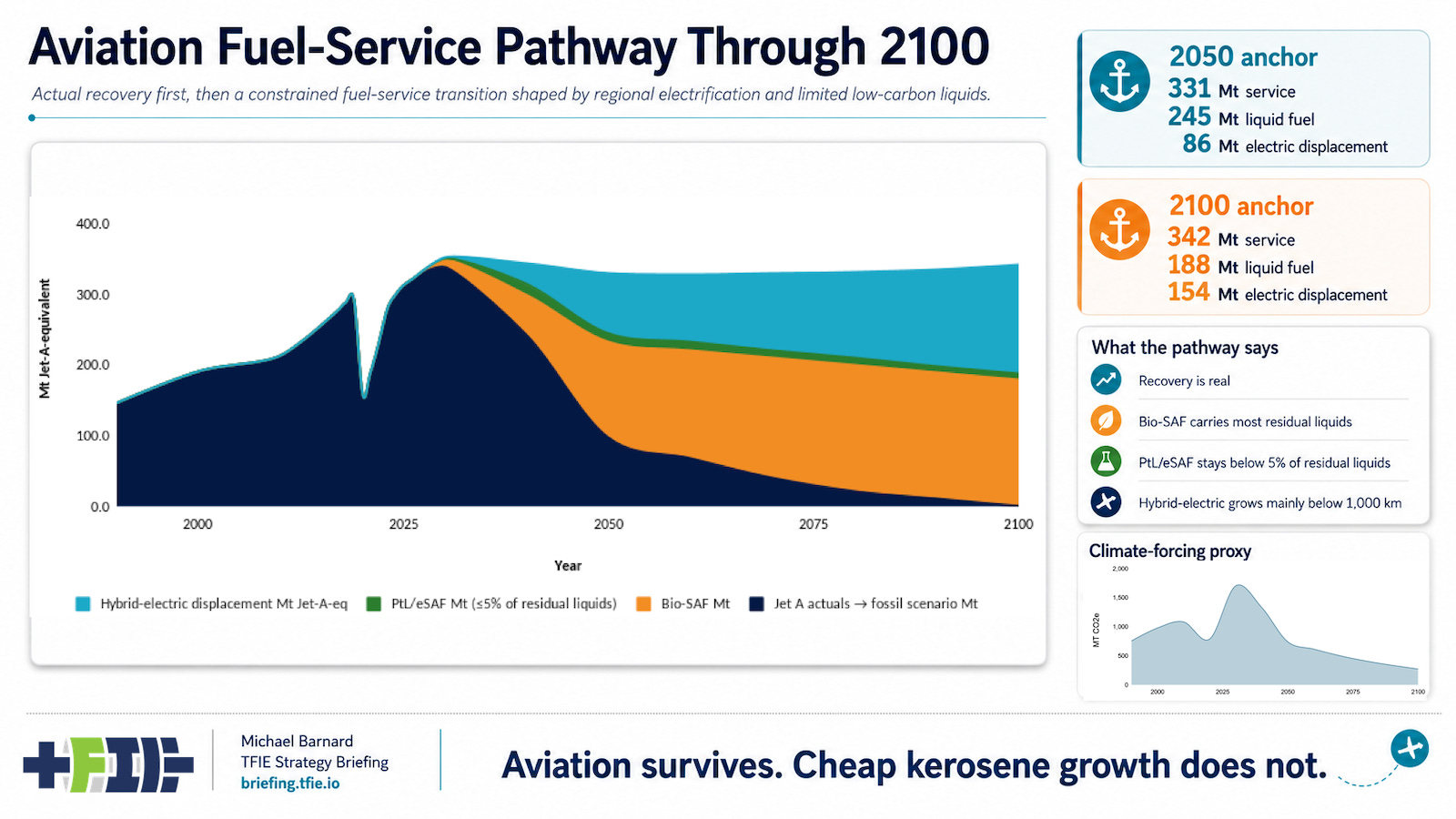
That is what I have done with my aviation decarbonization projection through 2100. The original pathway was directionally aligned with my broader view of aviation’s future: batteries and hybrid-electric aircraft for shorter routes, sustainable biofuels for much of the hard-to-electrify liquid-fuel remainder, e-fuels as a constrained supplement, and hydrogen outside the base case. But the timing was too aggressive. It allowed too much near-term demand destruction to sit too close to the COVID shock.
IATA’s latest outlook has global airline fuel use rebounding from 52 billion gallons in 2020 to 92 billion gallons in 2023, 99 billion in 2024, 103 billion in 2025 and 106 billion in 2026, above the 96 billion gallons burned in 2019. Passenger activity has recovered as well. That means the transition case has to start from recovery, not from residual pandemic damage.
The updated projection therefore makes the correction explicit. If aviation fuel demand falls later in the pathway, it has to be because economics, technologies and policy constraints change after recovery, not because the analysis pretends recovery did not happen. And, of course, it depends upon governments globally requiring aviation to actually decarbonize.
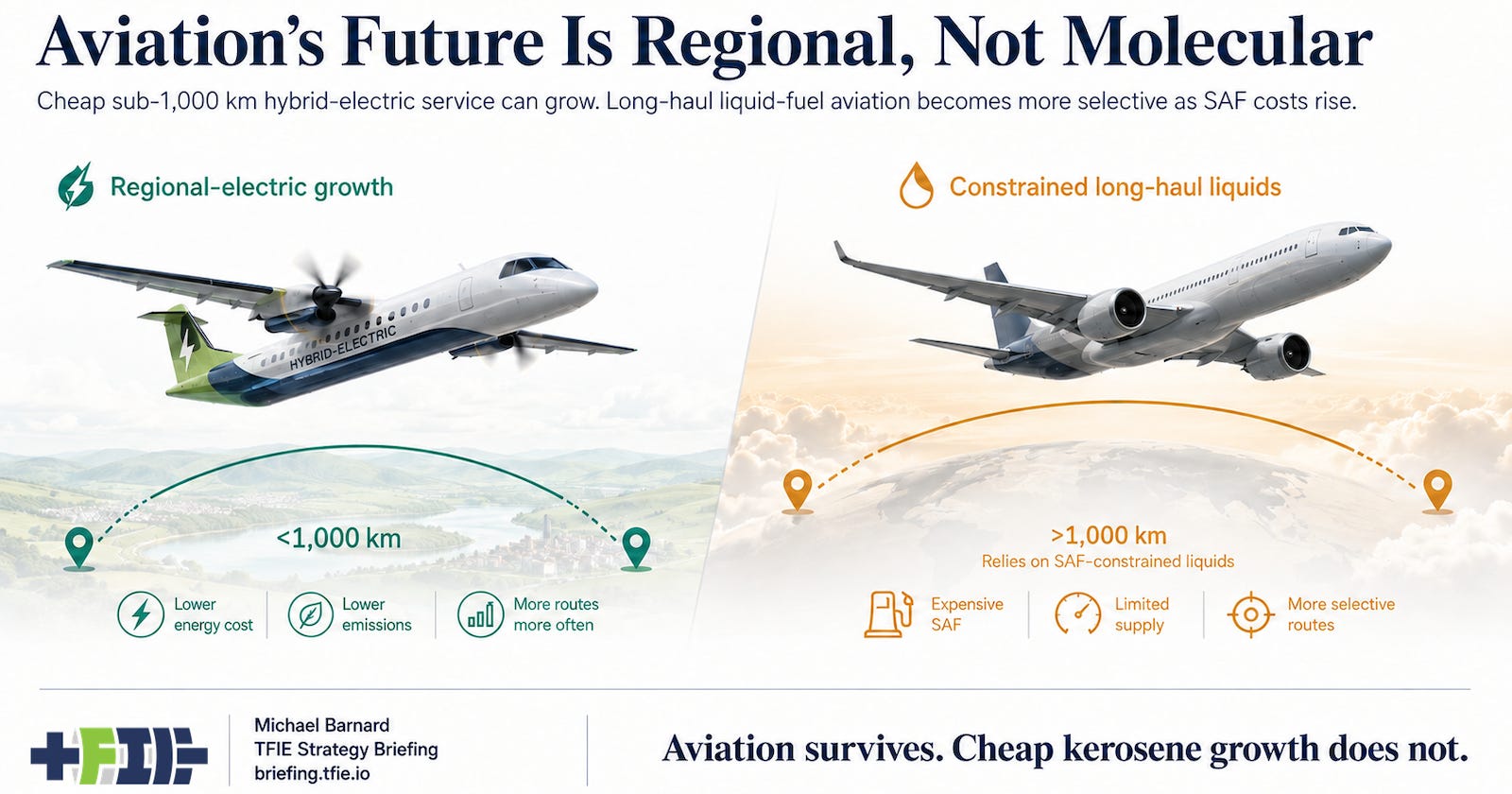
The central split is simple enough. Under roughly 1,000 kilometres, hybrid-electric aircraft have a credible path to becoming a cheap regional mobility product, especially where rail is weak, geography is awkward, airport infrastructure already exists and the energy cost advantage is large. Over roughly 1,000 kilometres, aircraft remain mostly tied to high-density liquid fuels, and those liquid fuels become increasingly expensive as SAF mandates, e-fuels, lifecycle standards, carbon prices and feedstock constraints start doing real work.
I have been arguing for years that aviation’s endgame is mostly batteries and biofuels, not hydrogen or aluminum fantasies, with short-haul electrification arriving from below and sustainable biofuels carrying the hard-to-electrify remainder. I have also argued that hydrogen-powered passenger planes are an expensive distraction, not because hydrogen aircraft cannot be made to fly in a demonstration sense, but because the whole system around them is economically and operationally weak compared with the alternatives. The updated projection keeps that stance. Hydrogen remains outside the base case.
The aviation industry likes aggregate curves because aggregate curves make the sector look smoother than it is. Passenger-kilometres rise, fuel efficiency improves, SAF shares tick upward, the 2050 target sits politely at the right-hand edge of the chart, and the difficult work is pushed into the space between those lines. That is not enough. The model has to show where liquid-fuel demand changes, which routes can actually electrify, which liquids remain necessary, and which claims are merely preserving the old denominator with a different label.
Route distance is the useful split. Short flights are numerous, but longer flights burn most of the fuel. ATAG has said around 80% of aviation emissions come from flights over 1,500 kilometres, which is a useful reminder that a sector can have many short movements while its climate and fuel-service denominator sits in the longer ones. Electrifying today’s short-haul flights is useful, but it is not enough by itself to transform aviation.
That is why this projection does not say electric aviation replaces jets. It says something narrower and more useful. Existing short-haul aviation electrifies where it can. New regional-electric service appears where the economics and infrastructure work. Some discretionary longer-distance travel is diverted into shorter regional trips because the mobility demand remains, but it does not always have to be served by several thousand kilometres of SAF-priced jet travel.
A suppressed 5,000-kilometre leisure trip does not become a 5,000-kilometre electric trip. It might become a 700-kilometre hybrid-electric trip, a rail trip, a video meeting, or no trip. The passenger may still travel, the airline may still sell a seat, and the economy may still get a mobility service, but the liquid-fuel requirement changes materially.
This is also why I’ve kept returning to electrified regional air mobility as the interesting aviation disruption. It does not offer the same narrative appeal as hydrogen widebodies or synthetic-fuel abundance. It does something more useful: it starts changing the bottom of the route network with lower energy costs, lower local emissions, less noise and a better fit for small-city travel. That is not as glamorous as a new global fuel chain, but it is much closer to how transitions usually enter markets.
The longer routes are different. They need liquid fuels, and liquid fuels are where aviation’s optimistic scenarios become expensive. SAF is real and necessary, but it is not a universal substitute at any plausible near-term cost or scale. IATA’s outlook has SAF at several times the price of conventional jet fuel in the near term and still under 1% of total fuel demand in 2026. Europe’s ReFuelEU mandate shows the policy ratchet clearly, rising from 2% SAF in 2025 to 70% SAF by 2050, with a synthetic fuel sub-mandate along the way. That is serious policy, but it is also a warning label. If the plan depends on vast volumes of scarce low-carbon liquid fuels, then the plan has a liquid-fuel denominator problem.
The public takeaway is not that flying ends. It is that flying regionalizes and stratifies. Short routes get cheaper where hybrid-electric aircraft fit. Longer routes get more expensive where liquid fuels remain unavoidable. Some demand is destroyed. Some is diverted. Some persists because family travel, migration, business, emergencies, remote communities, islands, wealth and human curiosity are not going away. Aviation survives, but the assumption of cheap unconstrained kerosene growth does not.
Below the paywall I show the work behind that judgment: the 2025 reality check, the fuel-service pathway through 2100, what counts as real aviation progress, what would change my mind, the workbook behind the projection, and the scorecard I’ll use to track whether the pathway is actually progressing.