

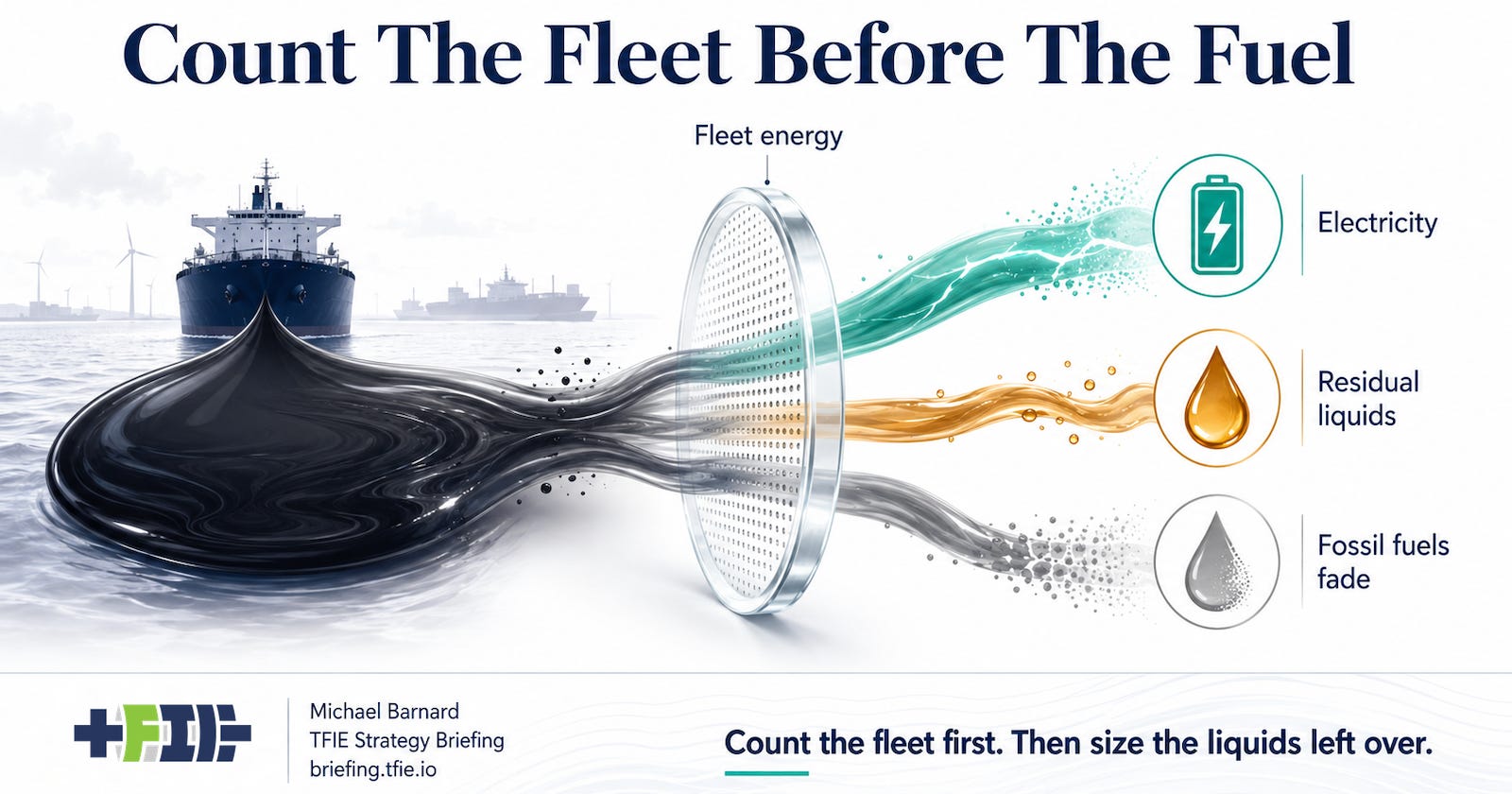
Shipping’s future fuel market is not today’s bunker-fuel pool with low-carbon molecules. In the updated TFIE pathway, the maritime system becomes much more electric, fossil liquids disappear, and liquid fuels remain for the parts of the fleet that still need dense energy. The central case leaves about 70 Mt of marine fuel-equivalent liquid energy by 2100. That is still a real maritime fuel market, but it is not a universal ammonia, hydrogen, LNG, methanol or synthetic-fuel replacement story.
The workbook uses exajoules because electricity, liquid fuels and efficiency need a common energy basis. For maritime readers, the simpler scale is fuel-equivalent: 1 EJ is roughly 24 Mt of conventional marine fuel energy. Fuel-equivalent means energy-equivalent to conventional marine fuel, not physical tons of any specific future liquid. On that basis, the liquid fuel requirement falls from about 425 Mt fuel-equivalent in 2030 to about 180 Mt in 2050 and about 70 Mt by 2100.
The reason is that shipping is not one machine. Deep-sea bulk carriers, tankers and container ships matter, but so do ferries, tugs, offshore support vessels, crew boats, fishing vessels, inland cargo vessels, service craft, port vessels and passenger vessels. Some of those vessels map cleanly to cargo tons and distance. Many do not. They still use energy, and a serious maritime projection has to count them.
Mackenbach, Singhal, Zhao and colleagues have provided a much better baseline for my maritime energy projection. Their npj Clean Energy paper starts from vessel segments and operating regimes rather than freight tonnage, then screens battery-electric feasibility against voyage energy, battery mass, battery volume and propulsion economics. By 2030, they find that technically electrifiable vessel segments account for 32% of maritime energy consumption, or 5.9 EJ per year, and 19% of maritime greenhouse gas emissions, or 205 MtCO₂e per year. They also find that roughly 90% of the energy in technically electrifiable segments is economically advantageous under central assumptions. That provides stronger evidence for my long-running thesis: shipping’s fuel transition is a denominator problem before it is a fuel-choice problem.
That does not mean every ocean-crossing container ship becomes battery-electric. It means the battery wedge was being undercounted where batteries are structurally strongest. Ferries, tugs, inland vessels, offshore support vessels, crew boats, service craft and many passenger vessels have shorter routes, repeated stops, known operating patterns and practical charging opportunities. Deep-sea cargo remains hard, but it is not the whole maritime energy system.
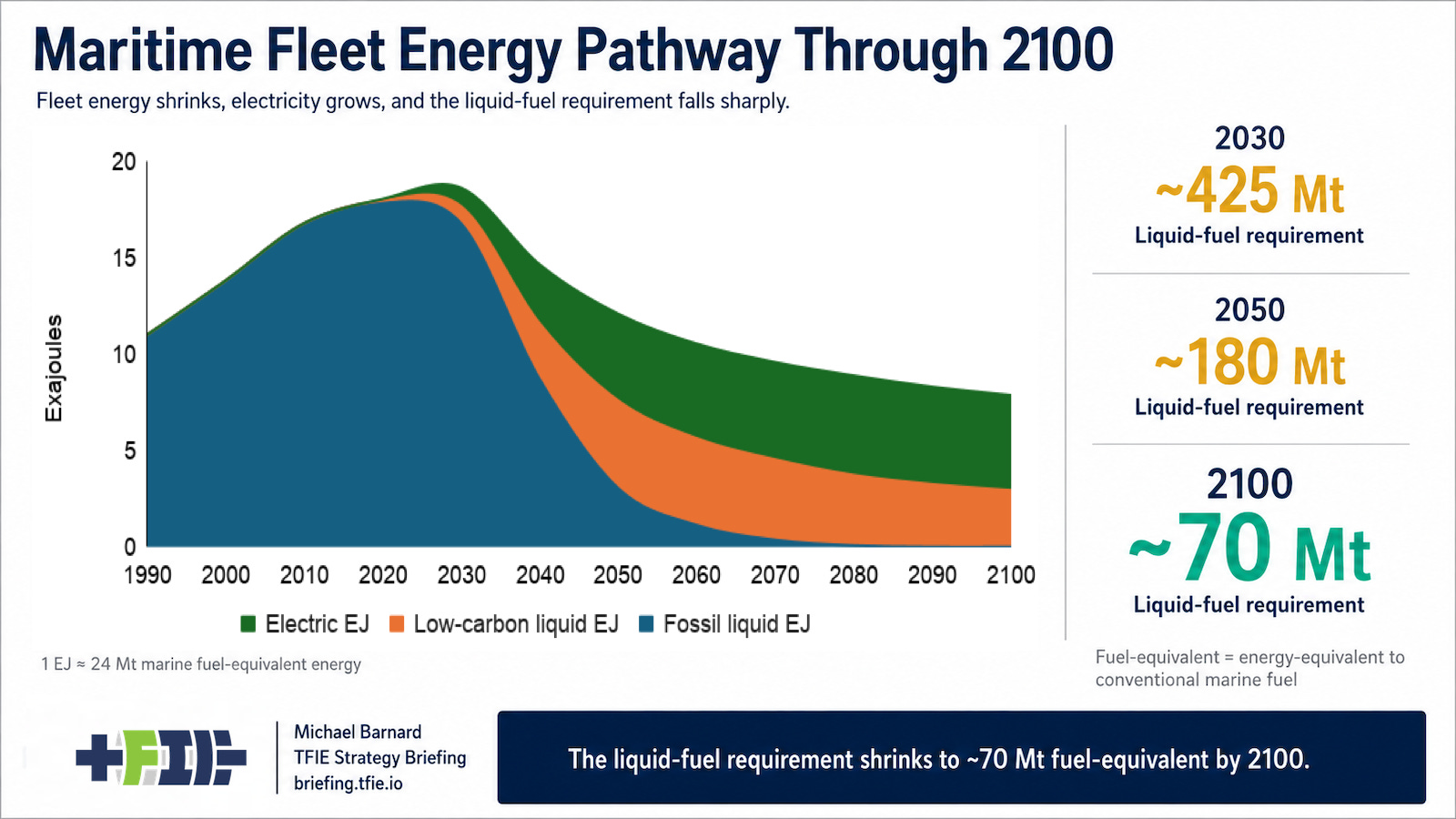
In the central case, total maritime fleet energy falls from about 18.6 EJ in 2030 to about 12.1 EJ in 2050 and about 7.9 EJ in 2100. That is not a collapse of maritime activity. It is a smaller fossil-fuel system, a more efficient fleet and a much larger electric share. Electric energy rises from about 1.0 EJ in 2030 to about 4.5 EJ in 2050 and about 4.9 EJ in 2100. The liquid fuel requirement falls from about 17.7 EJ to about 7.6 EJ and then about 2.9 EJ, or roughly 425 Mt, 180 Mt and 70 Mt fuel-equivalent.
Those numbers are pathway anchors, not forecast precision. The important result is the shape of the system. Electricity becomes the larger part of remaining maritime energy, fossil liquids disappear, and liquid fuels remain as a selective requirement for hard-to-electrify vessels. The future market for molecules is real, but it is much smaller than today’s bunker-fuel market.
Fossil cargo and raw iron ore still matter. Coal, oil, petroleum products, LNG and LPG are not just fuels; they are cargoes that exist because the fossil energy system exists. Raw iron ore is also structurally exposed as steel demand matures, scrap rises, electric arc furnaces take more share, and more iron reduction occurs closer to ore bodies and renewables-rich regions. I have covered that structural steel shift separately in the TFIE steel transition projection, and it remains central to the shipping denominator because raw iron ore is such a large long-haul bulk flow.
The surprising part is that the updated 2100 liquid-fuel endpoint is close to my 2020 projection. That was not because freight tonnage was the right boundary for maritime energy. It was because the first-order filters were right: fossil cargo decline, raw iron ore exposure, short-route electrification, efficiency and a hard deep-sea remainder. The old model was close on the liquid fuel left over and incomplete on the full maritime energy system.
The public conclusion is tighter than the old molecule contest. Batteries are larger than freight models made them look because the fleet is broader than freight. The liquid fuel requirement remains larger than battery-only narratives imply because deep-sea and hard-duty vessels still need dense energy. Fossil liquid fuels decline because the energy system and cargo base that support them decline. The maritime fuel debate starts making sense only after the fleet is counted, the fossil system shrinks and the liquid-fuel pool left over is sized honestly.
Below the paywall is the professional layer: the fleet-energy denominator, cargo takeout estimates, delivered-propulsion-work comparator, hybrid-electric fuel architecture, residual low-carbon liquid triage, update triggers, decision implications and the scorecard I’ll use to judge whether maritime fuel pathways are scaling, progressing, niche-valid, stalled or merely generating activity.