

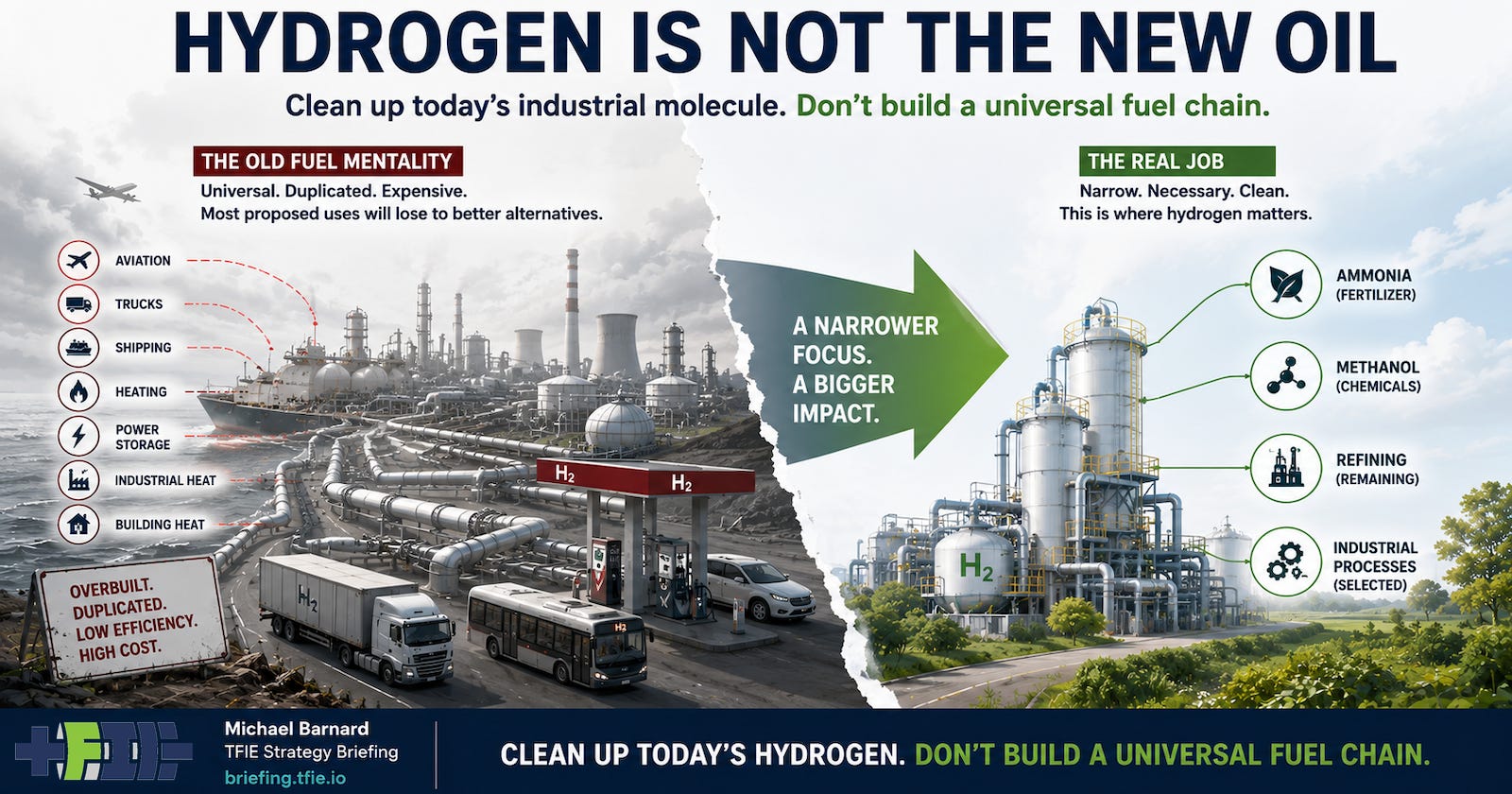
Hydrogen is usually presented as a growth story. The sales pitch is familiar: replace oil, gas and coal with a clean molecule, then push it through a new global fuel chain for transport, heat, storage, power balancing, industry and trade. That framing makes hydrogen sound like the next oil. The denominator points the other way.
Most hydrogen demand today is not a clean-energy market waiting to explode. It is dirty industrial hydrogen concentrated in refining, fertilizer production, methanol and related process uses. That matters because the largest existing pool is not structurally durable in a serious transition. Refinery-linked hydrogen declines as oil demand declines, while fertilizer demand persists but moderates with efficiency, better nutrient management and less waste. Methanol and selected process uses remain real, but they are not large enough to turn hydrogen into a universal fuel platform.
Shrinking demand does not make hydrogen unimportant. It makes the job more specific. Today’s hydrogen is already a major climate problem, not a speculative future one. The IEA puts current hydrogen production emissions for refining and industry at roughly 1.1–1.25 Gt CO2e, depending on allocation method, which puts it in the same order of magnitude as global aviation. The serious decarbonization task is therefore not building a universal hydrogen fuel chain. It is cleaning up the dirty industrial hydrogen that remains after refinery-linked demand, weak energy uses and speculative fuel claims are stripped away.
The mistake in high-hydrogen pathways is not that hydrogen can do nothing. Hydrogen can be assigned to many sectors on paper. It can be combusted, converted, compressed, liquefied, shipped, cracked, blended, reformed, synthesized and subsidized. The useful question is narrower: what demand survives delivered cost, physical efficiency losses, infrastructure duplication, utilization risk, policy dependence and better alternatives that are improving at the same time?
That filter is brutal for the broad energy-carrier story. Road transport keeps moving toward batteries and charging. Building heat keeps moving toward heat pumps and electrification. Grid balancing is better served by transmission, pumped hydro, batteries, demand flexibility and rare-firming molecules such as biomethane. Much industrial heat is better served by direct electric heat, induction, electric boilers, efficiency and process redesign. Shipping and aviation fuels remain molecule-constrained in harder segments, but hydrogen itself is usually a weak direct fuel. Efficiency, battery-hybridization and targeted biofuels take the first cuts at the remaining fuel-burning denominator, while other molecule-fuel pathways face their own cost, safety, infrastructure and lifecycle constraints.
My current model starts with existing demand, not imagined end-state substitution. Global hydrogen demand is modeled at about 116 Mt H₂/year in 2020, falling to about 61 Mt H₂/year around mid-century and about 36 Mt H₂/year by 2100. That is a decline of roughly 80 Mt H₂/year, or about 69%, from the 2020 baseline. The exact late-century allocation is uncertain, but the direction is not. Existing demand shrinks faster than new durable energy uses appear.
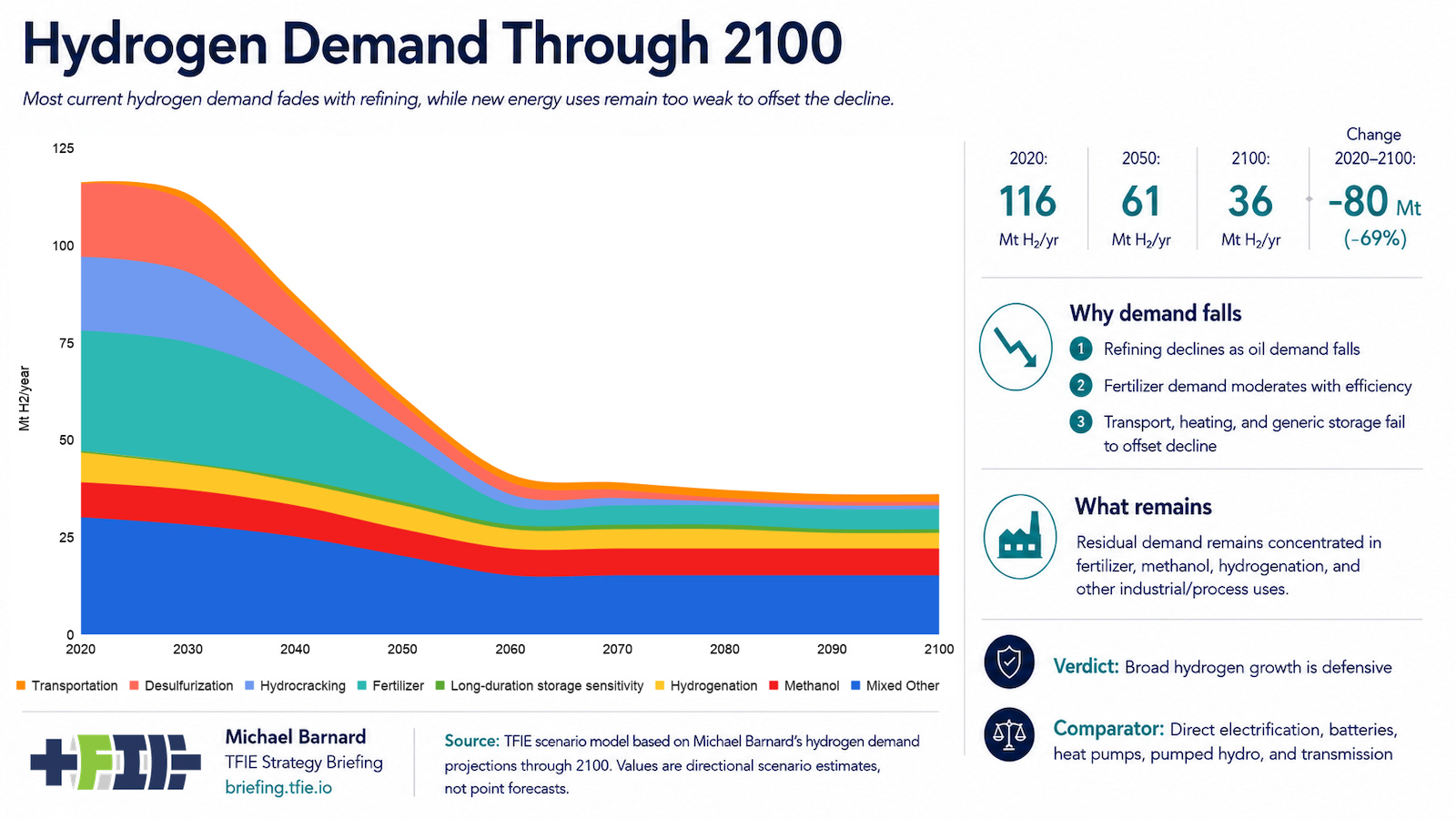
This is the latest iteration of a hydrogen demand projection I first published in 2021, when the hydrogen-for-everything story was still riding high. I updated it in 2022 and again in 2023 as sector evidence improved. This version is rebuilt as a TFIE 2100 projection and tested against the same sector-by-sector transition work behind my aviation, shipping, cement, steel, grid and electrification projections. The result is not a new reaction to the latest hydrogen cycle. It is a rebaselined denominator after several years of checking hydrogen claims against the markets they would actually have to win.
High-hydrogen scenarios often reach much larger numbers by treating technical possibility, policy ambition, modelled need or hydrogen trade as if they were durable demand. That is the wrong test. A scenario can allocate hydrogen to trucks, heat, shipping, aviation, power storage and industry, but allocation is not adoption. Durable demand requires buyers, utilization, infrastructure, delivered-cost competitiveness and a reason the molecule beats the electric or efficiency pathway in the field.
This is not an anti-hydrogen argument. It is an anti-bad-denominator argument. Clean up the hydrogen that remains where chemistry needs it: fertilizer production, methanol and chemicals, selected process chemistry, and remaining refining including biofuel hydrotreating. Discount the universal fuel story until it beats the alternatives in practice, not just in the model.
The public conclusion is deliberately hard on the growth story: hydrogen is not becoming the new oil, and most proposed energy uses are defensive claims against better systems. Below the paywall is the professional layer: the workbook, CO2e model, scenario divergence, demand survival filter, comparator map, activity-versus-demand evidence map, update triggers, decision implications and final scorecard.
