

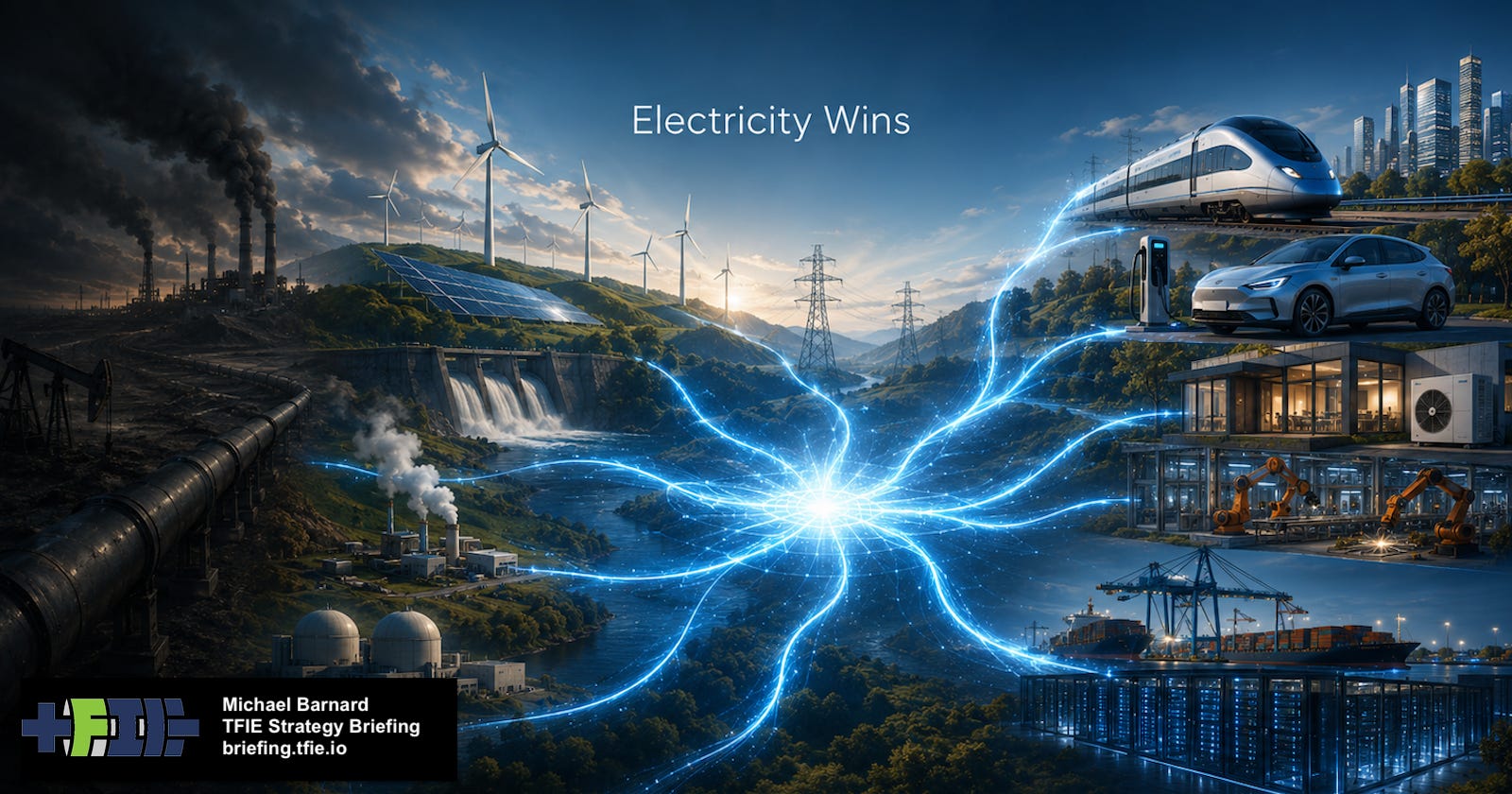
One of the easiest ways to get 2100 wrong is to treat electricity as simply another fuel. Coal, oil, gas, hydrogen, ammonia, methanol and electricity get placed in parallel columns, as if the future energy system is mostly a substitution table. That framing preserves too much of the fossil economy’s structure. Electricity is not just another entry in the fuel list. It is the organizing layer that lets the system separate energy sources from useful services.
The fossil economy is tightly coupled. A coal plant is built around coal mines, rail delivery, boilers, ash handling, turbines, cooling, emissions controls and coal-market exposure. A gasoline car is built around refineries, fuel distribution, internal combustion engines, maintenance networks and tailpipe pollution. A gas furnace is built around gas wells, pipelines, meters, combustion equipment and local air pollution. Those chains can be optimized, regulated and cleaned up at the margin, but the useful service is still tied to a specific fuel pathway.
Electricity loosens that coupling. A motor does not know whether the electrons came from a hydro dam, wind farm, solar plant, nuclear reactor, geothermal plant, battery, interconnector or demand-response event avoided elsewhere on the grid. A heat pump does not care whether the grid mix changes during its lifetime. A data center, rail system, electrolyzer, induction furnace, port crane or industrial drive can use electricity from a changing supply stack without changing its core end-use equipment every time the upstream source shifts.
That is the architectural advantage. Electricity lets sources and services evolve at different rates. Generation can decarbonize while the device in the building, vehicle, factory or port keeps doing its job. Storage can improve without replacing every motor. Transmission can expand without redesigning every heat pump. Demand response can become more sophisticated without changing the physics of the appliance. Fossil systems have some flexibility, but the fuel chain remains central. Electricity moves the system toward shared infrastructure and durable equipment.
The physics helps. Electricity is high-grade energy. It turns cleanly into motion, light, computation, control, electrochemistry and heat pumping. Combustion mostly starts with heat, then tries to turn some fraction of that heat into useful work while throwing away the rest. Internal combustion engines waste most of their input energy. Thermal power plants reject large amounts of heat. Gas boilers and furnaces are simpler, but they still burn a fuel at the point of use and lock the customer to a fuel delivery system. Electric motors, heat pumps, power electronics and electrochemical processes usually start closer to the useful service.
That does not make electricity free, frictionless or universally superior. It has to be generated, transmitted, distributed, stored, converted and controlled. Grids are physical systems with permitting problems, transformers, conductors, substations, interconnection queues, congestion, weather exposure, cyber risk, skilled-labor constraints and regulators who can take years to decide the obvious. A serious 2100 scenario cannot wave a hand over the grid. It has to build the wires, storage, flexibility, markets and institutions that make electrification real.
Those constraints are still different from the constraints of a fuel system. Fuel supply chains have to keep moving mass forever. Coal, oil and gas have to be extracted, processed, transported, stored, burned and cleaned up continuously. The equipment that uses them looks cheap only when the upstream system and downstream pollution are treated as normal background conditions. Electricity shifts much of the problem toward durable capital: generation, grids, storage, control systems, motors, heat pumps, batteries, chargers, transformers, power electronics and industrial equipment. Those assets have supply chains, and some are difficult. They are still not the same as burning another barrel, tonne or cubic metre every day.
This is why learning curves matter. Solar panels, batteries, power electronics, electric vehicles, heat pumps and many grid technologies are manufactured products. They improve through scale, factory learning, supply-chain competition, standardization and incremental engineering. Fuels do not improve in the same way at the point of use. Drilling improves, refineries improve and turbines improve, but the customer still pays for the next unit of fuel and the system still carries the volatility, emissions and geopolitical exposure of continuous combustion.
Electricity also tends to reduce mechanical complexity at the point of use. Electric drivetrains have fewer moving parts than internal combustion drivetrains. Heat pumps require maintenance, but they avoid onsite combustion, flues, fuel deliveries and many fuel-safety issues. Electric rail removes the need to carry diesel fuel and burn it in every locomotive. Port equipment, mining trucks, buses, delivery vehicles and industrial drives all gain from the same pattern where duty cycles and infrastructure line up. This does not abolish maintenance or make deployment automatic. It changes the starting point.
The evidence is already visible, though uneven. Road transport is moving rapidly toward batteries where vehicle size, range, charging and economics fit. Rail is already electrified across much of the world outside North America. Heat pumps are moving into buildings because they deliver useful heat with far less input energy than combustion. Steel recycling uses electric arc furnaces at large scale. Ports, warehouses, mines and factories are finding that electric equipment often solves air quality, maintenance and operating-cost problems at the same time. None of these examples proves that everything electrifies. Together they show why electricity keeps taking the parts of the system where it has a plausible route to scale.
The grid is the shared capital platform underneath that shift. A grid can take many sources on one side and serve many uses on the other. It can add storage, demand response, interconnection, flexible loads, distributed generation and better controls without forcing every end use to choose a new fuel chain. That is why weak grids become a ceiling on transition speed, and strong grids become a national advantage. The countries that build electricity systems capable of absorbing growth will have more options than countries that keep treating wires as a local nuisance.
The exceptions define the boundary. Long-haul aviation still has a strong claim on dense liquid fuels. Deep-sea shipping retains molecule demand where batteries, shore power, operational measures, cargo shifts and route changes do not remove the need. Fertilizer and chemicals need molecules as feedstocks. Some industrial processes require reducing agents or carbon-containing inputs. Remote sites, islands, military logistics and rare reserve cases can justify stored fuels even when electricity is the default elsewhere. Those cases matter. They do not turn molecules back into the default answer for the whole system.
This is where many transition forecasts get the starting point wrong. They begin with today’s fossil fuel flows, then ask what cleaner molecule can preserve them. The better starting point is the useful service. Does this job need motion, heat, computation, light, chemical transformation, freight movement, passenger mobility, resilience or a material input? Can electricity provide it directly or through a simpler process? Can efficiency, redesign, recycling, route changes or better use of existing assets shrink the requirement before any fuel is chosen? Only after those questions are answered should scarce molecules be allocated.
There are ways this assumption can weaken. It weakens if grid buildout stalls badly enough that electrified end uses cannot connect. It weakens if batteries, power electronics, transformers, conductors or heat pumps lose cost and performance momentum. It weakens if political systems protect fossil incumbents long enough to lock in another generation of combustion equipment, or if major developing economies find fossil infrastructure cheaper, faster and easier to finance than clean electricity. It also weakens if reliability failures are blamed on electrification rather than on underbuilt grids, poor planning or badly managed markets.
The assumption strengthens when clean electricity takes more marginal demand growth, when electric end uses keep winning on operating cost, when grids expand, when storage and flexibility become cheaper, when industrial firms choose electric processes, and when consumers find electric devices better as products rather than merely cleaner as symbols. That last point matters. Transitions scale faster when the new thing is better at the job, not merely preferable in a model. Electric cars did not become serious because they were virtuous. They became serious when they became fast, quiet, cheaper to run, easier to maintain and increasingly convenient to charge.
The better starting point is simple enough. Ask first whether the job needs a fuel. If the answer is no, the energy system should move toward electricity, efficiency, material loops, redesign and better infrastructure. If the answer is yes, then the molecule has to earn the role against the full system: cost, safety, supply, infrastructure, emissions, logistics and alternatives. That is how the 2100 scenario stays grounded. Electricity does not eliminate molecules. It stops them from being the default.
I do not claim to be right. I claim to be less wrong than most. In this case, being less wrong starts by treating electricity as the system’s decoupling layer, not as another fuel in a substitution table.
Subscribe to TFIE Strategy Briefing for the deeper pathway reviews, denominator checks, comparator cases, scorecards, workbooks and update triggers behind this public worldview.
Not that I am against electricity... not by a long shot. However, the bias toward electricity as a supply efficient approach may change when one starts from the end users on the demand side, especially when one looks a impacts of the local political economies.