

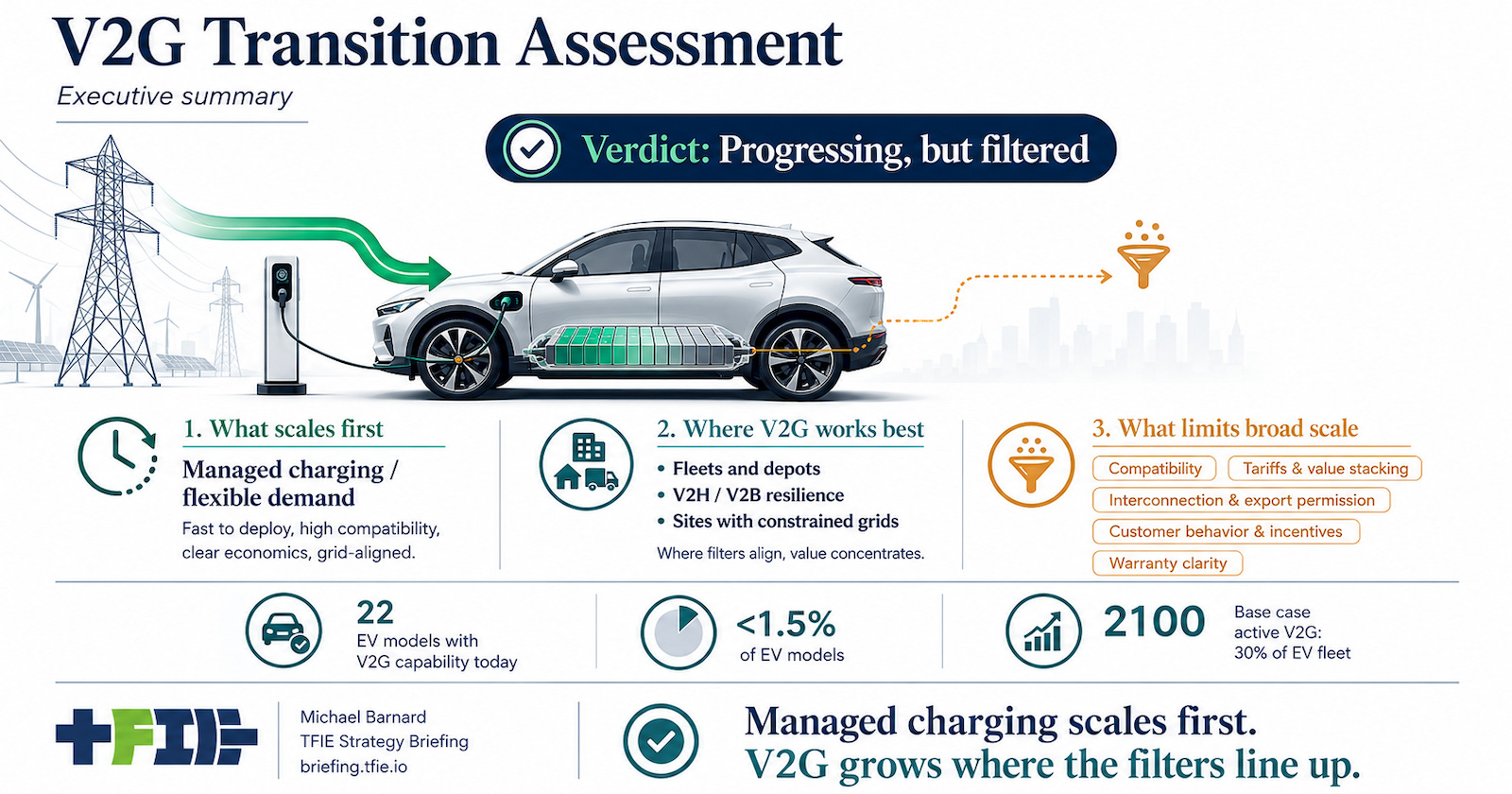
Vehicle-to-grid is usually discussed as if the future EV fleet were a giant distributed battery waiting for dispatch. That framing skips most of the hard parts. A vehicle battery has grid value only when the vehicle is plugged in, compatible, enrolled, compensated, permitted, dispatchable and still ready to do its primary job, which is moving people or goods.
My view for years has been that V2G was probably about 15 years too early, except in a few edge cases. The issue was not bidirectional charging as a technology. The issue was the eligible fleet. A vehicle battery in a driveway is not the same thing as a grid resource, and a bidirectional charger being technically possible is not the same thing as active, compensated, market-facing dispatch. There are useful cases, but there are also many claims where theoretical capability is treated as if it were already market participation.
The evidence base is stronger now, so the projection should be more precise about what is being counted. EVs are now large enough to matter to power systems. The IEA’s 2026 Global EV Outlook says electric car sales exceeded 20 million in 2025, reached 25% of new car sales and pushed electric cars to about 5% of the global car stock. This is no longer an early-adopter niche. It is a rapidly growing distributed electrical load with very large batteries attached.
The first and largest value from EV batteries is not exporting power back to the grid. It is shifting when charging happens, aggregating flexible demand and avoiding new peaks before they happen. Cars help the grid before they ever discharge, and electricity systems mostly reward boring things that happen reliably at scale.
That is why EV demand management aggregation matters more in the near term than residential battery export. Aggregators can recruit drivers, automate participation, reward flexibility and give utilities a demand-management resource they can call on when the grid is stressed. The important point is that this does not require pulling electricity out of the vehicle. It can simply move charging away from the wrong hours and toward the right ones, which is cheaper, easier and much less likely to trigger customer loss aversion.
This is also why the truck-charging lesson carries across. In my truck-charging strategy report with Rish Ghatikar, we argued that charging trucks is the first, second and third priority. The point was that stacking too many clever value propositions onto charging infrastructure can derail the basic job of getting vehicles charged. V2G has the same failure mode. If the system gets designed around selling grid services before it reliably serves the vehicle’s core mobility job, it can undermine the basic charging task.
The common V2G mistake is to multiply the number of future EVs by their battery size and treat the answer as grid storage. That gives large numbers and the wrong conclusion. Most cars are parked most of the time, but they are not necessarily parked in the right place, plugged into the right charger, covered by the right warranty, enrolled in the right tariff, controlled by the right aggregator, permitted to export and available at the right state of charge when the grid wants them.
The IEA’s 2026 vehicle-to-grid technology assessment is a useful reality check. It counts only 22 EV models with V2G capability today, less than 1.5% of all EV models. The report also makes clear that commercial offerings remain tied to specific vehicles, chargers and utility programs because broad multiparty interoperability is still immature. The interesting number is not the theoretical fleet battery. It is the much smaller count of vehicles that can actually participate under real market and grid rules.
That is why the scenario separates smart charging, grid demand management, vehicle-to-home or vehicle-to-building and vehicle-to-grid. Smart charging shifts or modulates charging without exporting electricity. Grid demand management aggregates that flexibility into a utility-facing resource. V2H and V2B provide behind-the-meter backup or bill management, mostly as resilience niches. V2G is the market-facing export layer, and it needs the most conditions to line up.
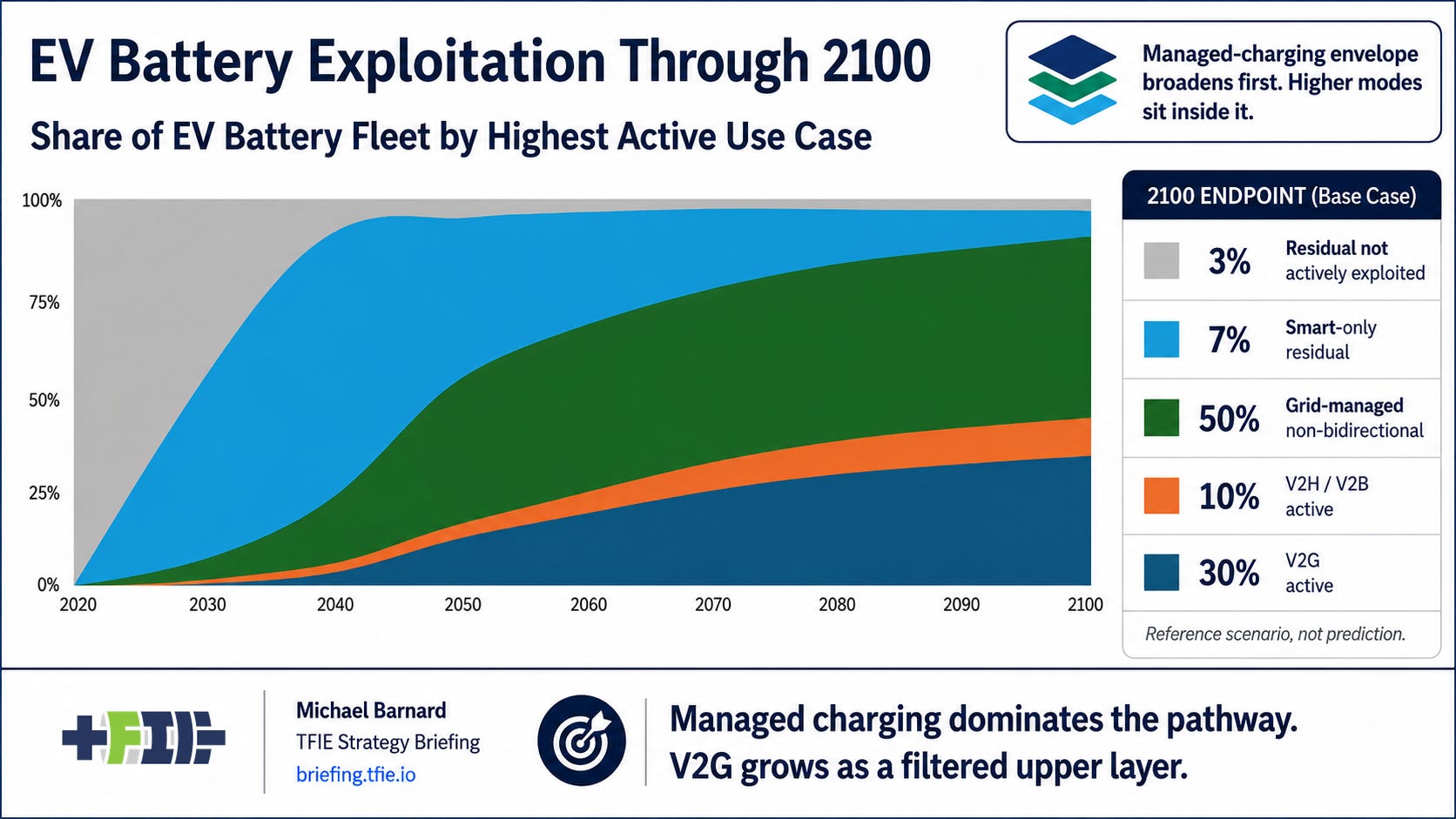
The chart counts each EV once by its highest active use case because the categories overlap. A vehicle using V2G is also inside the managed-charging envelope. A vehicle providing V2H or V2B resilience is still a flexible charging load. These are not separate fleets that can be added together without double counting.
In the v3.0 base case, the 2100 fleet sorts into exclusive states: 7% smart-only residual, 50% grid-managed but non-bidirectional, 10% active V2H or V2B and 30% active V2G, with 3% left outside active exploitation. The point is not that V2G disappears. It is that managed charging becomes the broad envelope first, while bidirectional export grows as a filtered upper layer where vehicles, chargers, tariffs, warranties, aggregators and customer behavior line up.
The public verdict is straightforward. Managed charging is the scaling pathway. V2H and V2B are niche-valid resilience and bill-management pathways. Bidirectional export is progressing, but it is filtered, slower and secondary to the broader EV flexibility story. The interesting professional question is not whether vehicle export exists. It is where it survives the comparator stack, where it remains a demonstration rather than a repeatable market and what evidence would move it from niche-valid to genuinely scaling.
Below the paywall is the professional layer: the workbook behind the v3.0 projection, the executive summary, denominator checks, comparator stack, update triggers, decision implications and final scorecard I’ll use to judge whether bidirectional export is scaling, progressing, niche-valid, stalled or merely generating activity.