

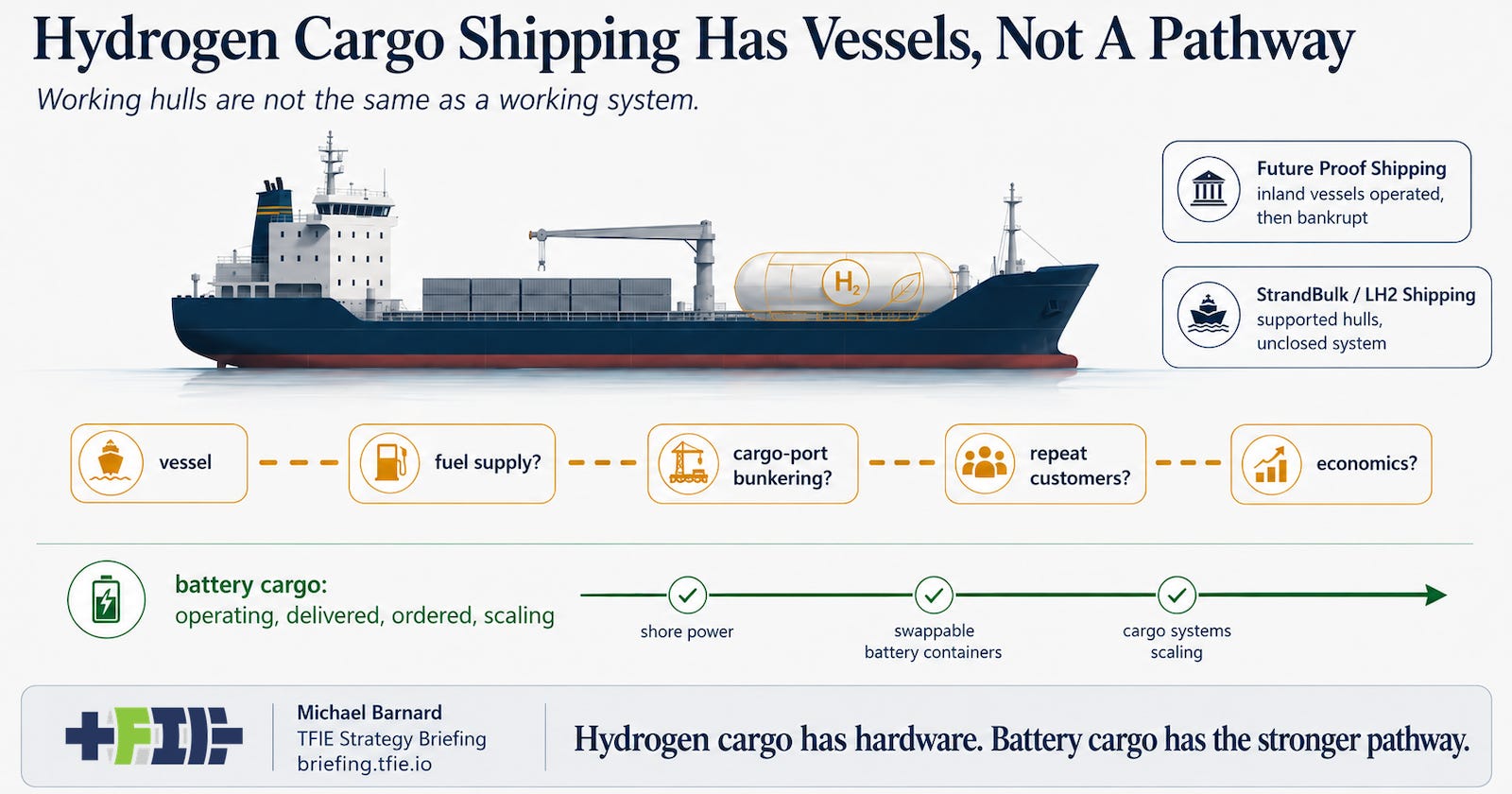
Future Proof Shipping looked, for a while, like the evidence hydrogen cargo shipping needed. H2 Barge 1 and H2 Barge 2 were not renderings, conference slides or another memorandum of understanding. They were inland cargo vessels, converted to hydrogen fuel-cell operation, working in real freight service in northern Europe. That matters because most hydrogen-for-shipping claims never get that far. Future Proof Shipping crossed the operating gate. Its operating case did not become durable market formation.
That distinction is the useful one. The barges showed that hydrogen fuel-cell cargo vessels can be assembled, approved and put to work. They showed that a customer, a route, vessels, fuel and port arrangements could be brought together at least in a bounded inland case. They did not show that the delivered cost was competitive, that the fuel system could be highly utilized, that customers would repeat the pattern without continuing public risk absorption, or that a working vessel had become a repeatable business. The subsequent bankruptcy of Future Proof Shipping does not prove that fuel cells cannot move freight. It does prove that moving freight was not enough.
StrandBulk is the other current case because it tests a different gate, and because the news moved in the opposite direction in the same period. Future Proof Shipping was an operating inland cargo case whose business failed to become durable market formation. StrandBulk is a supported short-sea cargo programme that has just received Enova backing for two additional liquid-hydrogen bulk carriers, taking LH2 Shipping’s hydrogen bulk-carrier portfolio to six vessel projects. The public description is specific enough to assess as a pathway claim: roughly 7,700 dwt bulk and general-cargo vessels, about 108 meters long, with 17 tons of liquid hydrogen storage, 3.4 MW of PEM fuel cells, a 3 MWh battery, shore power in port and diesel or biodiesel fallback if hydrogen is unavailable. That is materially more than a slide deck. It is also still not a commissioned commercial system. The StrandBulk concept remains tied to proposed Gen2 Energy production at Mosjøen / Nesbruket, and the harder questions are still outside the hull: delivered fuel, distribution to cargo-relevant ports, bunkering approvals, port interfaces, cargo commitments, delivered price, operating performance and repeat orders after service experience.
That is a serious programme, and the new two-vessel support makes it more pertinent rather than less. It shows that Norwegian public support for liquid-hydrogen cargo vessels is still expanding even as the strongest operating cargo example has gone through bankruptcy. But more supported hulls do not by themselves close the system. Public evidence still does not show commissioned liquid-hydrogen production and liquefaction at the marine volumes required, the distribution asset that moves fuel from Mosjøen to the cargo ports where the vessels would actually need to bunker, approved cargo-port bunkering interfaces, binding delivered hydrogen prices at the vessel, complete port pairs, named or binding cargo demand, shipyard delivery certainty, operating performance, or repeat orders after service experience. StrandBulk has a proposed system architecture and a growing supported vessel portfolio. It does not yet have a commissioned, demonstrated or commercially closed shipping system.
Future Proof Shipping and StrandBulk therefore should not be read as two steps in one maturing hydrogen cargo pathway. They are different reference classes. One shows that operation is not market formation. The other shows that public support for vessels is not the same thing as completing the vessel, fuel, distribution, port, customer and economics chain. That is why the useful question is not whether hydrogen can move a vessel. It can. The useful question is whether direct hydrogen propulsion is clearing the system gates faster than the alternatives.
The live comparator is no longer diesel alone. For short-sea and inland cargo, it is batteries, shore power, swappable battery containers and battery-dominant hybridization, with liquid fuel reserved for residual continuous-leg energy where required. ZES is directly relevant because it is operating inland container freight in the Netherlands with exchangeable battery containers, including Alphenaar on the Heineken route from Alphen aan den Rijn to Moerdijk and MS Den Bosch Max Groen using ZESpacks in the Den Bosch-Rotterdam corridor. That is close to Future Proof Shipping’s reference class, but with direct electricity instead of hydrogen. AtoB@C’s Green Coaster programme is relevant because it is a twelve-vessel series of plug-in hybrid coasters for Baltic and North Sea short-sea cargo, not a one-off demonstration. China’s Green Water 01 is relevant because it is a Yangtze container ship using swappable battery containers at very large scale. China’s Ning Yuan Dian Kun is relevant because it is a delivered coastal container carrier with roughly 19 to 20 MWh of containerized batteries, not a ferry analogy or a future concept. Gezhouba extends the battery-swap logic into inland bulk cargo. Those examples do not prove that every cargo route is ready for battery-only propulsion. They do show that hydrogen must beat battery-electric and battery-dominant comparators that are already operating, being delivered, repeatedly ordered and expanding into larger energy architectures.
The useful test starts with the cargo geography, not the fuel geography. StrandBulk’s claimed freight case is Norway to the continent, which means southern Norwegian and North Sea / Baltic short-sea cargo routes toward Denmark, Sweden, Germany, the Netherlands, Belgium and the UK. That puts a lot of relevant work in the 100 to 350 nautical mile band, with longer 500 nautical mile legs as stress cases. The hydrogen fuel story, by contrast, points north to proposed production at Mosjøen / Nesbruket. That does not mean a StrandBulk vessel would routinely sail north to refuel. It means the fuel would have to be moved from the production geography to the cargo geography, then bunkered safely and reliably at ports where the vessels actually work.
I tested the central cargo case as a 200 nautical mile one-way continuous leg, not a round trip. That is long enough to avoid making the battery case too easy, but still within the short-sea geography that matters for southern Norway and the nearby continent. The battery-dominant comparator uses a 60 MWh nominal battery, 85% usable energy, 0.25 MWh per nautical mile of base propulsion energy and a 15% operational-energy margin. That creates a 57.5 MWh energy requirement against 51 MWh of usable battery capacity, so the vessel is not assumed to be magically all-electric. It is about 89% electric, with residual liquid fuel covering the gap.
That is the important denominator. Hydrogen does not have to beat a perfect battery vessel. It has to beat a battery-dominant short-sea cargo system that does most of the work directly with electricity and uses fallback fuel only where the continuous leg exceeds the battery. For the 200 nautical mile leg, the hydrogen case costs about €31,400 in operating energy at €10 per kilogram delivered to the vessel interface. The battery-dominant hybrid comparator, including residual HVO for the portion the battery does not cover, costs about €7,100 for the same leg. A same-size vessel burning VLSFO for the same propulsion work would be roughly €6,000 at recent Rotterdam prices, depending on engine efficiency and bunker price. In other words, the battery-dominant hybrid is already in the incumbent-fuel cost band while eliminating most onboard fuel use, while hydrogen is about five times the VLSFO fuel cost and about 4.40 times the battery-dominant hybrid energy cost before fuel-cell replacement. On the energy side, hydrogen also requires about 2.58 times as much electricity for the same propulsion work before backup fuel. In the central supply-chain emissions screen, hydrogen is about 372 kg CO2e per MWh of propulsion work versus 131 kg for the battery-dominant comparator, or about 2.83 times higher.
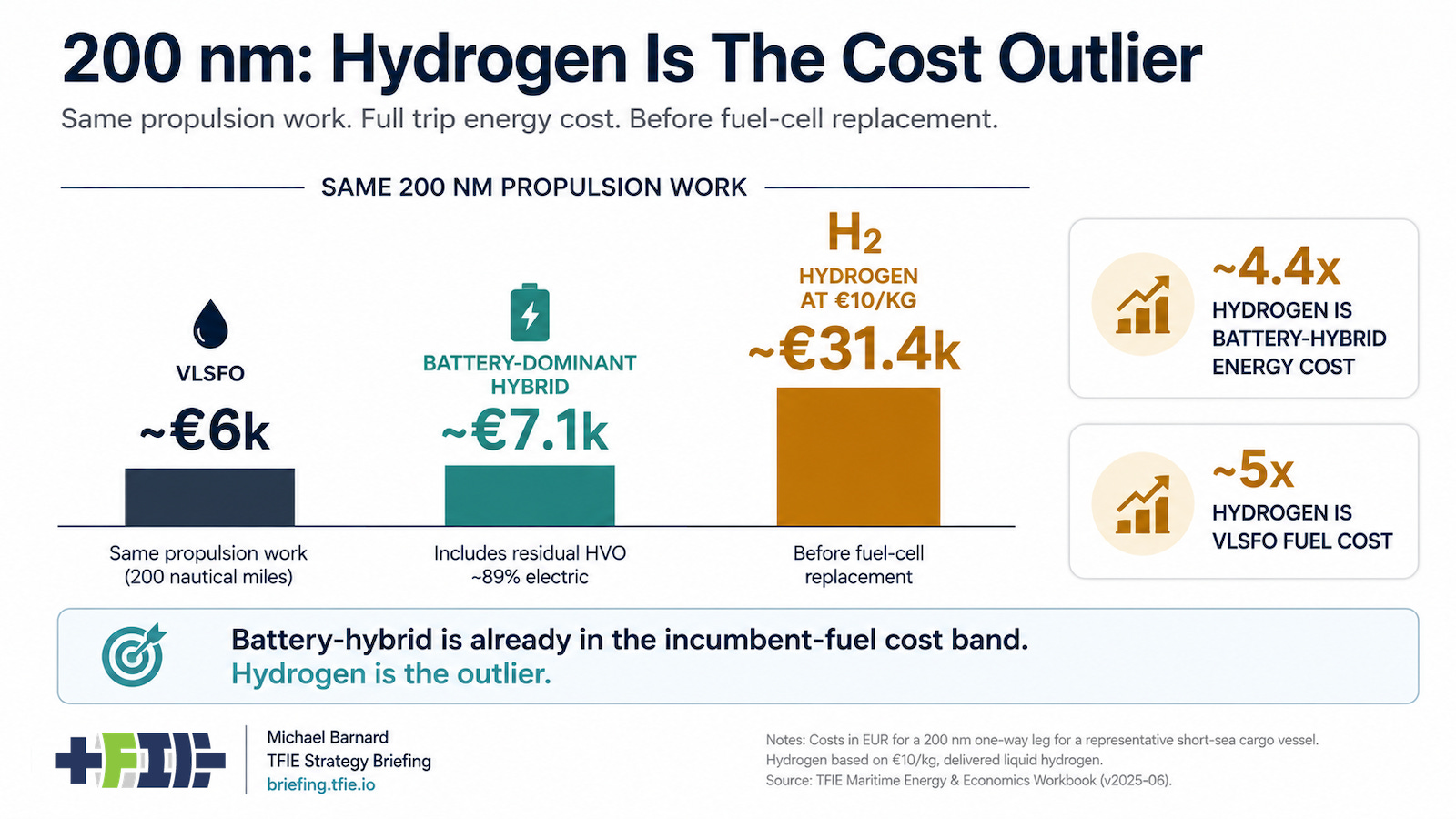
Those are screening results, not a vessel quotation, naval architecture study, project-finance model or complete lifecycle-cost estimate. The battery case does not prove where the modules go, how class approval would be structured, what cargo displacement would be, how charging redundancy would be designed, or what a specific port-grid upgrade would cost. But the hydrogen case has unresolved questions too, and they are larger than the hull. It still has to show delivered liquid hydrogen from Mosjøen or another production site to cargo-relevant ports, the cryogenic distribution asset, approved bunkering interfaces, transfer losses, utilization, boil-off management and a delivered fuel price that includes the whole chain.
That is why the screen is useful. It does not claim that batteries solve every short-sea route today. It shows what a hydrogen project has to prove before saying batteries cannot do the work. For southern Norway to the continent, the first answer is not a liquid-hydrogen vessel. It is route-by-route electrification, larger batteries, shore power, charging where dwell time allows it, and liquid fuel only for the residual energy that batteries do not yet cover. Hydrogen has to beat that system. On current public evidence, it does not.
Public support is not the problem by itself. Electric vessels also receive public support. Maritime decarbonization has always involved regulation, port planning, procurement support and early risk sharing. The test is whether support creates commissioned infrastructure, independent customers and repeat procurement, or whether it keeps carrying an unclosed system after the comparator has moved ahead. On current evidence, hydrogen cargo shipping has demonstrated vessels and attracted substantial public support. It has not demonstrated a durable market or an integrated system that beats battery-dominant electrification.
Future Proof Shipping reached service without building durable market formation. StrandBulk is adding supported hulls before the fuel and port system is commercially closed. Electric cargo vessels are already operating, being delivered, repeatedly ordered and moving into larger battery classes. Hydrogen cargo shipping is not waiting for one missing component to fall into place. It is failing several connected system tests while the better-fit pathway advances.
The paid analysis separates the gates these projects have and have not cleared, follows the Mosjøen fuel chain to the cargo ports where it would actually be needed, compares the strongest electric cargo references, and tests route energy, operating cost, supply-chain emissions and safety burden in the accompanying evidence base.
