

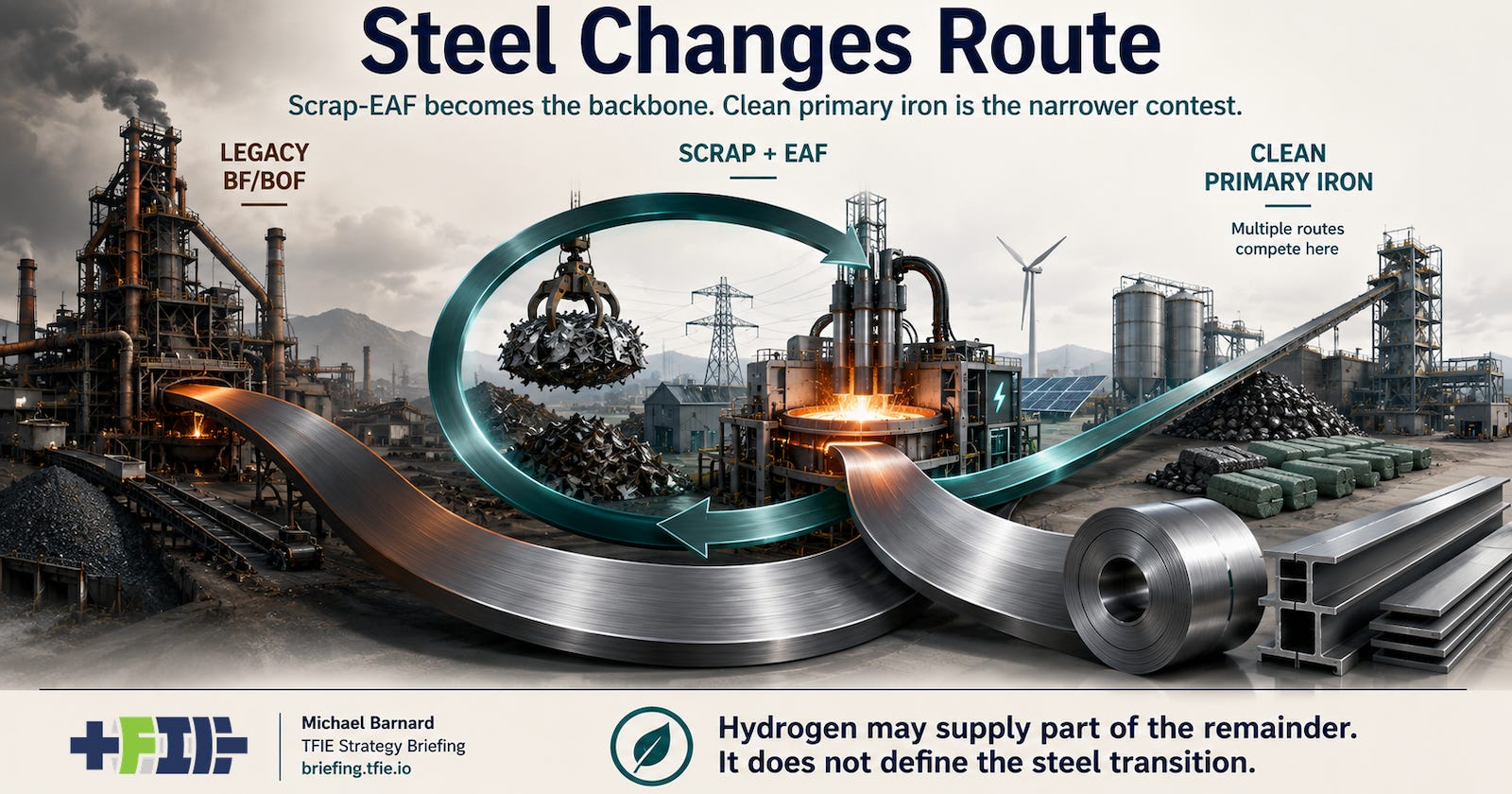
Steel is one of those industrial sectors where the wrong noun sends the strategy sideways. Call it a green hydrogen market, and the conversation moves quickly to electrolyzers, pipelines, caverns, compression, and national hydrogen strategies looking for industrial demand. Call it a steel route transition, and the useful questions return: how much steel the world actually needs, how much can come from scrap, what clean primary iron still has to provide, and how quickly the legacy coal-based route can leave the system.
That is the framing behind my formalized iron and steel projection through 2100. The projection is deliberately built around the physical structure of the sector: steel demand, scrap availability, electricity, clean primary iron, legacy capital stock, and trade. It does not treat steel as a convenient demand sink for whatever fuel system happens to be looking for customers.
This is a plausible scenario, not a prediction. I don’t claim to be right, I just claim to be less wrong than most. The point is to test a coherent pathway: what steel demand looks like if mature-economy saturation matters, what scrap-EAF can carry, how large the clean primary iron remainder might be, and what has to happen to legacy coal-based capacity for steel to be broadly aligned with serious climate targets.
Worldsteel’s latest figures put 2024 crude steel production at about 1.88 billion tons, with the listed process mix still dominated by oxygen-route steel. The industry remains very much built around the legacy high-emissions route, even though electric arc furnaces are mature industrial equipment rather than speculative hardware. Steel also remains a climate monster, with worldsteel reporting average 2024 emissions of 2.18 tons of CO₂e per ton of steel across scopes 1, 2, and 3, and total sector emissions around 4.1 billion tons of CO₂e.
That scale is why framing matters. Steel does not need a hydrogen story attached to it so that hydrogen infrastructure plans can show a large future offtaker. It needs a route transition that starts with demand, scrap, electricity, clean primary iron, capital stock, and trade, because those are the levers that determine whether the sector actually decarbonizes.
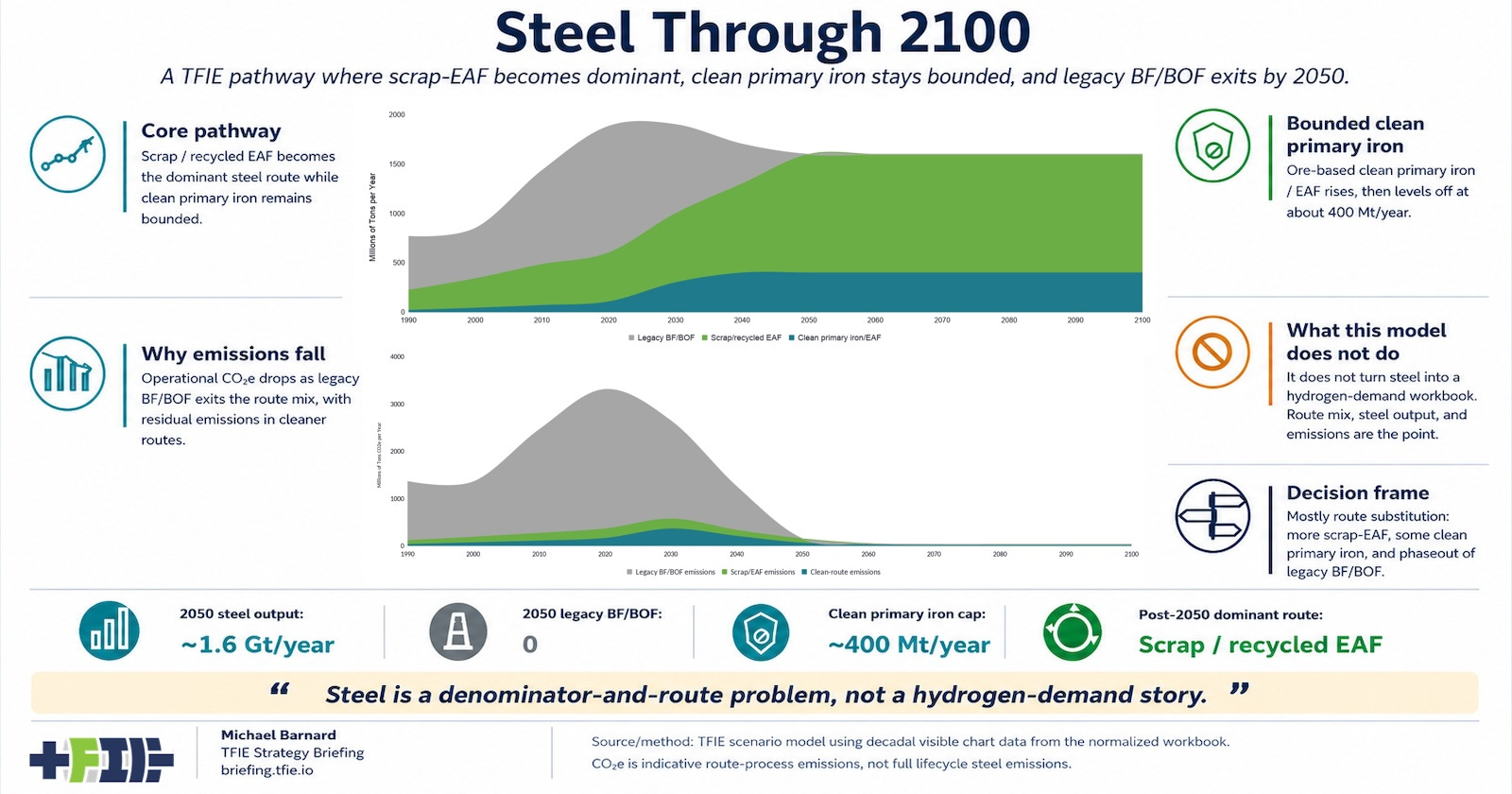
In this scenario, global crude steel output settles at about 1.6 billion tons per year from mid-century onward. That is lower than today’s roughly 1.9 billion tons, but it is not a fantasy of deindustrialization. It reflects a world where rich economies are not endlessly building their first bridges, first ports, first apartment towers, first transmission systems, first vehicle fleets, and first water networks. Once the big buildout phase passes, replacement, renewal, efficiency, and stock turnover matter more than first-time steel intensity.
The developing world still needs steel for transmission, rail, ports, factories, water systems, wind turbines, ships, machinery, and vehicles. The point is not that steel demand disappears, but that mature economies do not keep adding first-build steel intensity forever. The steel transition is hard enough without extending a 20th-century industrial growth curve indefinitely and then pretending the result is a neutral baseline.
The question is not how much hydrogen the steel sector might absorb if hydrogen were cheap, abundant, conveniently located, easily stored, and politically favored forever. The question is how much steel remains, how much scrap can reasonably do, what clean primary iron must still provide, and what routes are credible under real electricity, ore, capital, and trade constraints.
The scenario makes scrap and recycled steel in electric arc furnaces the dominant long-term route. That should not be surprising, because steel is not a fuel that disappears when used. It is a durable material that accumulates in buildings, bridges, vehicles, ships, appliances, industrial equipment, pipes, rail, and infrastructure, then returns as scrap when those assets retire. As economies mature, the available scrap pool grows, and a larger fraction of steel production can be recycled through electric furnaces.
That does not make scrap-EAF effortless. Scrap collection, sorting, contamination control, alloy management, product standards, furnace capacity, clean power supply, and customer specifications all matter. The physical stock-and-flow logic of steel makes scrap-EAF the obvious long-term backbone where the electricity system is decarbonizing and the scrap system is competent enough to deliver quality material.
Scrap sorting, residual control, and furnace utilization are less photogenic than hydrogen announcements, but they are much closer to the steel system’s long-term denominator. The emissions impact is more durable, because scrap-EAF reduces the need for primary iron instead of merely changing the chemistry used to make it.
Scrap does not eliminate primary iron. Some applications require tighter chemistry than the scrap stream can reliably provide, developing economies still need net additions to steel stock, and the scrap pool lags demand because bridges and buildings do not retire on the schedule preferred by decarbonization modelers. In this scenario, clean primary iron remains at about 400 million tons per year after the transition. That is a large industrial category, not a rounding error, but it is not the whole steel system.
Hydrogen direct reduced iron is one possible way to make clean primary iron, but it is not clean primary iron itself. That distinction matters because direct electrification, biomethane DRI with concentrated CO₂ streams, molten oxide electrolysis, flash ironmaking, low-temperature electrochemical ironmaking, and imported green iron units all compete inside the same bucket. Once the denominator is visible, hydrogen has to win against those alternatives. It should not be assigned the market by assumption.
I have become increasingly skeptical that hydrogen DRI will win the zero-carbon steel race at global scale. The economics remain ugly when realistic hydrogen costs are used, and competing routes keep taking pieces off the board. I made that argument directly in Why Hydrogen Won’t Win The Zero-Carbon Steel Race, and that is why hydrogen belongs as one possible clean primary iron route rather than as the organizing logic of the sector.
Fortescue’s green iron work is a useful signal here. Its Pilbara electrochemical iron effort is not proof that this specific route wins, but it is evidence that major industrial players are not simply waiting for cheap hydrogen to arrive. Fortescue is testing a pathway that uses electricity directly and avoids much of the hydrogen production, compression, storage, and handling chain that hydrogen DRI requires, which is exactly the kind of internal competition clean primary iron should be expected to face.
The largest emissions move is the retirement of the legacy BF/BOF route, shorthand here for the coal-based blast furnace and basic oxygen furnace route family that dominates current production. That is where the emissions stack sits historically, and that is where the transition has to bite if steel is going to become compatible with serious climate targets.
The scenario requires the legacy route to exit by 2050. That is aggressive, but not physically impossible. It is also not aligned with today’s capital-stock signals, which is why the 2050 exit line should be read as a transition requirement rather than a claim that the industry is already behaving sensibly. Global Energy Monitor’s 2026 steel tracker reports 319 Mtpa of coal-based blast furnace capacity announced or under construction, along with planned relinings that signal owners intend to keep some existing units running through another long campaign.
New blast furnace capacity and relining decisions are not bookkeeping details. They are multi-decade emissions commitments unless policy, procurement, carbon pricing, finance, and trade rules force different choices. The important distinction is between a transition requirement and a current-policy trajectory. The 2050 exit line is the former, not the latter.
One of the persistent errors in steel strategy is treating green iron and green steel as if they are the same industrial activity. They are not. Ironmaking is bulk, energy intensive, commodity-like, and highly sensitive to ore, power, land, water, logistics, and capital cost. Steelmaking and finishing are closer to product quality, alloying, rolling, coating, customer relationships, manufacturing ecosystems, and industrial value capture.
That split matters especially for Europe, Japan, Korea, and other high-cost energy importers. Regions with expensive electricity, little ore, dense industrial constraints, and political attachment to domestic hydrogen should be cautious about insisting that bulk green iron must be made locally. Regions with ore, land, low-cost renewables, port access, and industrial space may be better places to make clean metallic iron units, whether as DRI, HBI, or future electrochemical products.
That was the central argument in my piece on why green steel, not green iron, determines Europe’s industrial future. The importing region can still keep high-value steelmaking and finishing where industrial ecosystems justify it, while moving bulk ironmaking closer to ore and cheap clean energy. Hydrogen pipelines do not solve that geography problem. Green iron trade might.
Below the paywall are the denominator tests, comparator logic, capital-stock signals, sensitivity ranges, electricity implications, update triggers, and decision implications behind the scenario, including what would make the 1.6 billion ton steel pathway, the 400 million ton clean primary iron remainder, or the 2050 legacy BF/BOF exit line move.