
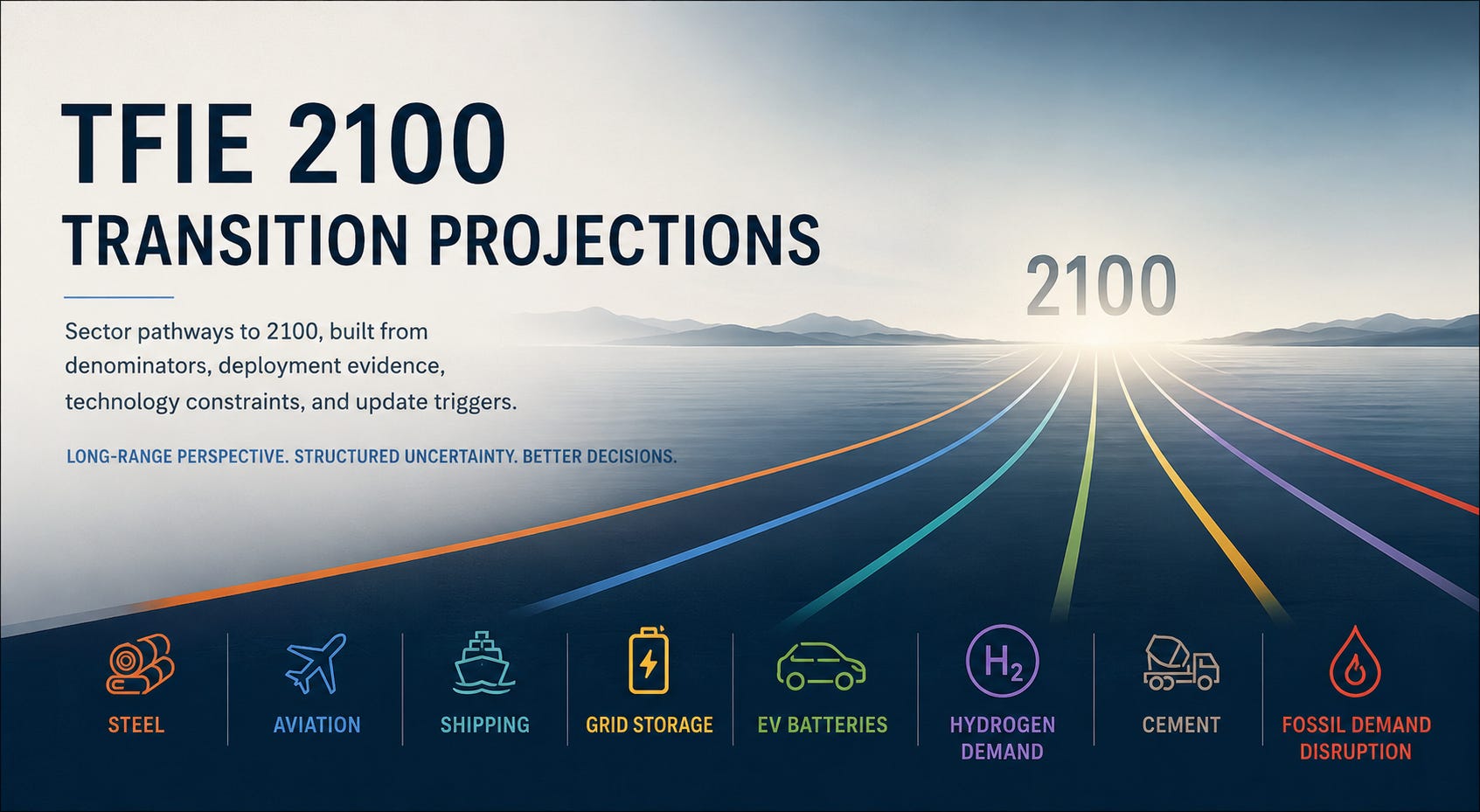
TFIE Strategy Briefing’s 2100 projections are structured pathway reviews for sectors where transition claims routinely outrun denominators. These are the sectors where capital, policy, procurement, and infrastructure decisions are being made today against assumptions that often fall apart under arithmetic.
Each review follows the same discipline: start with the denominator, test plausible pathways, expose assumptions, and identify update triggers. Free readers get the public pathway argument. Paid subscribers get the working layer behind it.
Available now
Steel through 2100
The steel transition is real, but it is driven by scrap availability, electrification, demand changes, new iron requirements, industrial heat, and regional electricity systems more than by the hydrogen narrative that dominates too much public discussion.
EV batteries and grids through 2100
The first large grid value from EVs comes from treating them as flexible loads through managed charging, not pretending that every parked car will become a dependable grid battery.
Shipping through 2100
Shipping’s 2100 pathway starts with less fossil cargo, more electrified short-sea and inland shipping, efficiency gains, and limited sustainable biofuels for long-haul routes, not ammonia or synthetic-fuel fantasy.
Aviation through 2100
Aviation decarbonization is shaped by aircraft size, route length, fleet turnover, energy density, and sustainable fuel availability, not by pretending hydrogen or synthetic fuels erase the physics.
Cement through 2100
Cement’s transition is not just a kiln-retrofit problem. The useful denominator is cement-equivalent structural service, because demand, clinker ratios, construction practice, design efficiency, reuse, renovation, alternative binder portfolios, engineered timber in eligible building categories, electrified heat, standards, China’s infrastructure maturity, and residual carbon capture all change how much Portland cement still has to be cleaned up.
Hydrogen demand through 2100
Hydrogen survives where molecules are actually required. It shrinks where it is merely being used as an expensive and inefficient substitute for electricity.
Grid storage through 2100
Grid storage is a stack of flexibility resources, not a magic box. Transmission, demand management, pumped hydro, batteries, and duration-specific storage all matter, while hydrogen remains mostly a detour.
Why the professional layer matters
Free posts are the public argument. Paid posts are the working layer: assumptions, workbooks, evidence, scorecards, comparator stacks, confidence grading, and update triggers.
That distinction matters because long-range projections are not useful when they pretend to be precise. They are useful when they make assumptions visible, test them against evidence, and show what would have to change for a different pathway to become plausible.
The professional layer is built for readers who need to do something with the analysis: challenge an investment thesis, pressure-test a procurement strategy, interrogate a policy claim, or brief a leadership team that has been handed another magic technology story.
How the projections are built
Each projection starts with the denominator: tonnes of steel, passenger-kilometres, tonne-kilometres, terawatt-hours, fleet turnover, infrastructure lifetime, or useful energy demand.
From there, the pathway is tested against deployment evidence, physical constraints, cost direction, infrastructure requirements, regional differences, substitution effects, and the inconvenient reality that not every technology that can be demonstrated can become systemically important.
Each review is deliberately updateable. The useful question is not whether a projection is exactly right in 2026. It is whether the pathway is less wrong than the alternatives, and what evidence would change the answer.
How to use these reviews
For professional readers, the useful question is often not whether a projection is exactly right. It is whether the current strategy would survive a serious denominator check.
Investors can use the projections to test whether a company’s story is aligned with plausible sector direction or dependent on heroic assumptions. Policy teams can use them to separate durable industrial strategy from technology-neutral language that quietly subsidizes dead ends. Procurement teams can use them to pressure-test infrastructure and fleet decisions against the direction of travel. Journalists and analysts can use them as a map of which claims deserve more skepticism.
Briefings and custom reviews
TFIE Strategy can turn these pathway reviews into focused briefings, challenge sessions, and custom assessments for investors, policy teams, utilities, infrastructure firms, industrial strategy groups, and climate-aligned organizations.
The same denominator-first method can be applied to a specific investment thesis, procurement decision, policy question, infrastructure plan, or sector strategy.
Living projections, not frozen reports
A frozen 2100 forecast is mostly theater. A structured pathway review with visible assumptions and clear update triggers is useful.
Each projection gets a light annual check and a fuller update when the evidence changes materially. Some sectors move slowly. Others produce sharp update triggers through procurement failures, policy shifts, battery cost changes, project cancellations, infrastructure bottlenecks, or Chinese deployment patterns.
I don’t claim to be right, I just claim to be less wrong than most.
Subscribe for the professional layer
The 2100 projection shelf is for readers who need something better than optimism, dismissal, or vendor-grade scenario theater. It is for readers who need plausible pathways, denominators, uncertainty, and evidence that can be updated.
Subscribe for the professional layer, or get in touch with TFIE Strategy for a focused briefing or custom pathway review.