

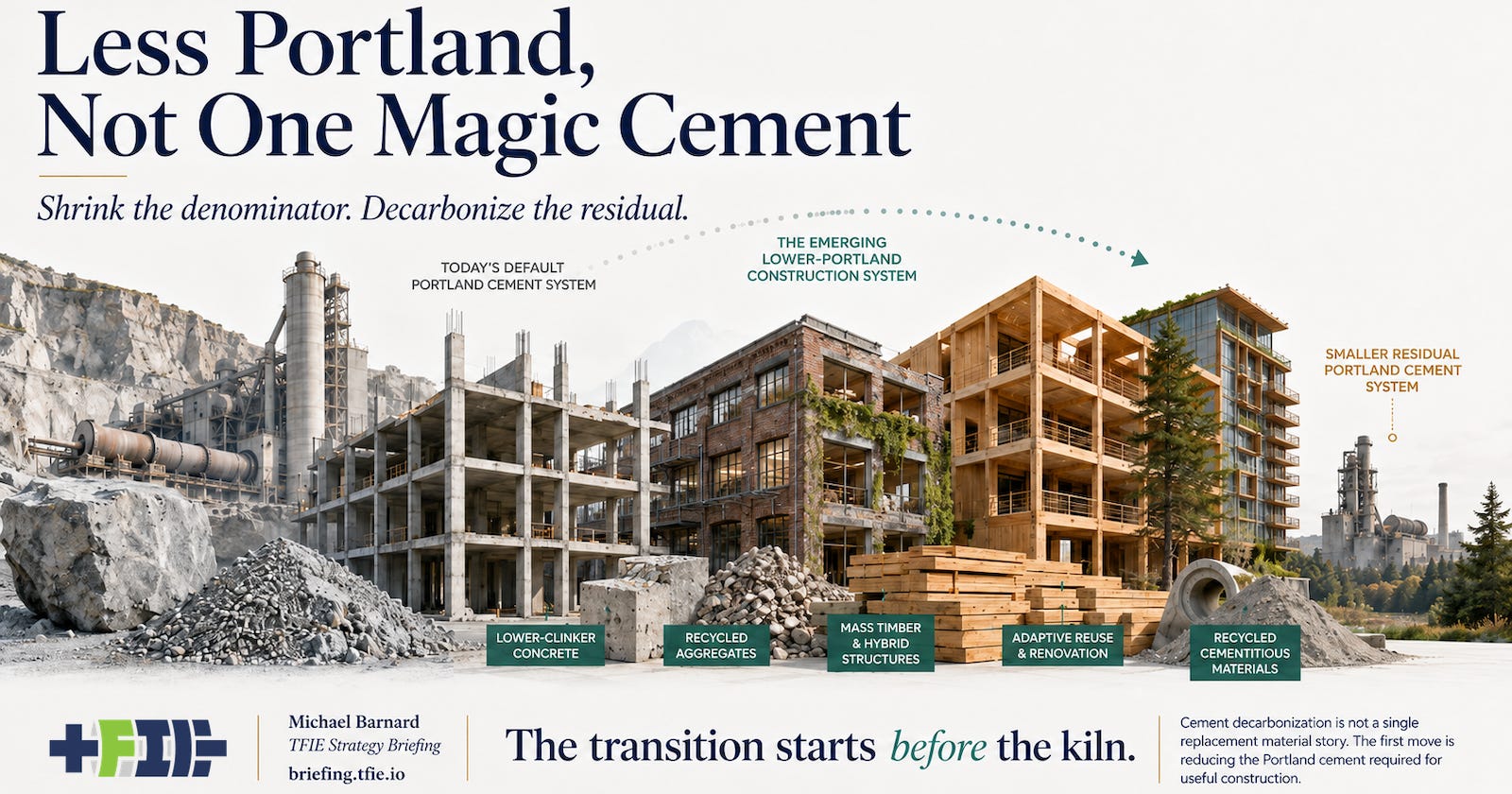
Cement is not going away. It is too useful, too cheap, too local and too deeply embedded in construction practice for that. It holds together bridges, foundations, water systems, wind turbine bases, apartment blocks, ports, tunnels, roads and the large share of civilization that prefers not to fall down. Any serious decarbonization pathway has to start by acknowledging that usefulness instead of pretending that a clever new binder will sweep through global construction by press release.
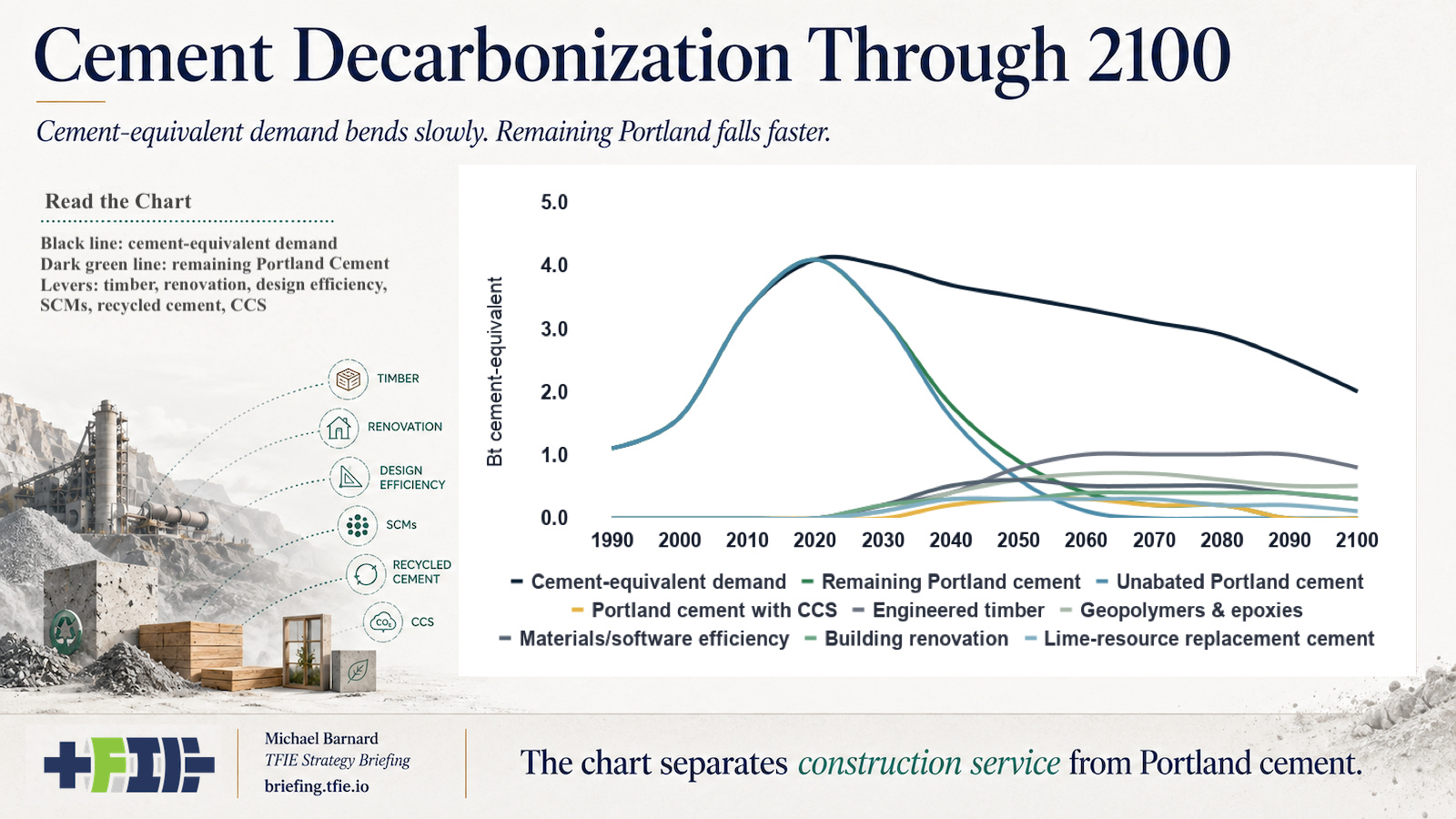
The better question is how much Portland cement remains when the construction system stops using cheap clinker as the default answer to every structural problem. Total construction service, expressed in cement-equivalent tons, falls slowly in my reference scenario. Remaining Portland cement falls faster because the things that displace it do not have to replace all construction. They only have to reduce the share of construction that depends on limestone clinker.
The longer report behind this article is Beyond Portland: Cement’s Transition to 2100, which brings together my cement work on demand, clinker reduction, electrified heat, alternative binders, carbon capture niches, construction-system change and the 2100 projection. This article is the shorter pathway-review version, with the workbook and evidence machinery placed below the paywall.
Portland cement has two carbon problems. The first is heat. Kilns burn fossil fuels to reach the temperatures needed to make lime and clinker. That part is technically straightforward to electrify, although capital costs, electricity prices and plant turnover make the economics uneven, which is why I argued years ago that cement’s CO2 emissions are solved technically, but not economically. The second problem is chemistry. Limestone is calcium carbonate, and making lime releases CO2 from the rock itself. Electrifying the kiln does not make that process carbon vanish. It only makes the heat cleaner and, in some configurations, makes the CO2 stream easier to manage.
That is why carbon capture appears in cement discussions more reasonably than it does in many other sectors. There is real process CO2. Some plants are near plausible storage. There are jurisdictions where carbon prices may eventually justify the cost. But CCS is residual-production mitigation, not cement displacement. It does not reduce the amount of cement required. It captures some of the emissions from Portland cement that remains after demand reduction, clinker reduction, material substitution and production changes have already done their work. That is why I treat cement CCS as potentially competitive only in niches, not as the main pathway.
The first useful measure is therefore remaining Portland cement. That quantity shrinks for reasons that are already visible. China’s 40-year infrastructure and urban build-out drove a huge share of global cement growth, and that phase is ending. Advanced economies are mostly in maintenance, renovation and replacement, not fresh national build-out. Global population growth peaks this century. Developing economies will still build a great deal, but India, Africa, Indonesia and Brazil are not simply rerunning China’s industrial and infrastructure sequence at the same speed, with the same manufacturing role and the same material intensity.
The World Cement Association’s long-term white paper is useful partly because it is not my forecast. It also sees a peak and decline in cement demand and clinker demand well before the end of the century, with global cement demand in 2050 around 3 billion tons per year and clinker demand lower still. That is not the same as my reference scenario, but it points in the same direction. The disagreement is not whether the cement system changes. The useful debate is how quickly the demand base bends and which levers are being counted twice by accident.
In the formalized TFIE reference scenario, cement-equivalent construction demand declines from roughly 4.1 billion tons today to about 2 billion tons by 2100. That is not a collapse in construction. It is a shift in the material intensity and composition of the built environment. Remaining Portland cement declines faster because renovation, design efficiency, mass timber, supplementary cementitious materials, alternative binders, recycled cement and selective CCS all act on different parts of the problem.
Mass timber is the easiest lever to overstate and the easiest to understate. It is not a substitute for dams, ports, tunnels, wastewater systems, highways or most foundations. It is, however, a serious substitute for reinforced concrete in a large share of the building sector. Buildings account for roughly half of cement demand on a conservative assumption, and my cement report uses a roughly 60% building-sector framing in places. That is the market against which the timber wedge should be tested, not total cement demand.
The mass timber work matters because it is an industrialization story as much as a carbon story. Cross-laminated timber, glulam and related products move structural work from messy job sites into factories, compress schedules, reduce on-site labor, make vertical extensions easier and allow older buildings to be expanded instead of demolished. Brock Commons at UBC, Murray Grove in London, the T3 building in Minneapolis, 55 Southbank in Melbourne and other projects show that this is not architectural fantasy. They also show the constraints. Mass timber scales when codes, insurance, forestry, lamstock, factories, logistics, repeatable designs and procurement line up. Architects liking warm interiors is not a scaling strategy.
That discipline is why the timber wedge in the workbook is treated as a high-adoption case, not a universal claim. Full mass timber buildings can cut concrete use dramatically in the right building types, and hybrid timber buildings can still remove a large share of concrete from floors, walls and superstructure while reducing foundation mass. But the addressable market has to be filtered through building type, height, fire code, insurance, sustainable forestry, factory capacity, transportation distance and overlap with renovation and design efficiency. A ton of timber does not automatically displace a ton of cement. It displaces a share of concrete in a particular building system, in a particular market, with a particular approval pathway.
The software and design-efficiency wedges are less photogenic and possibly more important. BIM, finite element analysis and generative design all reduce the tendency to over-order, overbuild and over-dimension. Some of that is better quantity control. Some of it is tighter engineering. Some of it is the ability to run thousands of design options and find the one that uses less material while meeting the same safety and performance requirements. These tools matter especially because they reduce cement before anyone has to build a new kiln, qualify a new chemistry, finance a pipeline, insure a storage reservoir or persuade a municipal code official that a new binder will keep the building upright.
Supplementary cementitious materials are the mature near-term lever inside the cement system itself. Fly ash, ground granulated blast furnace slag, natural pozzolans and calcined clays can reduce clinker ratios and improve concrete performance. The first two have been used heavily because they are often cheaper than Portland cement where they are locally available. That is also the limit. Fly ash and blast furnace slag are legacy waste streams from industries that are themselves being decarbonized or retired. There are large stockpiles, but quality, location, contamination and transport all matter. Calcined clays and LC3 become more interesting as cheap SCMs decline and carbon prices rise, but they are not evenly distributed, not costless to mine or fire, and not automatically close to cement plants.
Geopolymers are real, but not general. They work best where precursor waste streams, activators, controlled production settings, performance requirements and code pathways align. Precast, offshore, chemically harsh environments, industrial facilities and locally advantaged waste clusters make more sense than broad claims of replacing Portland cement everywhere. Epoxy concrete is even narrower. It is valuable where chemical resistance, high strength or industrial durability justify cost and workflow penalties. It is not a global cement decarbonization wedge hiding in plain sight.
Electrochemical and recycled cement pathways are among the more interesting deep-tech options, but they remain optionality until they prove repeated commercial scale. Processes that recover lime from demolition concrete or EAF slag can matter where the waste stream exists, the electricity is low carbon and cheap, the output qualifies for use, and the waste products are manageable. I looked at that logic in more detail in Electrochemistry Might Help Solve Cement’s Carbon Problem. The short version is that demonstrations are useful, but they are not market formation. Cement is a 4 billion ton annual commodity. The relevant test is qualified, bankable, repeated output at cement-plant scale against alternatives that are also improving.
The weakest broad claims are the ones that try to replace limestone with rocks that have much less lime, worse geography, higher hardness, higher processing requirements and large waste streams. Basalt and similar low-lime routes can make for an impressive narrative if the mass balance is hidden. Once the chemistry is visible, they look more like expensive SCM production with a small amount of cement on the side. Chemistry remains annoyingly indifferent to pitch decks.
The public conclusion is optimistic, but not because cement has a miracle solution waiting offstage. It is optimistic because the problem becomes smaller and more segmented when the material flows are handled properly. Cement decarbonization has two linked jobs: shrink the Portland cement requirement, then decarbonize the residual Portland that remains. The first job is already under way through demand rollover, renovation, material efficiency, timber, SCMs and alternative materials. The second job is narrower, more local and more expensive, which is exactly where electrification, recycled cement, electrochemical routes and selective CCS should be tested.
Below the paywall is the executive summary, the downloadable projection workbook, denominator checks for each lever, the pathway scorecard, progress-signal audit, comparator notes, update triggers and decision implications I’ll use to judge whether cement decarbonization is scaling, progressing, niche-valid or merely generating activity.