

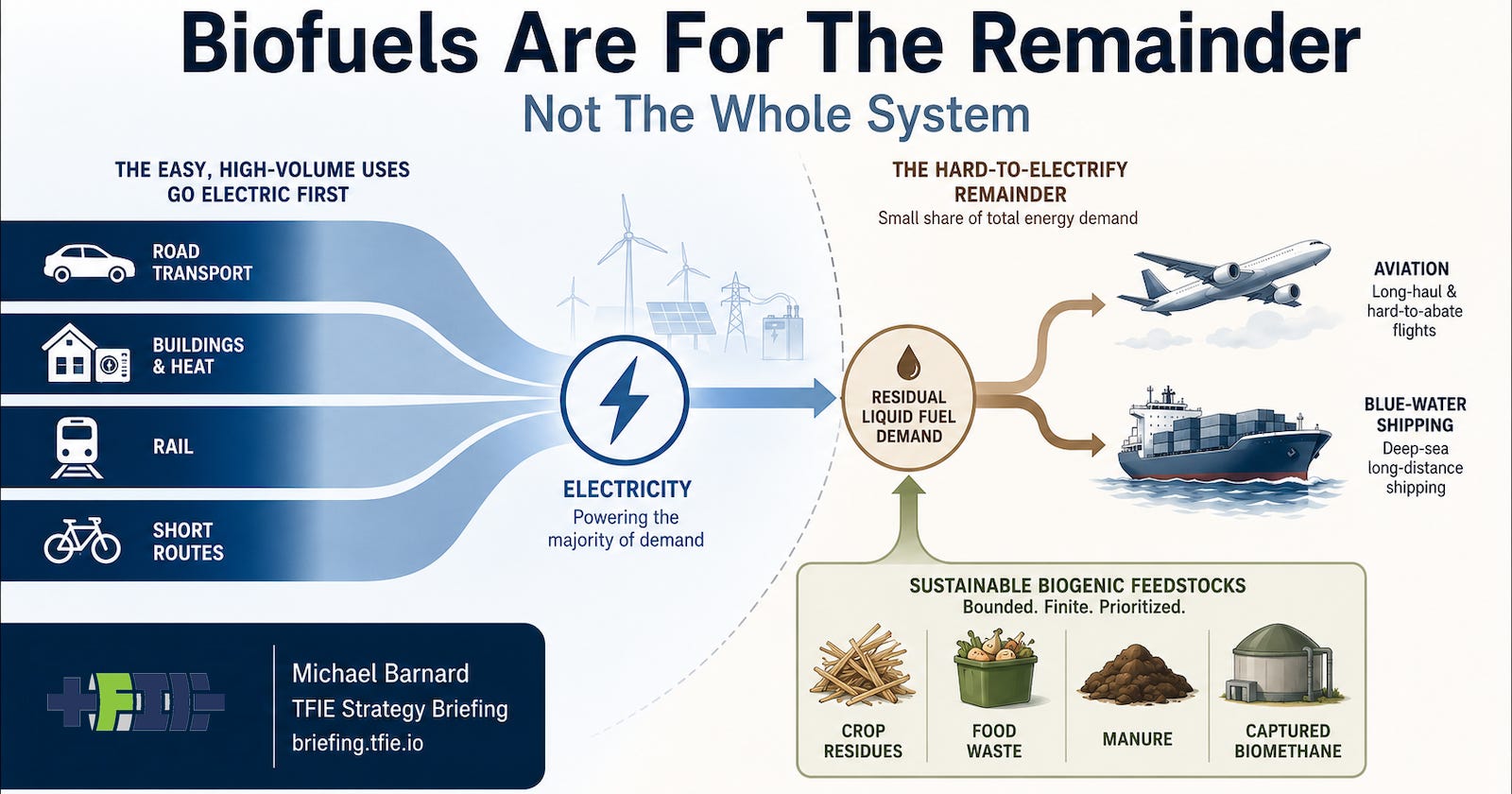
Biofuels are easy to overstate and easy to dismiss. Both errors start from the same mistake: treating today’s fossil-fuel demand as the denominator. If the question is whether biofuels can replace the full volume of coal, oil and gas we burn today, the answer is obviously no. That question is not useful. The useful question is what liquid-fuel demand remains after electrification, efficiency, better logistics, changing cargo flows, material substitution and industrial redesign have done the larger work.
That is why biofuels belong in the remainder, not at the center of the energy system. Road transport electrifies. Rail should electrify. Most building heat electrifies. A great deal of industrial heat electrifies. Shorter maritime routes electrify. Regional aviation gets partly displaced by batteries and hybrid-electric systems over time. Once that happens, the residual liquid-fuel problem is much smaller and much more specific. It is mainly longer-distance aviation, selected blue-water maritime routes and a few hard edge cases where energy density, chemistry or logistics make molecules difficult to avoid.
That framing now sits inside the broader TFIE Strategy Briefing pathway work. The aviation fuel projection does not assume aviation disappears. It assumes cheap unconstrained kerosene growth disappears, while regional electrification, operational efficiency and constrained sustainable aviation fuels reshape the residual fuel pool. The shipping fuel projection starts with less fuel first, because fossil cargoes decline, short routes electrify, hybridization spreads and efficiency compounds before the remaining molecule problem is counted. The molecules-shrink frame says the same thing in broader terms: molecules remain where they have real jobs, not where they are trying to preserve the old fuel system.
With that denominator in place, the biofuels picture becomes much less alarming. We do not need enough biomass to preserve the current oil system. We need enough low-carbon liquid fuel for the parts of aviation and shipping that remain liquid-fuel dependent after the rest of the system changes. That is a very different feedstock and pathway problem.
The strongest pathway is still likely to be cellulosic biofuel from crop residues. Grain crops already separate useful food or feed from stalks, straw and other residues. Wheat, rice and corn stalks are biomass streams that can be collected at specific times, processed and turned into alcohols, biocrudes or other intermediates. Those intermediates can then be upgraded into aviation and marine fuels. The important point is that this is not a food-versus-fuel story when done properly. It is a dual-output system: food or feed from the edible part of the plant, and fuel feedstock from the residue.
That does not mean every stalk should become fuel. Residues have soil functions too. Some should remain on fields for soil carbon, erosion control, moisture retention and nutrient cycling. Collection logistics matter. Regional agronomy matters. But the scale of global grain production means the residue pool is large enough to matter if the demand it is serving has already been narrowed to residual aviation and shipping.
Switchgrass and other perennial grasses are a second route, but not likely the dominant one. They can grow on semi-arable land that is not suitable for intensive food production. They can provide soil and biodiversity benefits in some landscapes. They can also be harvested and processed through cellulosic systems. The issue is logistics. Dedicated grass crops spread across lower-quality land are harder to collect, densify and move than residues that already pass through agricultural machinery and commercial supply chains. Switchgrass-type pathways are useful, but the highest-value starting point is probably residue streams that already exist.
Corn ethanol is the pathway that made many people allergic to the word biofuel. That reaction is understandable, especially in the United States. Corn ethanol was built into ground-transport fuel policy, supported by subsidies and tied to modern industrial agriculture’s fertilizer, pesticide, herbicide and diesel burdens. It has often been more farm-policy instrument than climate strategy. But it is also a poor representative of the future biofuels question. Using edible corn for low-impact ground-transport blending is not the same as using residues and wastes for residual aviation and shipping fuel after electrification has narrowed the pool.
Sugarcane ethanol is different again. Brazil has long experience with ethanol as a transport fuel, and sugarcane is a more efficient ethanol crop than corn because the plant itself is a sugar-rich feedstock. That does not make sugarcane a universal answer. Land-use change, water, labor, biodiversity and regional limits still matter. But sugarcane shows that biofuel pathways should be judged by feedstock, geography, agricultural practice, land-use impact and final use, not by one generic label.
Palm oil sits in the same category of “real but constrained.” It has been associated with severe deforestation, haze and biodiversity damage, especially in Southeast Asia. That history cannot be handwaved away. At the same time, palm is a high-yield oil crop, and improved standards, better residue use and tighter land-use governance can change the emissions and sustainability profile. The right conclusion is not that palm-derived fuels are either salvation or permanent sin. It is that feedstock governance and land-use boundaries are decisive.
Manure is a more interesting feedstock than it often gets credit for. Livestock produce vast volumes of waste biomass, and poorly managed manure emits methane, a much stronger warming gas than CO₂ over near-term periods. Turning manure into biocrude, biomethane or other intermediates can solve two problems at once: reduce uncontrolled methane emissions and create a useful carbon-containing feedstock. The economics and conversion ratios matter, and the logistics are not trivial, but concentrated waste streams are exactly the kind of thing a residual-fuel strategy should examine.
Food waste is another large pool. A significant share of food never reaches a stomach. It rots in fields, is damaged in transit, is discarded by retailers, is scraped from plates or decomposes in landfills. Much of that waste creates methane when it breaks down without oxygen. The first priority should be to reduce food waste, improve distribution and compost or return nutrients where that is the better use. But a world with enormous unavoidable or poorly avoided food waste also has a meaningful biogenic carbon stream. Where collection is practical, that stream can support biofuel production.
Pyrolysis is the general-purpose biomass conversion route. Heat biomass without oxygen and it can produce biocrude, biochar, gases and other products rather than simply burning to ash. It can use wood residues, agricultural residues, food waste and other biomass streams. The details matter: energy balance, heat source, product slate, feedstock moisture, contaminants, scale and whether the process maximizes useful fuel output or diverts too much energy internally. But the basic route is not speculative. Biomass can be converted into liquid intermediates, and those intermediates can be refined into useful fuels.
Biochar and carbon black complicate the picture. Some pyrolysis processes produce solid carbon products that can displace fossil-derived carbon black, improve soils or store carbon. Those are useful co-products where they have real markets or durable storage value. But they should not become a subsidy-driven excuse to pretend every tonne of biomass should be pyrolyzed. In a disciplined pathway, the valuable products matter, but the objective remains residual fuel and emissions reduction, not a new permanent subsidy machine.
Biomethane is the most easily abused category. Methane from landfills, manure ponds, wastewater systems, reservoirs and rotting biomass is a real climate problem. Capturing it is often sensible. Flaring it can be better than letting it leak. Using it locally can be better again. But deliberately building a broad methane economy and calling it green is a different matter. Natural gas utilities are especially prone to treating small volumes of biomethane as a branding device for continued gas distribution.
The useful biomethane question is narrower. Where methane is already being created from unavoidable waste streams, can it be captured, stored or converted into useful fuels? In some cases it may be better used as a strategic reserve molecule than as a distributed gas-grid greenwashing input. In other cases, methane can be converted biologically or chemically into liquid fuel intermediates. Methanotrophic microbes, for example, can consume methane and produce biomass or lipids that can become biocrude. The pathway is not the same as saying “burn biomethane everywhere.” It is saying methane emissions are a problem, and some captured waste methane can become part of the residual fuel solution.
Hydrogen-assisted biofuel pathways deserve special caution. Hydrogen can improve yields in some conversion processes. It can help add hydrogen to carbon-rich biomass intermediates and produce more liquid fuel. But green hydrogen is expensive, inefficient to make and needed for a narrow set of real industrial uses. The hydrogen demand pathway therefore treats hydrogen-assisted biofuels as bounded, not as a giant new hydrogen-growth story. If a biofuel pathway depends on large volumes of cheap green hydrogen, it has to beat pathways that use little or none.
This is also relevant to shipping. Some hydrogen shipping proposals try to push molecules directly into vessels in forms that are expensive, inefficient or operationally awkward. The hydrogen cargo shipping pathway review treats that as a narrow and difficult route, not a central solution. Biofuels and biomethanol may have stronger maritime cases because they fit the liquid-fuel remainder more naturally, especially when ships are hybridized and fuel demand has already been reduced.
Agriculture itself will also change. Fertilizer production can be decarbonized. Precision agriculture can reduce fertilizer and chemical use. Electrified equipment and drones can displace diesel in some field operations. Better agronomy can reduce waste and emissions. Agrivoltaics can improve farm economics and resilience where solar structures do actual farm work, such as shade, protection, grazing integration or water resilience. The feedstock future should not be judged against the worst 20th-century version of agriculture.
The mistake, again, is to argue from extremes. Biofuels will not save the current fuel system. They will not run all cars, trucks, trains, ships, planes, factories and buildings. They should not be used to delay electrification. They should not justify clearing forests, draining peatlands or locking in bad agricultural practice. They should not become an excuse for hydrogen overbuild or gas-grid greenwashing.
But the opposite claim is also wrong. Biofuels are not irrelevant. Residues, wastes, selected crops, manure, food waste, captured methane and some engineered conversion routes can provide meaningful liquid fuels when the demand is properly bounded. Aviation and shipping will still need some liquid fuels. The right answer is not to fret about biofuels as if they must replace oil. The right answer is to shrink the liquid-fuel pool first, then allocate sustainable biogenic carbon to the places where electrons cannot easily do the job.
That is the strategic landing point. Biofuels are for the remainder. They matter after electrification has done the easy and large work. They are not a license to keep burning molecules everywhere. They are a way to provide selected residual liquid fuels in a system where most energy services have moved to electricity, efficiency, batteries, grids, better materials and better design.
Subscribe to TFIE Strategy Briefing for the professional layer behind fuel-transition claims: denominator tests, pathway reviews, feedstock limits, update triggers and the difference between a useful residual fuel and an attempt to preserve the fossil-fuel system.
This article was originally published at CleanTechnica as “The Pathways To Biofuels: A Survey Of Why We Should Stop Fretting.” It has been archived and lightly updated at TFIE Strategy Briefing.
A mea culpa: Turns out that the chemical reaction requires a lot of hydrogen, requiring the water-gas shift (WGS), which generates a lot of CO₂. That means the OX-ZEO process emits as much CO₂ as the methanol route for coal-to-olefins:
CO + H₂O → CO₂ + H₂
2CO + 4H₂ → C₂H₄ + 2H₂O
1 mol C₂H₄ : 4 mol H₂ : 4 mol CO₂
28 g/mol × 1 mol C₂H₄ : 44 g/mol × 4 mol CO₂
28 g C₂H₄ : 176 g CO₂
1 g C₂H₄ : 176/28 g CO₂
1 g C₂H₄ : ~6.29 g CO₂
Standard methanol route process emissions:
CO + H₂O → CO₂ + H₂
CO + 2H₂ → CH₃OH
2CH₃OH → C₂H₄
1 mol C₂H₄ : 2 mol CH₃OH : 4 mol H₂ : 4 mol CO₂
28 g C₂H₄ : 176 g CO₂
1 g C₂H₄ : 176/28 g CO₂
1 g C₂H₄ : ~6.29 g CO₂
I am not sure if I agree with the entire chain of logic here, but given that the focus is on the role of biomass in the fuel system, and that too, to largely meet urban requirements, the conclusions appear pleasing on the surface... even though the approach of a supply driven system feels quite distorting.
As such, it is more useful to look at biomass for storage, high value material uses and distributed end use driven energy use (ref: "Banking with Biomass by K. R. Datye) in the developing world.