

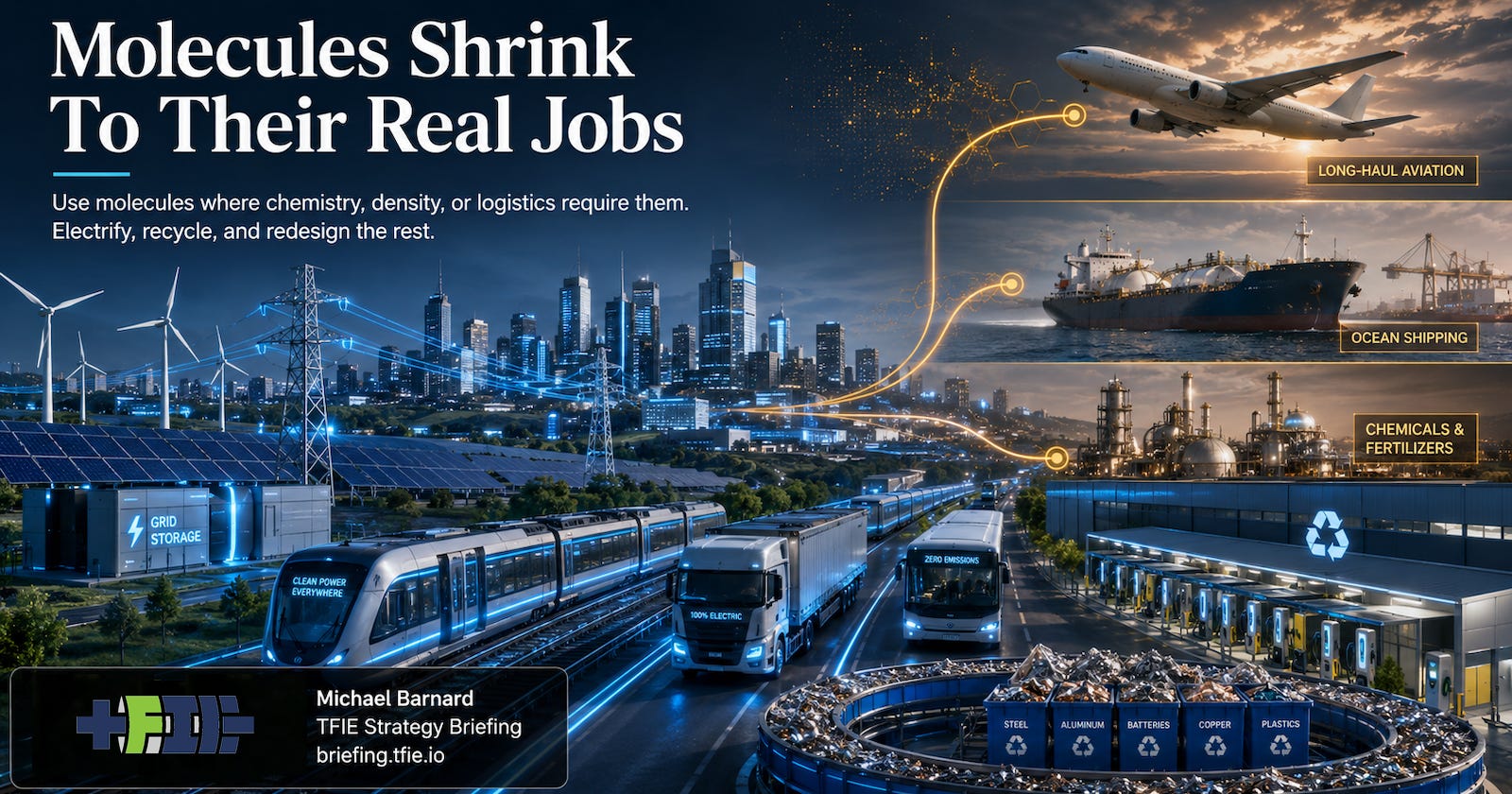
The fossil economy used molecules by default. Coal, oil, and gas were not just fuels; they were the organizing logic of energy supply, industrial heat, transport, shipping, aviation, chemicals, fertilizer, and a large share of geopolitics. One of the easiest ways to get 2100 wrong is to preserve that structure by assuming fossil hydrocarbon volumes mostly reappear as lower-carbon liquids, gases, reducing agents, and chemical carriers. The labels change, but the old volume story is still doing the work.
That is the wrong starting point. The transition does not have to preserve the fossil economy’s molecule volumes. It has to deliver useful services and industrial products with lower risk, lower emissions, and better economics. Often that means electrons. Often it means recycling, better design, lower material intensity, changed routes, different industrial processes, or more effective use of stock that already exists. Molecules remain important, but they move from being the default energy carrier to being one tool in a more selective system.
The first question is whether the job still needs a molecule at all. If a heat pump, electric motor, electric arc furnace, battery, wire, rail system, efficiency measure, logistics change, or process redesign can do the work better, the molecule starts with a disadvantage. If a molecule is still required, the next question is which one fits the job. Hydrogen, ammonia, methanol, biomethane, biodiesel, biocarbon, SAF, synthetic hydrocarbons, and chemical feedstocks have different constraints, infrastructure, safety cases, feedstocks, and economics. The final question is how much volume remains after the easier parts of demand have been removed. Those questions shrink molecule demand sharply compared with substitution stories that begin by preserving today’s fossil hydrocarbon volumes.
Critical minerals and recycling belong in this discussion because they change the form of demand. The transition moves large parts of the economy from continuous fossil fuel flows toward durable equipment and material loops. Batteries, motors, wind turbines, solar panels, transmission, transformers, heat pumps, rail systems, and power electronics require mining, processing, manufacturing, maintenance, and recycling. Those supply chains are not trivial, and some are geopolitically concentrated. But they are not the same as burning coal, oil, and gas every day forever. A battery is not a barrel, a transformer is not a tanker cargo, and a wind turbine is not a coal train. Durable assets can be used for years, maintained, repowered, and increasingly recycled. That does not make critical-mineral supply easy. It does make molecule-for-molecule replacement a poor model of the transition.
Recycling and material efficiency also compete directly with future molecule demand. Scrap steel reduces the need for new primary iron. Better concrete design and clinker substitution reduce process demand in cement. Battery recycling, chemistry shifts, right-sizing, and sodium-ion or LFP chemistries change primary mineral demand. Industrial heat that is avoided through better process design does not need a clean fuel. Shipping cargo that disappears because coal, oil, gas, or raw iron ore flows shrink does not need a replacement bunker fuel. A molecule projection that ignores material loops is usually preserving old demand before asking whether the demand still exists.
Aviation is the cleanest example of a real molecule need with bounded scale. Long-haul aircraft require dense liquid fuels for a long time because batteries cannot yet do that job at scale. Sustainable aviation fuel therefore matters. IATA expected SAF production to reach about 1.9 million tonnes in 2025, still a tiny share of global jet fuel use. That small base does not make SAF irrelevant; it means the residual liquid-fuel problem has to be sized carefully. The fuel requirement comes after route length, aircraft efficiency, regional electric or hybrid alternatives, airport constraints, ticket prices, carbon costs, feedstocks, and demand sensitivity have been counted. Long-haul aviation keeps a strong claim on low-carbon liquids. Cheap kerosene growth does not.
Shipping is similar, but with more moving pieces. Ships already run on molecules, so the evidence required is not that a molecule can move a vessel. The evidence required is that low-carbon fuels can defend large volumes after cargo changes, route changes, batteries, shore power, wind assistance, speed optimization, hull efficiency, and logistics are counted. Ammonia, methanol, biofuels, LNG variants, and synthetic fuels are not competing only with each other. They are competing with a smaller and different energy requirement. They are also competing with the decline of fossil cargo itself. A ship that no longer needs to move coal or oil does not need a clean fuel for that voyage.
Steel is where the incumbent molecule argument often starts in the wrong place. The usual claim is that new steel requires coal, so decarbonization needs a replacement reducing agent at very large scale. Some primary iron routes may use a molecule, and hydrogen direct reduction can be a serious pathway where ore quality, clean electricity, water, infrastructure, financing, and market conditions line up. But the first denominator is steel demand, existing stock, scrap availability, new iron requirements, ore quality, electricity, and route choice. Scrap-electric arc furnaces avoid new reducing molecules for a large share of steel. Electrochemical approaches may reduce iron ore directly with electricity. Biomethane, biocarbon, hydrogen, and other reducing routes may compete where a molecule still makes sense. The world needs clean steel; it does not follow that the central projection should start with the largest imaginable molecule market for steel. My steel work treats this as a demand, scrap, new iron, ore quality, electricity, and route-choice problem before any reducing molecule becomes a comparator.
Strategic energy storage shows the same discipline. The system need is rare, reliable reserve for difficult periods, not a standing market for a preferred molecule. Hydrogen can store energy chemically and can be burned later, but it competes with batteries, pumped hydro, existing hydro reservoirs, interconnection, demand flexibility, thermal storage, and reserve fuels that fit existing infrastructure. In my system case against hydrogen for grid storage, the conclusion was not that grids never need stored chemical energy. It was that a layered system with batteries, pumped hydro, thermal storage, transmission, demand flexibility, and a modest strategic biomethane reserve often makes more sense than building a green hydrogen system for the last few difficult hours or days. Biomethane is limited and should not be wasted on uses electricity can handle, but for rare backup using existing gas storage and turbines, it can be a better fit than a newly manufactured hydrogen chain.
Fertilizer and chemicals are stronger molecule cases because the molecule is often the product or feedstock, not merely an energy carrier. Ammonia production requires hydrogen as a chemical input. Methanol and many chemical products require carbon-containing molecules. Refining hydrogen demand declines as oil demand declines, but fertilizer and chemical demand do not disappear because transport electrifies. These applications have much stronger claims on scarce low-carbon molecules than road transport, residential heat, or generic power-sector combustion. They still have to compete within the molecule palette, but they start from a real chemical requirement rather than a desire to preserve fossil-derived molecule volume.
Supply constraints reinforce the sorting. Low-carbon molecules require inputs and infrastructure that are already contested. Green hydrogen requires large amounts of clean electricity. Synthetic fuels require hydrogen plus carbon dioxide or another carbon source, then more capital and conversion losses. Ammonia and methanol require production plants, storage, bunkering, safety systems, engines or fuel cells, and reliable availability in the right places. Biofuels require sustainable feedstocks that are already claimed by food systems, materials, chemicals, aviation, shipping, existing biofuel markets, and strategic reserve. Biocarbon and biomethane have real roles, but only if they come from sustainable residues and waste streams rather than new land-use problems. None of this makes low-carbon molecules impossible. It makes prioritization unavoidable.
The worldview implication is straightforward: low-carbon molecules are scarce strategic inputs, not universal substitutes. Their market grows where chemistry, energy density, logistics, or rare reserve requirements make them hard to avoid. It shrinks where they are being used to defend fossil molecule volume, pipeline value, combustion equipment, or an incumbent industrial narrative. The full palette has to compete. A fuel or feedstock does not win because a sector has historically used a molecule. It wins only where the full system still favors it after electrification, recycling, redesign, route changes, safety, infrastructure, and cost are counted.
There are real countercases. Grids can be slow to build. Direct electrification can face space, retrofit, reliability, or duty-cycle limits. Some industrial clusters have byproduct hydrogen, captured biogenic carbon dioxide, sustainable biomethane, low-cost clean electricity, or infrastructure that changes local economics. Remote sites, islands, mines, ports, military applications, and backup systems can justify molecules even when they are not the global default. A useful worldview assumption is not a ban on exceptions. It is a warning against making the exceptions the central case.
Carbon pricing, fuel standards, procurement rules, border adjustments, and sector regulation will increasingly require lower-carbon molecules where molecule use remains. The question is which molecule wins each residual job after electrification, recycling, redesign, route changes, cargo shifts, and process alternatives have reduced the addressable market. SAF has to compete among bio-derived fuels, synthetic liquids, feedstock limits, carbon sources, hydrogen costs, airline price tolerance, and shorter-route alternatives. Maritime fuels have to compete among biomethanol, green methanol, ammonia, biodiesel, synthetic fuels, batteries, shore power, wind assistance, speed changes, and cargo decline. Industrial molecules have to compete against scrap, electrochemical routes, biomethane, biocarbon, alternative feedstocks, process changes, and demand reduction. The likely result is not one winning molecule everywhere, but a smaller set of molecule markets where the cheapest, simplest, safest, and most convenient low-carbon option wins the specific job.
That is the safer assumption: low-carbon molecules will be required in real markets, but they will be rationed by cost, convenience, infrastructure, safety, feedstocks, regulation, and competition from non-molecule pathways. Use molecules where they are valuable, and use electrons, material loops, redesign, and system changes where they are better. The future has hydrogen, ammonia, methanol, SAF, biomethane, biodiesel, biocarbon, synthetic fuels, and chemical feedstocks. It also has many modern pathways that avoid molecules entirely. The goal is not to recreate the fossil molecule economy with cleaner branding. It is to stop treating fossil hydrocarbon volume as the denominator.
I do not claim to be right. I claim to be less wrong than most. In this case, being less wrong starts by asking whether the job still needs a molecule, and if it does, which molecule or non-molecule pathway earns the role after the full system is counted.
Subscribe to TFIE Strategy Briefing for the deeper pathway reviews, denominator checks, comparator cases, scorecards, workbooks, and update triggers behind this public worldview.
Do you know if there are any ways to make petrochemicals economically without oil, gas and carbon emissions?
This is an important framework. Spread the word, help lead the way, Michael. Well done.