


Hydrogen-for-grid-storage arguments usually start by making storage one thing. It is not. A grid does not need one asset class that stretches from milliseconds to winter. It needs many different capabilities, operating at different speeds, durations, utilization rates, locations and cost structures. The system problem is not “how do we store renewable electricity for every possible future hour?” The system problem is how to maintain reliability across a portfolio of fast response, daily shifting, multi-day balancing, seasonal demand variation and rare strategic reserve events.
Once that denominator is corrected, hydrogen shrinks quickly. It is not impossible to turn electricity into hydrogen, store it and turn it back into electricity. It is just a costly, lossy and infrastructure-heavy way to solve a problem that is mostly handled by other assets long before the rare reserve case appears. The claim only looks attractive when the far-right tail of the duration curve is treated as if it were the whole storage market.
Seconds-to-minutes response is not a fuel problem. It is an inverter, battery, controls and grid-services problem. Frequency regulation, voltage support and fast contingency response need assets that can react almost immediately, sit close to the grid issue and operate repeatedly without complex fuel logistics. Batteries and modern power electronics are already good at this. They are modular, factory-built, fast to deploy and increasingly embedded in grid planning, renewable projects, commercial buildings, data centers and distribution networks.
Intraday shifting is a different job. The need there is to move energy from one part of the day to another, especially from solar production hours into evening peaks. Lithium-ion batteries are already taking a large share of that market because the cycles are frequent, the value stack is clear and the asset can earn across energy arbitrage, capacity, ancillary services and local grid support. Pumped hydro also remains important where geography and permitting allow it. Demand response, thermal storage and smarter load management reduce the size of the storage requirement before a molecule is ever considered.
Multi-day balancing is different again. Weather systems, low-wind periods, cloudy stretches and regional demand swings create longer-duration needs, but those needs are not solved only by storage. Transmission matters. Geographic diversity matters. Overbuilding renewables matters. Pumped hydro, flow batteries, reservoir hydro, flexible loads and interconnection all change the shape of the problem. A wider grid does not eliminate variability, but it reduces the amount of local storage required by letting different weather, demand and resource profiles help one another.
That is one reason electricity wins because it decouples the system. Once useful work is electrified, the generation source, storage mix, grid architecture and end-use equipment can evolve independently. The system is no longer tied to a delivered fuel chain for every unit of energy service. That decoupling is the strategic advantage. Hydrogen-for-grid-storage proposals usually reintroduce a fuel chain, then ask to be treated as if complexity were resilience.
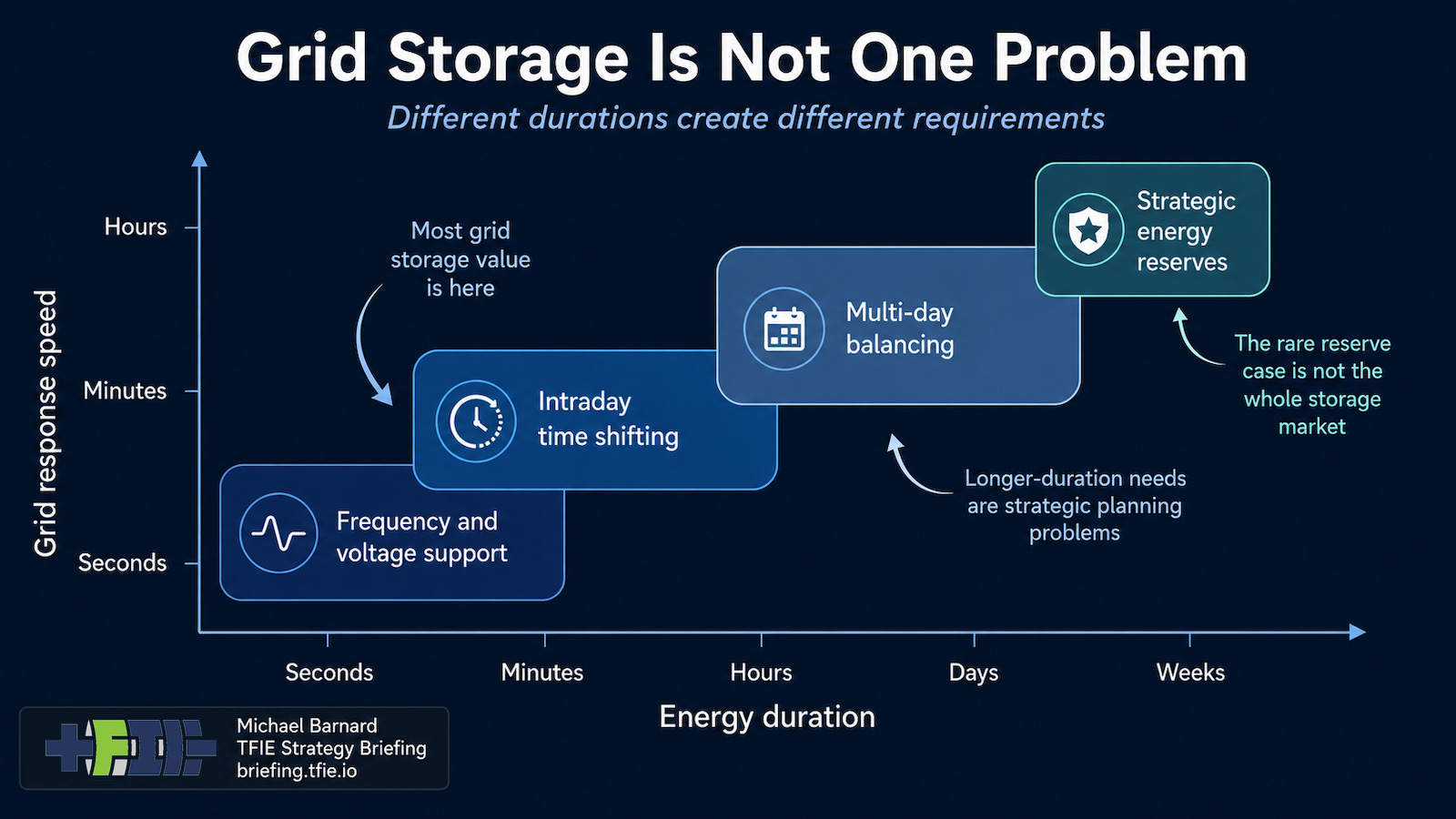
Long-duration storage does matter. A high-renewables grid still needs assets that can manage difficult weeks and rare weather-driven events. But that does not make every long-duration concept central. A grid asset used rarely has a brutal utilization problem. If it is expensive to build, expensive to fuel, expensive to maintain and only dispatched in exceptional conditions, its delivered cost per useful kilowatt-hour will be ugly unless the reserve value is explicitly recognized. That is not ordinary storage economics. It is strategic reserve economics.
This is where many hydrogen arguments slide between categories. They talk about storage, but the actual use case is a reserve for rare events. They talk about cheap renewable electricity, but ignore electrolyzer utilization. They talk about stored molecules, but undercount compression, storage, reconversion, turbines, pipelines, safety systems and maintenance. They talk about clean power, but avoid the round-trip efficiency penalty that means much more generation must be built upstream to deliver the same electricity downstream.
Those penalties are why molecules shrink to their real jobs. Hydrogen remains valuable where chemistry requires hydrogen or where molecules have a genuine density, process or feedstock role. It is not automatically valuable because electricity needs firming. The grid already has a large set of tools that work directly with electricity or reduce the need for storage in the first place. Turning electrons into molecules and back into electrons should be the last resort for a narrow reserve case, not the first answer to a generic storage question.
Pumped hydro is the obvious counterexample to the claim that long-duration storage lacks scale. It is geographically constrained, permitting-heavy and slow to build, but it is also real, durable, efficient enough and already dominant in installed grid storage energy capacity. Closed-loop pumped hydro, existing reservoir optimization and selected upgrades to conventional hydro systems are all more grounded than building a new hydrogen storage system and then waiting for rare events to justify it.
Flow batteries are more uncertain than pumped hydro, but they are aimed at a recognizable grid job: longer daily duration, high cycle life and stationary storage where weight and volume matter less. They still have to prove cost, bankability and supply chains at scale, but their conversion chain is much shorter than hydrogen-to-power. Thermal storage also deserves more attention, especially where the final demand is heat, cooling or industrial temperature rather than electricity. Storing heat as heat is usually more sensible than using electricity to create a molecule so that the molecule can later recreate electricity to recreate heat.
Transmission is not storage, but it substitutes for a lot of storage. HVDC interconnection, regional grid buildout, reconductoring, grid-enhancing technologies and market integration let generation and demand balance over larger areas. That does not make storage unnecessary. It changes how much storage is required, where it is required and what duration class has value. The constraint is real, but constraints are dynamic. Transmission bottlenecks trigger investment, policy reform, reconductoring, interconnection queues, industrial response and demand relocation. They should not be frozen into 2050 models as if today’s queue were a geological fact.
Demand flexibility is also too often treated as a footnote. Industrial loads, commercial buildings, water systems, cold storage, EV charging, district heating, data centers and household devices can all shift some demand without materially changing the useful service delivered. Not all demand is flexible, and flexibility is not free. But a power system with millions of controllable loads needs less storage than a model that treats demand as a fixed wall and then asks one technology to absorb every mismatch.
The same denominator problem appears in energy accounting. If the analysis is still dominated by primary energy or fuel-equivalent thinking, hydrogen looks larger than it should. Electrification reduces wasted conversion steps, which means the useful-energy system is smaller than the fossil primary-energy system it replaces. That is why steering with the wrong energy metrics leads to bad pathway conclusions. Hydrogen often appears to be filling the fossil system’s old volume rather than the electrified system’s residual requirement.
The strategic reserve problem remains after all of that. There will still be rare events where a grid needs stored energy, dispatchable capacity or emergency reserves. But the reserve question should be handled as a reserve question. Existing gas turbines converted over time to low-utilization biomethane, retained hydro reserves, emergency interconnections, backup generation, industrial demand curtailment, fuel stockpiles and other reserve mechanisms may be cheaper and simpler than a dedicated hydrogen-to-power chain. The answer will vary by region, weather, grid strength, hydro availability, interconnection, political tolerance and existing infrastructure.
That is why the right test is not whether hydrogen can technically store energy. It can. The right test is whether it survives the full system comparison. It has to beat batteries for fast and daily services, pumped hydro where geography permits, transmission where interconnection is the cheaper hedge, demand response where load flexibility is cheaper than generation, thermal storage where the end use is heat, and strategic reserves where the asset is rarely used. That is a hard set of comparators.
The useful policy conclusion is not “never hydrogen.” It is “do not let the rare reserve case distort the whole grid-storage strategy.” Build the assets that solve the common, valuable and repeatable problems first. Strengthen grids. Add batteries where they cycle often. Build pumped hydro where it is practical. Use demand flexibility and thermal storage where they reduce peaks. Expand interconnection. Preserve or develop strategic reserves for rare events. Then examine whether any remaining long-duration gap genuinely needs a hydrogen pathway after the better options have done their work.
That is also the investor conclusion. Hydrogen-for-power stories should be tested against utilization, round-trip losses, storage cost, reconversion cost, infrastructure dependency and the realistic dispatch pattern. A low-utilization asset with multiple conversion steps is not made economical by calling it seasonal storage. A large total addressable market is not the same as a bankable duty cycle.
This is the same discipline applied in Hydrogen Demand Through 2100. Hydrogen demand does not grow because every energy problem can be reframed as a molecule problem. It concentrates where hydrogen has defensible jobs: existing industrial feedstocks that need to be cleaned up, selected process chemistry and a shrinking set of residual uses that survive electrification, efficiency and material substitution. Grid storage is not exempt from that discipline.
The better grid-storage story is less dramatic and more useful. Storage is not one problem. Reliability is not one asset. The future grid is a portfolio: generation diversity, geographic smoothing, transmission, batteries, pumped hydro, flow batteries, thermal storage, flexible demand and strategic reserves. The hydrogen answer shrinks when the storage problem is properly divided.
Subscribe to TFIE Strategy Briefing for the professional layer behind grid, storage and hydrogen claims: system boundaries, cost stacks, utilization, alternatives and update triggers.
This article was originally published at CleanTechnica as “The System Case Against Hydrogen for Grid Storage.” It has been archived and lightly updated at TFIE Strategy Briefing.
Thanks for the lessons!
This! 100% this