

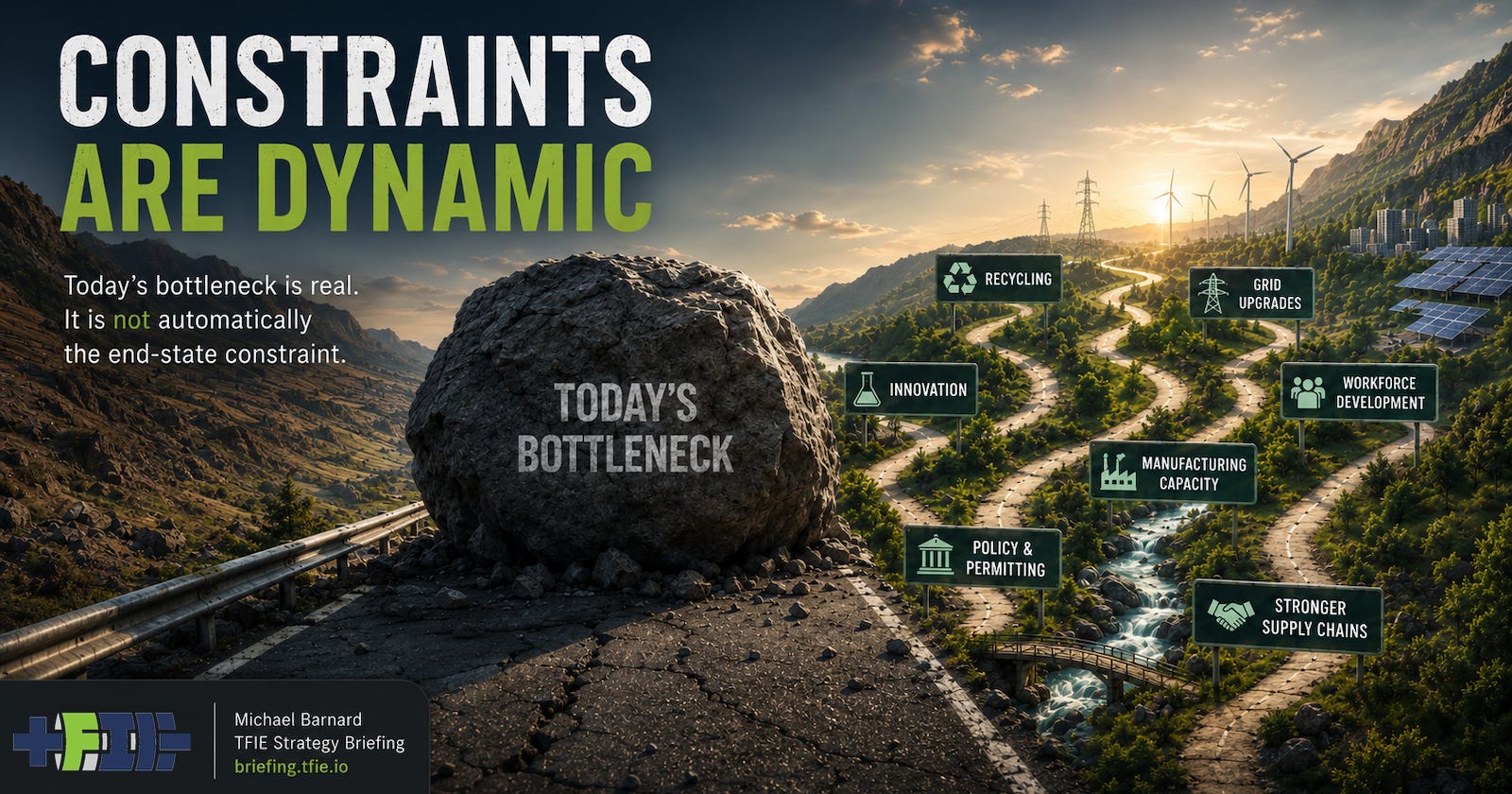
One of the ways to get 2100 wrong is to take a current bottleneck and stretch it across the rest of the century. Tight materials, long grid queues, slow permitting, concentrated supply chains, and scarce workers can all damage projects, markets, and policy schedules for years. They matter. But they are poor foundations for a century-long central case when they are treated as fixed properties of the transition instead of constraints that markets, governments, engineers, chemists, buyers, and manufacturers respond to.
My working view is that constraints are dynamic. Engineers redesign products, chemists substitute materials, manufacturers alter processes, buyers shift demand, regulators change rules, investors fund capacity, and countries build industrial strategy around pain points. Constraints can get worse before they get better, remain hard for decades, or move to a different layer of the system. But very few remain untouched when large markets, national security, commodity prices, industrial margins, and policy pressure all push against them.
That does not mean constraints should be waved away. It means they should be modeled as systems, not slogans. The useful question is not simply whether a bottleneck exists. It is what kind of bottleneck it is, what incentives act on it, how quickly the system can respond, and what substitutes, recycling loops, design changes, infrastructure investments, standards, and policy choices alter the constraint over time.
Critical minerals are the obvious example because they are the default constraint story for electrification. Lithium, nickel, cobalt, graphite, rare earths, copper, manganese, and other materials all matter for batteries, motors, grids, vehicles, industrial equipment, and clean manufacturing. Supply chains are concentrated in places, some processing capacity is politically exposed, and some mining and refining pathways carry serious environmental and social impacts. None of that makes today’s mineral mix the final material requirement for the century.
The battery industry has already shown how quickly a constraint can change shape. Cobalt was once treated as the central barrier to electric vehicle scale. Then lithium iron phosphate chemistries grew, nickel-rich chemistries reduced cobalt intensity, manufacturers segmented chemistries by vehicle class and duty cycle, and recycling moved from theory toward industrial practice. Cobalt still matters, but it stopped being the master constraint. The lesson is not that every mineral concern is overblown. The lesson is that material constraints respond to price, security, ethics, chemistry, manufacturing scale, and buyer pressure.
The same process is visible in sodium-ion batteries, silicon anodes, lithium recycling, LFP scale, manganese-rich chemistries, magnet-free motors, rare-earth reduction, and battery second-life debates. Not all of these will become dominant, and some will disappoint. They still show the mechanism. When a material becomes expensive, exposed, unethical, or geopolitically risky, the system starts looking for ways to use less of it, recover more of it, substitute around it, or reserve it for the applications where it earns its place.
Copper is the useful counterweight because it is much harder to route around. Electrification, transmission, distribution grids, motors, transformers, data centers, and industrial equipment all use it. Aluminum substitution helps in some roles, recycling matters, grid design matters, and efficiency matters, but copper remains a central industrial constraint. That makes it a better test of the worldview than cobalt. Dynamic does not mean easy; it means the constraint should be treated as an evolving industrial system with price response, substitution, recycling, permitting, geopolitics, and investment, not as a fixed wall.
The grid is another place where current bottlenecks are often mistaken for permanent limits. Weak grids can block electrification faster than almost anything else, and interconnection queues, transformer shortages, permitting delays, distribution bottlenecks, substation constraints, land-use fights, and cost allocation disputes are all real. But the grid is not a single constraint. It is a set of different constraints with different tools, lead times, institutions, and failure modes.
A grid constraint can require new transmission, but it can also require reconductoring, advanced conductors, dynamic line ratings, grid-enhancing technologies, batteries placed at constrained nodes, demand flexibility, tariff reform, faster interconnection rules, distribution upgrades, or local voltage and reactive power support. Some weak-grid problems are about annual energy, while many are about where, when, and how electricity moves through constrained equipment under real operating conditions.
That distinction matters because a bad constraint diagnosis produces the wrong asset. Treat every grid bottleneck as a generation shortage and the system builds supply that cannot move. Treat every bottleneck as a need for long-distance transmission and it can miss cheaper local fixes. Treat every islanded or weak grid as a need for fossil spinning mass and it misses grid-forming inverters, synchronous condensers, STATCOMs, protection-system redesign, and better controls. A dynamic-constraints view starts with what is actually binding.
Some constraints are institutional and industrial rather than geological. Permitting, workforce, and manufacturing can slow the transition as surely as lithium, copper, or transformers. Transmission lines, mines, ports, factories, rail upgrades, storage projects, and industrial retrofits all run through agencies, courts, communities, skilled trades, suppliers, and procurement systems. These constraints do not vanish because a policy target exists, but they also do not behave like ore bodies. Agency capacity, standardized processes, training systems, apprenticeships, durable procurement, supplier investment, and credible demand signals can all change the constraint. When they do not change, that is often weak industrial execution, not proof that the pathway cannot scale.
This is where the first-build and replacement distinction matters. Fossil fuels are continuous flows; clean infrastructure is mostly durable stock that is built, maintained, upgraded, and eventually recycled. Solar panels, wind turbines, batteries, transformers, rails, wires, heat pumps, motors, and power electronics can create serious first-build material constraints, but they also create future recovery streams. Recycling does not solve the first-build ramp. It changes the long-run denominator as the asset base matures, which is exactly why a 2100 projection cannot treat today’s primary mineral demand as a permanent fuel-like flow.
Infrastructure learning matters for the same reason. First projects are often slow, expensive, and politically painful, but the tenth project should not be assumed to repeat all of the first project’s mistakes. Offshore wind ports, battery factories, transmission corridors, rail electrification teams, heat pump installation programs, methane detection regimes, industrial electrification packages, and grid-connection reforms can all learn if the system is built to learn. When learning fails, it is often because projects remain bespoke, institutions refuse to standardize, or stop-start policy destroys supply chains. That is still a dynamic constraint, but it is a sign of weak industrial execution rather than proof that the pathway cannot scale.
There are hard limits. Geography, ore grades, water availability, land conflict, ecosystem protection, community resistance, strategic dependence, genuinely difficult grid corridors, and dirty or concentrated mineral processing can all keep constraints hard for a long time. Dynamic constraints are not magic doors. They are pressure points with response functions, and some response functions are slow, expensive, politically fragile, or incomplete.
In my 2100 work, constraints move only when the evidence moves. For minerals, that means chemistry shifts, recycling capacity, processing diversification, price response, substitution, inventories, and procurement standards. For grids, it means interconnection reform, transformer lead times, reconductoring, advanced conductors, grid-enhancing technologies, distribution investment, and permitting timelines. For industrial capacity, it means factory investment, utilization, standardization, order backlogs, and supplier concentration. For workforce and permitting, it means training throughput, agency capacity, approval quality, litigation rates, benefit structures, and whether projects stop being bespoke. These are not side notes. They are the mechanisms that turn a static bottleneck into a changing constraint.
For 2100 work, the implication is straightforward: do not freeze today’s bottleneck into tomorrow’s denominator. The world will not build the transition with today’s exact battery chemistries, grid processes, permitting regimes, industrial supply chains, or recycling rates. It will also not escape physics, geography, materials, politics, or institutional capacity. The useful central case sits between those errors.
That is the worldview assumption: constraints are dynamic. They are real enough to slow projects, distort markets, and punish lazy forecasts, but responsive enough that treating them as permanent usually misreads how industrial systems behave under pressure. The right question is not whether a constraint exists. It is what kind of constraint it is, what responds to it, how fast, at what cost, and what new constraint appears next.
I do not claim to be right. I claim to be less wrong than most. In this case, being less wrong means respecting bottlenecks without mistaking them for destiny.
Subscribe to TFIE Strategy Briefing for the professional due-diligence layer behind transition constraints: denominator checks, bottleneck tests, supply-chain evidence, grid and mineral update signals, workbooks, scorecards, and 2100 decision context.