

A European fertiliser manufacturer needs ammonia. It does not necessarily need hydrogen produced nearby, delivered through a new pipeline and converted into ammonia in the same country. Ammonia can be manufactured in Europe or imported from producers elsewhere, provided its specifications, emissions and reliability meet the buyer’s requirements. Those choices change Europe’s hydrogen demand without eliminating the industrial activity that consumes ammonia.
European hydrogen planning has often worked from the other direction. Strategies establish production ambitions, identify corridors and assign prospective customers to infrastructure intended to connect them. The resulting forecasts depend on industries continuing to purchase hydrogen in quantities that may make sense only if their production processes and sourcing choices remain largely unchanged.
I’ve been challenging that assumption since my first global hydrogen-demand projection in 2021. The updated projection published in 2023 anticipated declining demand rather than the enormous new energy market envisioned by many governments and industry groups. The reasoning has broadened as electrification, industrial process changes and hydrogen’s limited competitiveness in transport and heating have become clearer.
In Molecules Shrink To Their Real Jobs, I examined how electrification, recycling, efficiency and changes in material demand reduce the need for energy-carrying molecules. Hydrogen retains important industrial chemical roles, but those do not establish a market for replacing every fossil fuel application with hydrogen.
Europe’s existing hydrogen economy demonstrates the distinction. ACER estimates that the EU consumed approximately 7.4 million tons of hydrogen in 2024, including 4.2 million tons in refining and 1.9 million tons in ammonia production. My independently compiled twelve-sector register totals 7.215 million tons, with differences in source coverage and classification. Both describe a market dominated by industrial inputs rather than new energy applications.
Refining demand should decline as petroleum consumption and processing change. Ammonia demand for fertilisers and chemicals will persist, but its production geography can change. In the central 2050 case of my new European hydrogen assessment, qualifying imported green ammonia costs €755–839/t, against approximately €1,222/t for European synthesis using on-site hydrogen. These are modelled delivered costs, not contracted prices, but they demonstrate why preserving European manufacturing does not necessarily require producing its upstream hydrogen domestically.
Steel presents the same problem through different industrial choices. In Steel Is A Route Problem, Not A Hydrogen Demand Story, I examined future steel requirements through scrap availability, clean primary iron, competing processes and electricity. Hydrogen-based direct reduction is one option, but it competes with imported reduced iron, scrap-based production and emerging electrochemical routes.
In Why Green Steel, Not Green Iron, Determines Europe’s Industrial Future, I distinguished energy-intensive primary iron production from higher-value steelmaking, alloying and finishing. Europe can retain valuable downstream manufacturing while purchasing iron inputs produced closer to inexpensive clean electricity, suitable ores and ports. Industrial competitiveness depends on the delivered product and the complete supply chain, not the location of every hydrogen molecule.
Industrial heat adds direct-electric alternatives. Transport adds another set of changes. Electric vehicles, rail, inland shipping and some aviation can reduce liquid-fuel requirements, while efficiency and changing activity reduce demand further. Sustainable biofuels and hydrogen-derived fuels then compete for the remaining market. These pathways should be compared before assigning their energy requirements to hydrogen.
Recent European policy revisions have reinforced the need for that comparison. In September, I examined how the Netherlands cut its 2040 hydrogen ambition from approximately 460 PJ to 200 PJ while making electrification much more central. Yet the revised figure remained well above existing demand of roughly 130 PJ. The plan still lacked a quantified case for structural hydrogen-demand decline.
Germany illustrates the corresponding infrastructure risk. Its announced 6 GW of hydrogen network reservations did not establish 6 GW of committed consumption. In Germany’s 6 GW Hydrogen Reservations Are Options, Not Demand, I distinguished prospective capacity from paying customers and traced much of the interest to existing industrial hydrogen applications. Some clusters may support dedicated networks, but reservations are not evidence that a much larger market will materialise.
The new European assessment brings these strands together in a reproducible Python model. It compares selected industrial products and transport services under competing technologies, production costs, sourcing locations and resource constraints. An evidence workbook documents inputs and assumptions, while an interactive dashboard makes selected sensitivities accessible without running Python.
The dashboard below—link near the bottom of the article—shows how quickly the hydrogen requirement changes when industrial choices and imports change.
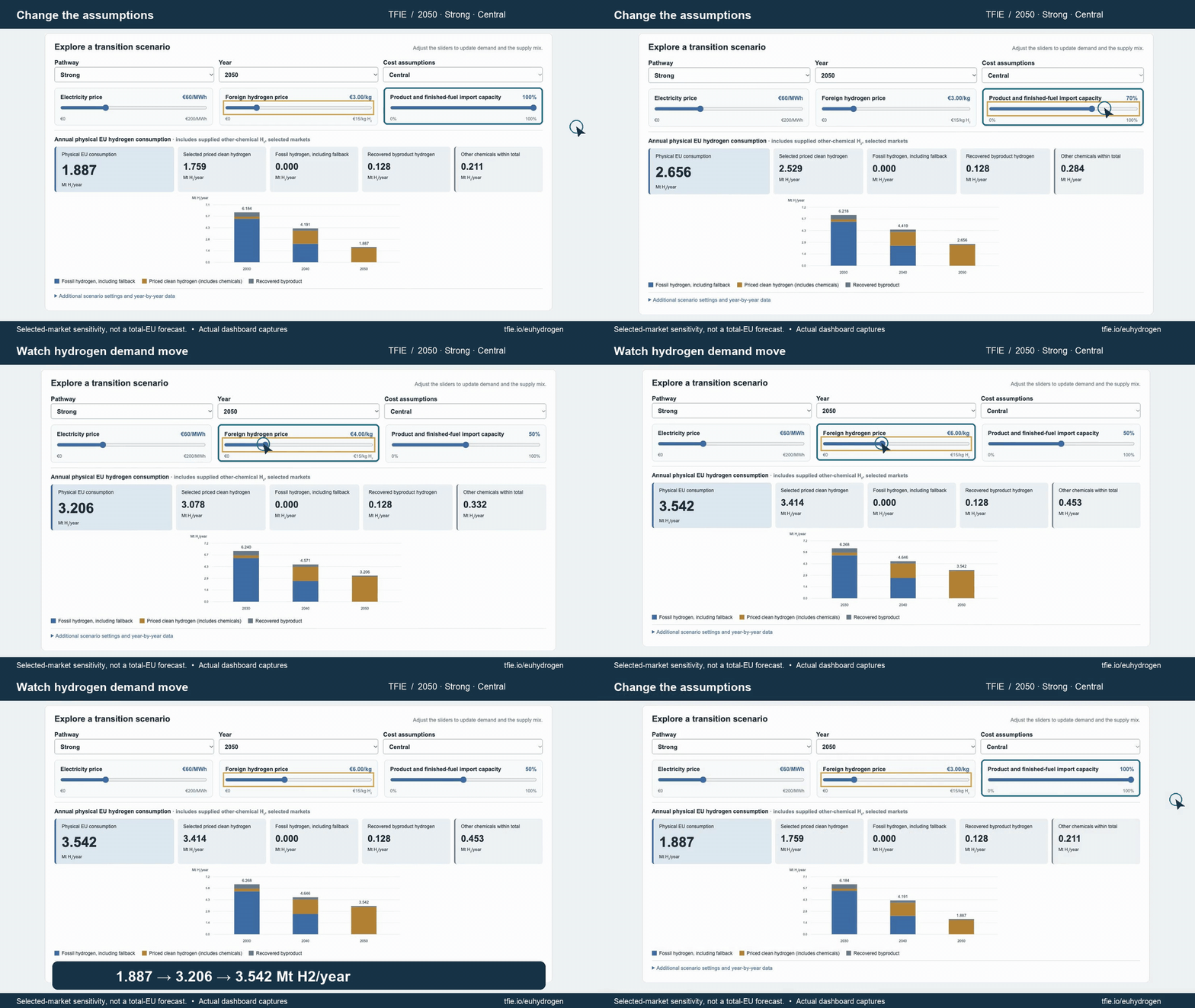
Under the Strong pathway with central costs, physical hydrogen consumption in the modelled markets reaches 6.184 million tons in 2030, 4.191 million tons in 2040 and 1.887 million tons in 2050. The 2050 total includes 1.759 million tons of clean hydrogen and 0.128 million tons of recovered byproduct hydrogen, with no fossil hydrogen supplied in those selected markets.
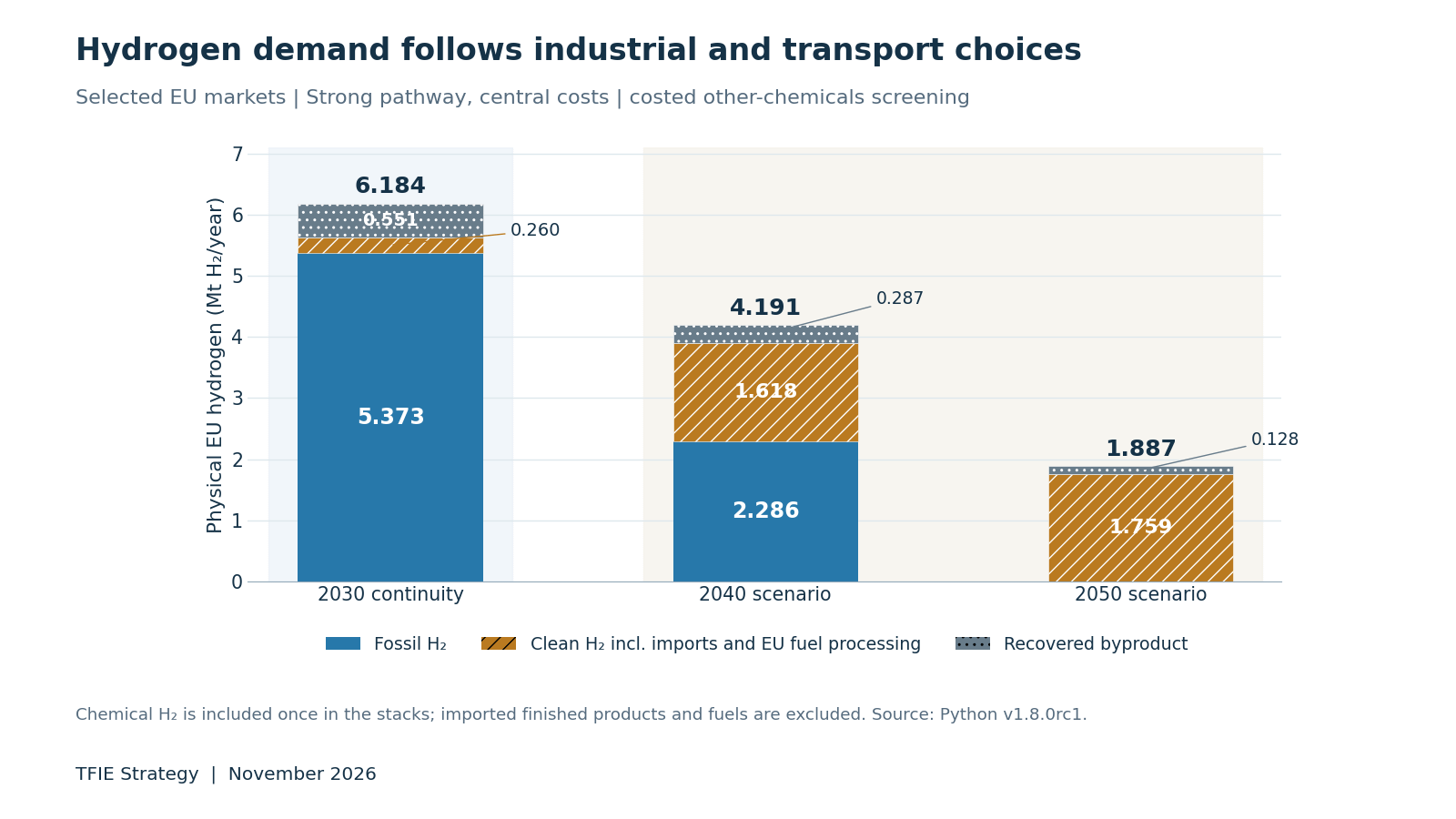
These are not forecasts of total EU hydrogen consumption. The model covers selected industrial markets and transport services, and hydrogen embodied in imported industrial products and finished fuels is excluded from physical European consumption. Its future sector coverage also differs from the observed 2024 register, so the figures cannot be combined into a single EU-wide historical trend.
The results change when competing alternatives become less available. Halving modelled industrial product-import capacity raises the 2050 hydrogen requirement from 1.887 to 3.206 million tons. Restrictions on emerging ironmaking technologies, foreign hydrogen prices and sustainable biofuel availability can increase it further. These sensitivities identify which assumptions matter, rather than treating the central case as a prediction.
Domestic production may still warrant support for reasons beyond immediate cost. Security of supply, employment, technical capabilities, environmental performance and resilience can justify retaining industries that face cheaper imports. Those benefits and their premiums should be evaluated explicitly rather than embedded in hydrogen consumption targets.
European infrastructure planners already model different industrial demand, technology and economic conditions. The additional test I have proposed for TYNDP 2028 is to compare the processes and production locations capable of supplying equivalent industrial products and transport services, then calculate the infrastructure those choices require.
A proposed hydrogen pipeline should first be assessed unchanged across policy-aligned and economic-competition scenarios. Its utilisation, customer commitments, delivered costs, tariffs, emissions and public financial exposure should be visible before considering smaller, staged or alternative investments. The competition case does not establish compliance with current EU hydrogen mandates, which require a separate policy-aligned comparison.
TFIE Strategy Inc. submitted this analysis and its technical annex to the European Commission on 11 November 2026, under feedback reference F33582541. The interactive dashboard and complete research package provide the scenario controls, evidence workbook and reproducible Python model. The work is an independent policy contribution, not a Commission-endorsed assessment.
The submission builds on years of analysing hydrogen demand, industrial competitiveness and infrastructure economics. Its additional contribution is a connected European model that lets competing production routes determine hydrogen requirements and tests what those results imply for investment.
Europe should establish which industrial capabilities it wants to retain, determine how their products can be supplied competitively, and use those requirements to guide hydrogen production and infrastructure. Building the hydrogen system around assumed demand risks committing capital to industrial choices that customers may never make.
Subscribe for the next articles in this series and more evidence-based analysis of industry, energy and infrastructure.