

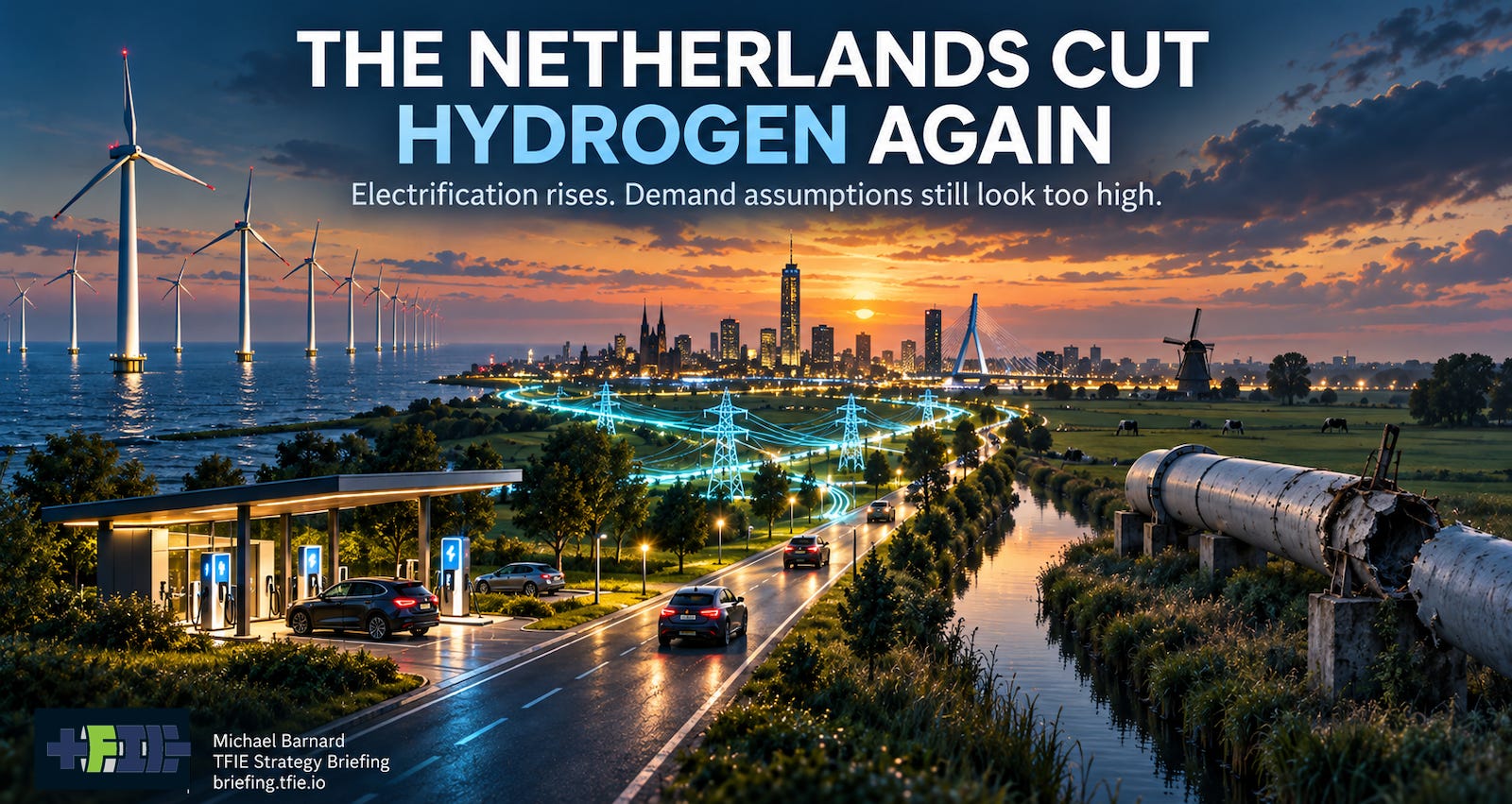
The Netherlands’ updated National Energy System Plan is a substantial correction to the assumptions that shaped its 2023 energy strategy. Direct electrification is now much more firmly at the centre of the transition. The plan’s central 2040 scenario has electricity supplying 52% of final energy, up from about 25% today, alongside rapid electrification of road transport, buildings and industry. That number needs some care because final energy is a delivery-boundary statistic, not a measure of useful energy or energy services. Electric vehicles, heat pumps and electric industrial equipment provide the same mobility, heat or work with much less final energy than combustion technologies, so 52% electricity in final energy implies much deeper electrification of the economy than “just over half” suggests.
I recently wrote about this distinction in Stop Steering With The Wrong Energy Metrics. Primary energy measures energy entering the system, final energy measures what reaches the user, and useful energy measures what actually performs the work. Michael Liebreich has made the same point in discussing Europe’s electrification targets. On his illustrative efficiency assumptions, an electricity share of 46% in road-transport final energy corresponds to roughly 80% of the vehicle fleet being electric, while the same final-energy share for space heating implies roughly three quarters of heat being supplied by heat pumps. The Dutch 52% figure is therefore not a modest halfway point. It is consistent with a system in which most of the readily electrifiable energy services have already shifted to electricity.
The NPE’s own sector assumptions support that interpretation. It expects 71% to 88% of road transport activity to be electric by 2040 depending on vehicle class, about 64% of households to use an all-electric or hybrid heat pump, and industrial electricity consumption to rise by roughly 35 TWh. The plan also recognizes the efficiency effect explicitly: final energy demand falls sharply in transport because electric drivetrains waste much less energy, while heat pumps reduce the amount of centrally supplied final energy needed by harvesting ambient heat. If ambient and geothermal heat enabled by electrification are added to the accounting, the plan’s 52% figure rises to 63%, although that still is not a complete useful-energy measure.
Against that increasingly electric system, the hydrogen correction is striking. The 2023 plan envisaged about 460 PJ of gaseous hydrogen demand in 2040. The new central case is about 200 PJ, a reduction of roughly 57%. Hydrogen largely disappears from the 2040 power-generation outlook because using it for dispatchable electricity is extremely expensive. Low- and medium-temperature industrial heat shifts toward direct electrification. Buildings get essentially no hydrogen beyond pilots. Direct hydrogen use in road transport, aviation and shipping is reduced to a few PJ. Hydrogen use in steel moves later and competes with green gas and imported iron. Large-scale Dutch production of synthetic fuels gives way increasingly to imports of energy-rich intermediates and finished fuels from regions with cheaper renewable electricity.
These are meaningful corrections, and the Netherlands deserves credit for making them. The plan explicitly says hydrogen is too expensive to serve as either a temporary or structural alternative to electrification for low- and medium-temperature process heat. Its own cost history explains much of the reassessment. Earlier analyses entertained renewable hydrogen around €1.70 to €4.70 per kilogram around 2030. The NPE now cites Dutch bids into the first European Hydrogen Bank auction averaging €9.80 per kilogram and 2040 estimates from CE Delft and PBL of about €6.70 to €6.80. Expectations for rapid cost declines have not survived contact with actual projects, financing costs, balance-of-plant requirements and North-West European electricity prices.
There is also a denominator problem hidden in those PJ numbers. As I argued in Hydrogen Is A Tonnes Market, hydrogen should generally be counted first as a physical commodity, not as an energy market. PJ is useful for balancing an integrated energy system, but ammonia plants, refineries and chemical facilities buy and consume hydrogen by mass. The more informative denominator is tonnes of H₂ per year. On a lower-heating-value basis, the Dutch plan’s roughly 130 PJ of current demand is about 1.1 million tonnes of hydrogen per year, 200 PJ in 2040 is about 1.7 million tonnes, and the old 460 PJ vision was about 3.8 million tonnes. In reality, hydrogen shouldn’t be in an energy plan except for the energy required to make it.
The bigger question is not how far the Netherlands has already cut its hydrogen expectations, but what happens when the remaining assumptions are tested against the markets that must actually buy the molecule. Below the paywall I unpack the missing downside case, the EU policy change that could remove part of the mandated demand, and why the national hydrogen backbone may be sized for customers that never arrive.
