

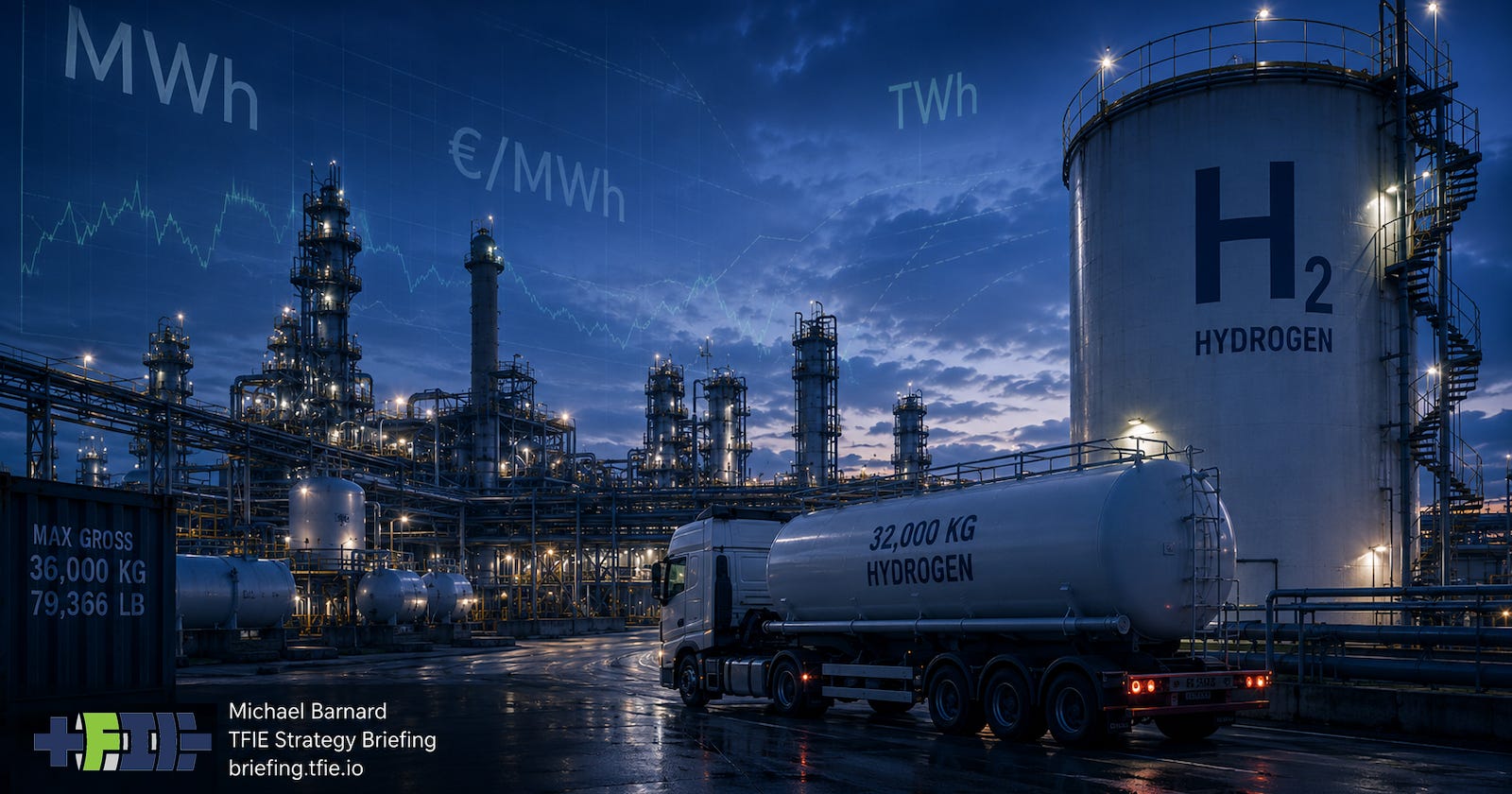
Global hydrogen demand exceeded 100 million tonnes in 2025, and almost all of it was still consumed in the same places hydrogen has been used for decades: refining and industry. Even the IEA’s latest hydrogen-demand accounting, despite projecting a considerably larger future role for hydrogen than I do, describes the existing commodity principally in millions of tonnes and shows refining and industrial uses continuing to dominate demand. Low-emissions hydrogen remains tiny by comparison. The reason the mass unit fits so naturally is straightforward: an ammonia plant, refinery or methanol plant does not buy an abstract quantity of energy called hydrogen. It buys a chemical feedstock by mass and uses the molecule in a specific industrial process.
A 2023 article of mine argued that expressing hydrogen in MWh and TWh was distorting energy-transition discussions. There is a technical qualification worth making. A megawatt-hour is dimensionally a unit of energy, so hydrogen’s heating value can certainly be converted into MWh without violating physics or mathematics. The analytical problem starts when dimensional validity is treated as though it made the choice of unit neutral. Electricity is overwhelmingly generated, traded, stored and consumed in kWh, MWh and TWh, while hydrogen is overwhelmingly manufactured, transported and consumed as kilograms and tonnes of an industrial molecule. Putting both into the language of MWh encourages a comparison between energy commodities before hydrogen has demonstrated that it has won the energy markets being imagined for it.
Natural gas is an imperfect analogy because its economic purpose is much more closely tied to its chemical energy. Buyers overwhelmingly want gas for heat or for conversion into electricity and mechanical work, which makes calorific units closely related to the service being purchased even though volume and mass remain important. Hydrogen’s present market has a different structure. Ammonia producers need hydrogen atoms, refineries use hydrogen for desulfurization, hydrocracking and hydrogenation, and methanol and other chemical processes consume it as feedstock. Those industrial balances naturally resolve into kilograms and tonnes because that is what plant capacity, contracts, process ratios and physical deliveries are built around. Converting the same flows into TWh can be mathematically clean while making the economic role of the molecule less clear.
This sits beside a denominator problem I addressed recently in Stop Steering With The Wrong Energy Metrics. That assessment separated primary energy, final energy and useful energy because they describe different boundaries in the energy system: raw supply entering the system, energy crossing the customer boundary, and the heat, motion, light or work the economy ultimately receives. The hydrogen problem begins one step earlier. Before choosing among energy denominators, it is worth asking whether the commodity being discussed is principally an energy commodity at all. Hydrogen overwhelmingly is not today, and kilograms and tonnes describe its industrial market more directly than MWh or TWh.
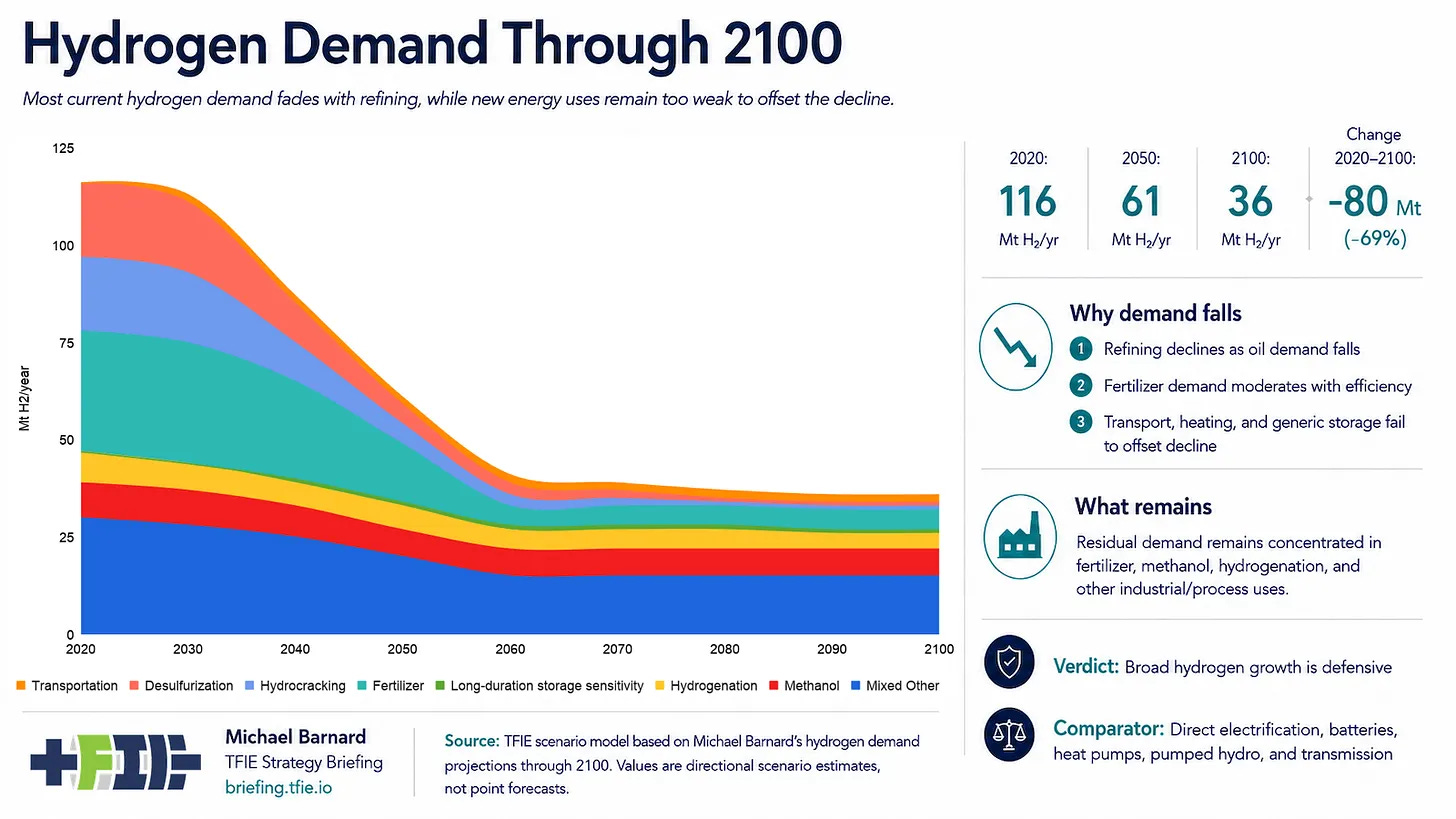
That distinction has become more important as the hydrogen-for-everything narrative has collided with actual deployment. My current Hydrogen Demand Will Shrink, Not Become The New Oil model begins with existing commodity demand and then asks what survives the transition rather than allocating hydrogen into imagined future sectors first. It has global demand at about 116 Mt H₂/year around 2020, declining to roughly 61 Mt around mid-century and about 36 Mt by 2100 as refinery-linked demand falls and proposed transport, heating and generic-storage uses fail to grow enough to replace it. The remaining pool is concentrated in fertilizer, methanol, selected industrial chemistry and residual refining rather than a broad new fuel economy.
The deeper problem with high-hydrogen scenarios is not simply the unit printed on the axis. A hydrogen application is not automatically a hydrogen market. Space heating belongs to a heat market, electricity generation belongs to electricity and capacity markets, and grid storage belongs to flexibility and reliability markets. Hydrogen can compete as an input to any of them, but additional hydrogen demand exists only after customers in those markets choose it over the alternatives. Starting with a modeled number of TWh reverses that causality by assuming the application first and calculating the molecule afterward, which can make an allocation exercise look much more like demonstrated market formation than it really is.
Below the paywall, the analysis turns from the unit question into the decisions different audiences actually have to make. Investors get a way to distinguish real hydrogen demand from modeled or policy-created demand by following tonnes, offtake quality, utilization and the economics of the market hydrogen is trying to enter. Policymakers get a clearer basis for setting targets around physical demand and useful services instead of headline TWh allocations that can smuggle assumptions into the denominator. Analysts and strategists get the EEX and EIA cases as concrete examples of how unit choices and accounting boundaries can reshape the story without changing the underlying physical system, along with a practical rule for choosing metrics that match the market or service being evaluated. The value is not in proving that hydrogen can be converted into MWh; it is in knowing when that conversion clarifies a decision and when it quietly manufactures a market that does not yet exist.
