

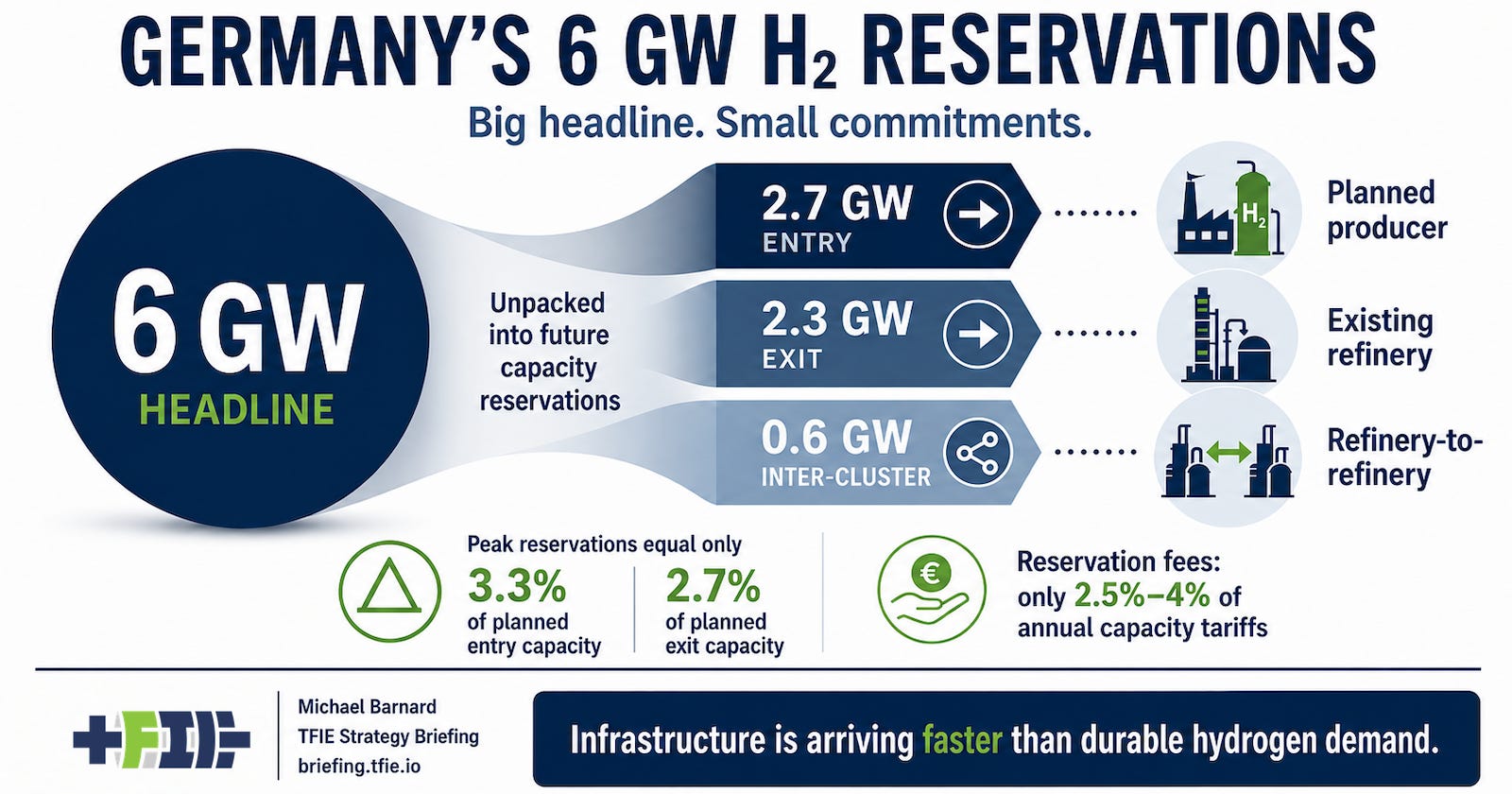
Germany’s hydrogen network operators have something they can finally point to as evidence of customers. On August 4, FNB Gas announced that companies had made paid reservations for just under 6 GW of entry and exit capacity on the emerging hydrogen core network. Another roughly 0.6 GW of inter-cluster transport capacity had been reserved, with about 0.5 GW more under review. FNB Gas managing director Barbara Fischer called the reservations and associated willingness to pay a strong indication that the hydrogen economy was gathering momentum.
The number sounds much more substantial than the underlying commitments. FNB’s own figures show roughly 2.7 GW of entry reservations and 2.3 GW of exit reservations around 2030, with about 0.54 GW of inter-cluster transport reported separately. By 2034, entry reservations rise to roughly 3.3 GW while exit reservations remain around 2.3 GW. Adding entry and exit is legitimate network-capacity accounting, but it is not the same thing as measuring hydrogen demand. Hydrogen injected at one point and withdrawn somewhere else can appear once as an entry reservation and again as an exit reservation. The nearly 6 GW headline therefore does not mean that customers have committed to consuming, producing or even transporting 6 GW of hydrogen.
The near-term denominator is useful because it avoids comparing early reservations only with the much larger completed network. Around 2030, FNB reports approximately 10.7 GW of entry capacity and 8.8 GW of exit capacity still available in addition to the roughly 5 GW already reserved. On that basis, about 20% of the entry-plus-exit capacity currently being offered around 2030 has been reserved. That is a meaningful expression of interest in a network being deliberately built ahead of demand, but it is a long way from evidence that the network is filling up.
The eventual scale is much larger. Germany’s approved Hydrogen Core Network is 9,040 km long, carries an estimated investment cost of €18.9 billion and is designed around approximately 101 GW of entry capacity and 87 GW of exit capacity by the early 2030s. Against those design numbers, the current peak reservations amount to roughly 3.3% of planned entry capacity and 2.6% of planned exit capacity. The comparison is not intended to suggest that an infrastructure system should be fully subscribed years before completion. It does show how premature it is to present the current reservation round as confirmation of the large hydrogen economy around which the network was designed.
More importantly, these are reservations rather than normal long-term capacity bookings. ONTRAS allows customers to reserve future hydrogen capacity for as long as seven years where the physical connection is not yet ready for ordinary booking. The reservation does not automatically become a capacity contract. Customers later decide whether to make an actual booking once the relevant infrastructure becomes available.
The amount of money at risk is correspondingly modest. ONTRAS charges 2.5% of the applicable annual hydrogen capacity tariff, with a €12,000 annual minimum. GASCADE has set its reservation charge at 4% of the annual tariff. In the ONTRAS system, as much as 100% of the reservation payments can later be credited against actual capacity bookings if the required conditions are met. These are not free expressions of interest, but they look much more like inexpensive options on future infrastructure than commitments to use that infrastructure at scale.
TotalEnergies’ reservation for its Leuna refinery makes the difference tangible. The company has reserved up to 500 MWh/h, effectively 500 MW, of hydrogen exit capacity from 2030. Using the current regulated hydrogen ramp-up tariff of €25 per kWh/h per year, actually booking 500 MW for a year would carry a capacity charge of roughly €12.5 million. At ONTRAS’s 2.5% reservation rate, preserving the option on that amount of capacity costs about €312,500 per year, potentially creditable against a later booking.
Five hundred megawatts would represent a large hydrogen stream if it were ultimately booked and used continuously. At hydrogen’s lower heating value, 500 MW corresponds to about 15 metric tons an hour, or roughly 131,000 metric tons a year at 100% utilization. But TotalEnergies has not agreed to buy or consume 131,000 metric tons of hydrogen every year. It has reserved the right to withdraw up to that rate in the future for a few hundred thousand euros annually under the current tariff structure. That is sensible risk management for a major refinery facing uncertain hydrogen policy, supply and economics. It is much weaker evidence than a long-term hydrogen offtake agreement.
The concentration is also striking. TotalEnergies’ single 500 MW reservation represents roughly 22% of the approximately 2.3 GW of German exit capacity reserved around 2030. In the eastern cluster containing Leuna, FNB’s published chart shows only about 620 MW of exit reservations. On those aggregate figures, the Leuna refinery appears to account for roughly four-fifths of the cluster’s total reserved withdrawal capacity. FNB intentionally aggregates some reservation data to protect commercial confidentiality, so that cluster comparison is an inference rather than a disclosed customer ledger, but the national 500 MW figure alone demonstrates how much of the headline can come from one existing industrial site.
That matters because Germany already has hydrogen infrastructure waiting for customers. GASCADE finished converting and filling roughly 400 km of former natural-gas transmission pipeline with hydrogen in December 2025, making the first major section of its Flow network available to the market. More of the national backbone is under construction or development. As of this writing, I can find no publicly identified commercial end-user flow on that first 400 km section.
The publicly announced reservation at Lubmin reinforces rather than resolves the problem. WAL, backed by H2APEX and Copenhagen Infrastructure Partners, plans an electrolyzer starting at 100 MW with ambitions to expand to 600 MW. It has reserved an undisclosed quantity of entry capacity on GASCADE’s network. But WAL is a prospective producer, not an end user, and its announcement describes the reservation as allowing planned hydrogen production to connect with potential customers. A producer preserving future access to an already operational pipeline while developing both the plant and its market is evidence of project activity. It is not evidence that substantial hydrogen demand has arrived on the pipeline.
The identifiable withdrawal customers tell a more interesting story. TotalEnergies wants hydrogen delivered to Leuna, an existing refinery that already uses hydrogen for hydrocracking, desulfurization and related processes. BAYERNOIL has reserved capacity in Bavaria specifically for hydrogen transport between its Vohburg and Neustadt refinery sites. The two sites already operate as an integrated refinery complex, and BAYERNOIL is developing a 125 MW electrolyzer at Neustadt to replace part of its existing fossil hydrogen production.
This is exactly the sort of role in which a hydrogen pipeline can make practical sense. Instead of every refinery or chemical site maintaining all of its own hydrogen-production capacity, a network could allow production to be concentrated where it is cheapest, move lower-emissions hydrogen between industrial sites, connect large producers to several consumers and allow existing steam methane reformers to be retired. That would create a more merchant-oriented industrial hydrogen market from what is still largely captive production today.
What it would not necessarily create is much new hydrogen demand. BAYERNOIL itself says that as fossil fuel production declines, its hydrogen requirements for refinery processes are expected to decline as well, potentially leaving more of its renewable hydrogen available for other customers. The network can therefore become more important to the way hydrogen is supplied even while the underlying refinery hydrogen market contracts.
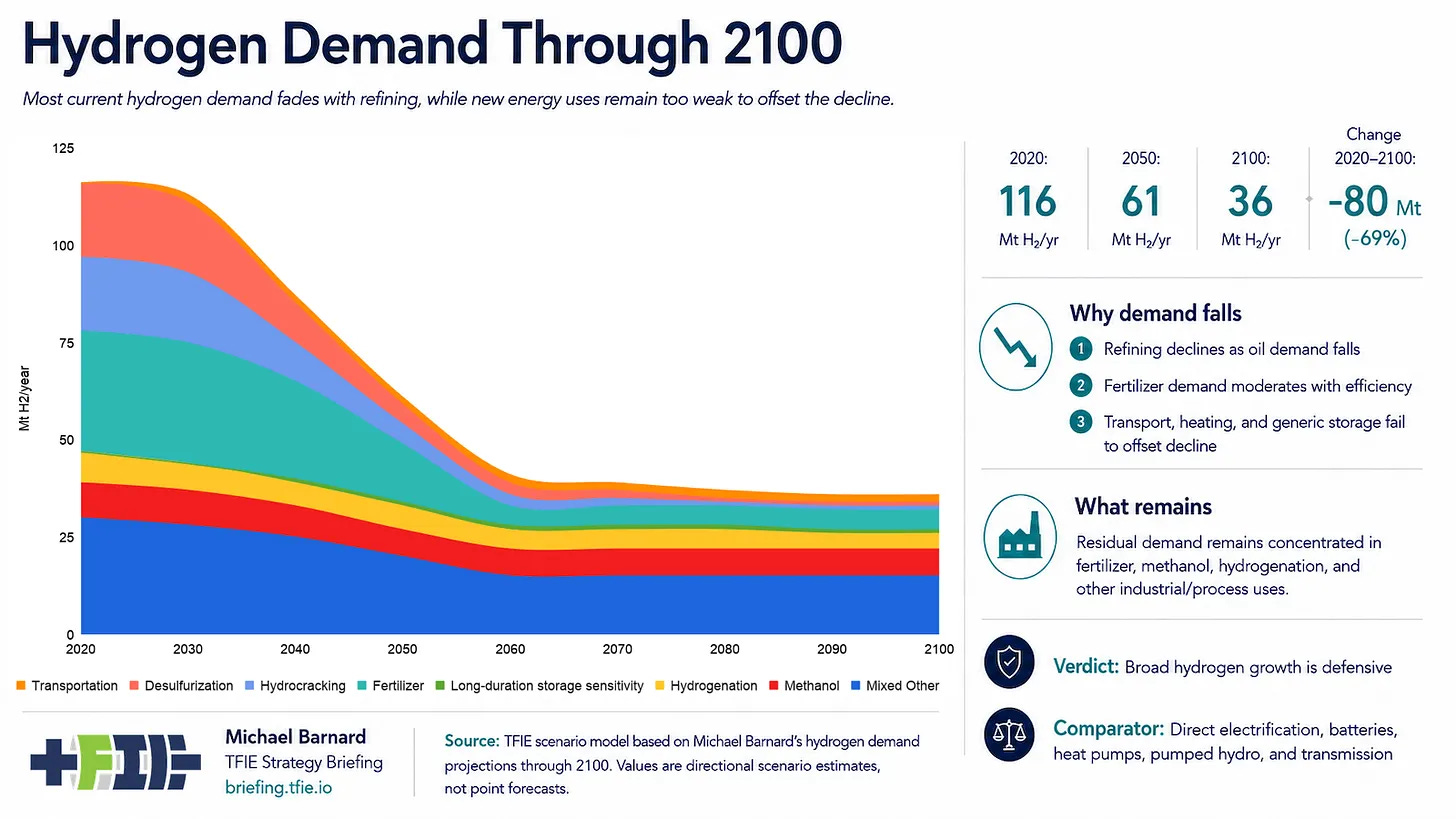
That is consistent with the demand structure I have been modeling for several years. Hydrogen today is not an energy market waiting to expand into trucking, heating, electricity storage and general industrial combustion. It is an industrial feedstock and process market concentrated in refining, fertilizer, methanol and related chemistry. Refinery demand declines with oil demand, while fertilizer, methanol and selected industrial chemistry leave a smaller residual market that still needs to be cleaned up. My current projection starts at about 116 million metric tons of hydrogen demand in 2020, falls to roughly 61 million around mid-century and reaches about 36 million by 2100. The surviving demand remains concentrated in applications where hydrogen is chemically useful rather than where it is an alternative energy carrier.
Germany’s policy deserves one important caveat. The core network is intentionally being constructed ahead of demand to address the familiar infrastructure chicken-and-egg problem. A new network should not be expected to operate at mature utilization immediately, and early capacity reservations are useful signals about where producers and consumers might eventually connect.
But building ahead of demand makes the quality of those demand signals more important, not less. So far, Germany has a 400 km hydrogen-filled pipeline already available to the market, thousands more kilometers planned or under development, roughly €18.9 billion of anticipated network investment, and reservations covering only a fraction of the capacity being offered. The reservations themselves require only a few percent of the eventual annual capacity tariff, can remain options for years, and in some cases can be credited back if the customer proceeds.
Most revealingly, the named customers look much more like the hydrogen market that already exists than the much broader market the backbone was designed to enable. A refinery wants lower-carbon hydrogen delivered. Another refinery operator wants flexibility to move hydrogen between existing sites. A prospective producer wants network access while it develops its customer base. Those are credible industrial use cases, and a pipeline network may serve them well. They are not evidence that hydrogen is becoming a new general-purpose energy carrier.
The nearly 6 GW announcement is therefore useful, just not quite in the way the hydrogen industry is presenting it. Germany is beginning to reveal the shape of an actual hydrogen market. At present, it looks smaller, more industrial and much more closely tied to existing feedstock demand than the scale of the infrastructure would suggest.
Subscribe to TFIE Briefing Strategy for denominator-led assessments of transition deployment, not industry fluffing.