

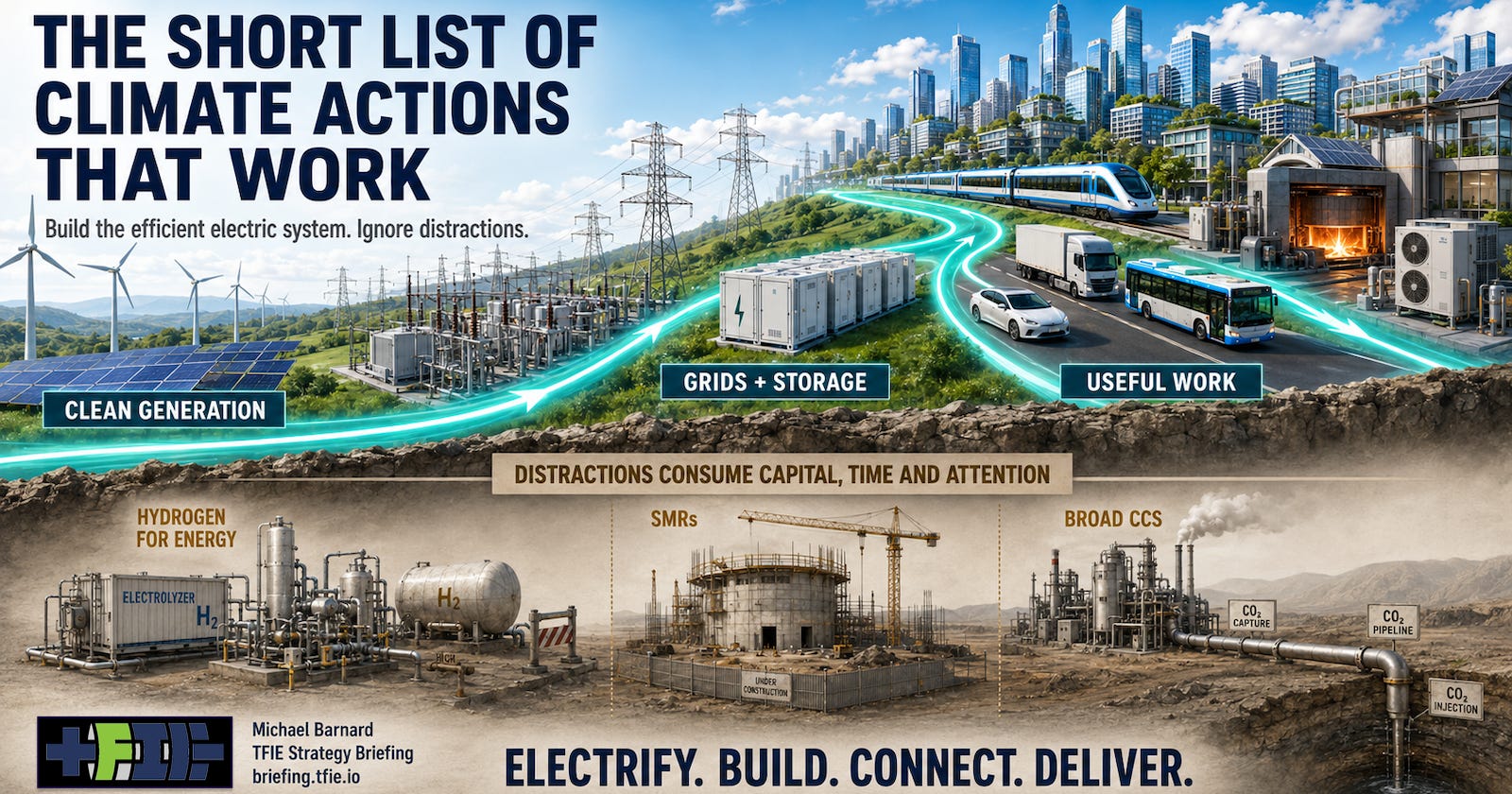
Climate strategy does not need a longer list. Governments, investors and utilities still behave as though they face a broad menu of equally plausible technologies, but physics, delivered cost and operating evidence have already removed much of that apparent choice. The uncertainty lies less in what must be built than in whether institutions will build it quickly and stop giving central-pathway status to options that postpone difficult decisions.
Electrify everything. The first mistake in most energy forecasts is counting fuel instead of useful work. Economies do not need barrels of oil, tonnes of coal or cubic metres of gas; they need mobility, heat, light, refrigeration, data processing and industrial production. Combustion systems deliver those services while discarding much of their input energy as heat. Electric vehicles, heat pumps and electric industrial equipment remove many of those losses, allowing an electrified economy to provide the same or greater useful work with a much smaller primary-energy system.
This is also why clean molecules shrink toward the jobs where molecules are actually required. Turning electricity into hydrogen, moving and storing it, and then converting it back into useful work rebuilds much of the waste that electrification removes. Synthetic fuels add more conversion steps again. They remain relevant for a limited set of chemical, aviation, maritime and reserve applications, but they are poor general substitutes for electricity. The useful comparison is the service delivered by the complete system, not whether a fuel can technically be made to work.
Overbuild renewable generation. A clean grid should produce more annual electricity than average demand requires because a system designed around variable wind and solar needs spare generation, curtailment and geographic diversity. In my base case, renewable overbuild is around 25%. That is ordinary system design: it buys resilience, abundant low-marginal-cost electricity and better use of storage and transmission without the fuel costs and emissions attached to combustion assets.
Curtailment is often treated as waste. The better comparison is with every other infrastructure system that carries reserve capacity for peak conditions, maintenance and uncertainty. Fossil systems already maintain underused plants, pipelines and fuel inventories. A renewable asset producing less than its theoretical maximum can still make the wider system cheaper and more reliable.
Build continent-scale grids. Weather systems, demand peaks and high-quality renewable resources do not respect utility territories or national borders. High-voltage direct-current transmission and coordinated electricity markets allow one region’s wind, hydro or solar surplus to serve another region’s shortage, reducing reserve requirements and making expensive local scarcity less frequent. This is why HVDC is the new pipeline: it moves useful energy directly without creating a parallel fuel chain.
Rooftop solar, local batteries and microgrids improve resilience at the edge, but they do not replace the bulk network required to balance cities, industry and regional weather. The grid is both large and distributed; treating those scales as competitors leads to underbuilding both.
Build storage and flexibility. Batteries are now the central manufactured storage technology because deployment speed, falling cost and factory scale are pushing them into duration bands that other technologies expected to own. Global additions reached 108 GW in 2025, while stationary battery packs fell to about $70/kWh. Pumped hydro remains the long-life bulk anchor where geography, transmission, permitting and patient capital allow large civil works. Flow batteries retain a secondary role, while other long-duration concepts still have to earn large allocations through repeat projects, bankable warranties and operating fleets.
The grid does not need one storage technology to solve every hour of every year. Transmission moves electricity through geography. Flexible demand moves charging, water heating, cooling, pumping and some industrial production through time. Seasonal thermal storage shifts heat without converting it into electricity twice, while strategic reserves can cover rare multi-day events without becoming daily cycling assets. The current TFIE storage pathway is batteries-led and pumped-hydro anchored, but its more important judgment is that storage should not solve problems other reliability resources handle better.
Use less material and close the loops. Heavy industry becomes easier to decarbonize when demand forecasts stop assuming that the world will repeat China’s infrastructure and property buildout. The rest of the world is unlikely to repeat that first-build intensity. Slower growth in virgin-material demand, longer-lived assets, reuse and better design reduce the industrial problem before a new process is selected.
Steel, cement and chemicals still require major changes. Electric-arc furnaces, more scrap, electric process heat, lower-clinker cement, alternative binders and better product design already have large roles. Direct reduction, electrolysis, alternative chemistries and selective low-carbon molecules will compete across different products, resources and geographies. The pathway is a portfolio of demand reduction, electrification, recycling, process substitution and narrower molecule use, not a universal breakthrough process.
Fix agriculture. Better nitrogen management, precision application, nutrient recycling, improved livestock and manure practices, methane control and soil management can cut emissions without pretending that one drone, microbial product or farming label solves the sector. The relevant denominator is delivered food and agricultural value, not fertilizer tonnes or livestock numbers preserved unchanged. Good policy rewards lower emissions and nutrient losses per unit of output while respecting local crops, soils and farm economics.
Restore nature. Reforestation, wetlands, peatlands and grassland restoration are necessary for biodiversity, water, resilience and long-term carbon removal. Their climate timing differs from rapid cuts to fossil carbon and methane, so restoration should proceed in parallel rather than becoming an excuse for another decade of combustion.
Cut methane and refrigerants quickly. Fossil methane leakage can be detected and eliminated, waste methane can be captured where practical, and agricultural methane can be reduced through feed, manure and production changes. The Kigali Amendment is driving the phase-down of high-global-warming-potential refrigerants. These measures are narrower than the power-system transformation, but they can reduce near-term warming while grids, transport and industry take longer to rebuild.
Price carbon and stop subsidizing fossil expansion. Carbon pricing, border adjustment and the removal of fossil subsidies change the economics of millions of investment and purchasing decisions. The European Union’s Carbon Border Adjustment Mechanism entered its definitive regime in 2026, extending the carbon-cost signal into covered imports. Carbon pricing does not replace transmission planning, public infrastructure, permitting reform or industrial policy. It makes them more coherent by stopping governments from treating emissions as free while subsidizing new extraction and fuel use.
Retire fossil assets strategically. Generation can fall much faster than nameplate capacity as wind, solar, storage and transmission expand. The least efficient, most polluting and worst-sited coal and gas plants should close first, while a shrinking set of assets may remain temporarily for rare reserve events. Governments and regulators should decide how that reserve will be paid for and retired rather than allowing underused fossil fleets to manufacture revenue through unnecessary generation.
A managed transition needs retirement schedules, reserve contracts, remediation obligations and limits on new capital expenditure. Otherwise yesterday’s reliability asset becomes tomorrow’s claim for continued fuel consumption.
Ignore distractions. A proposed climate solution belongs on the central pathway only when it performs a necessary job better than practical alternatives, reaches competitive delivered system cost, scales through available supply chains and institutions, shows repeat procurement and operating evidence, and arrives within the emissions timetable. Solutions have to survive physics, the real comparator and adoption. A technical milestone is evidence of technical progress, not evidence that a pathway deserves central-policy status.
Existing nuclear plants can remain useful low-carbon assets, but most proposed new nuclear construction and small modular reactors compare poorly with renewables, grids and storage on cost and construction speed. Hydrogen as a feedstock remains necessary for fertilizer, methanol and selected industrial processes, but performs poorly as a transport, heating or power pathway. Synthetic fuels belong behind direct electrification and constrained sustainable biofuels. Carbon capture will be of value for pure streams of biogenic CO2 out of industrial processes, but broad capture and direct air capture do not justify preserving fossil combustion near current scale.
The point is not to ban research or deny every niche. It is to stop confusing a technically possible residual role with a central climate strategy. Capital, policy attention and institutional capacity are finite, and weak pathways impose opportunity costs even when their individual projects appear small.
The climate transition does not require every government, investor or utility to agree on a single technology. It does require a hierarchy. Some solutions are already scaling and belong on the central pathway. Others perform residual jobs and should receive capital in proportion to those jobs. A third group remains expensive, slow or weakly evidenced but continues to occupy policy attention because it protects incumbents or promises change without institutional disruption. The short list is short because the relevant comparisons have already removed much of the apparent choice. The remaining work is delivery: grids, factories, permitting, procurement, carbon prices and public institutions aligned around the options that can displace emissions at scale.
Subscribe to TFIE Strategy Briefing for evidence-led transition pathways, technology diligence and decision context for infrastructure, policy and investment.
Variations of this piece have appeared several times since I first published it in 2019.
"Economies do not need barrels of oil, tonnes of coal or cubic metres of gas; they need mobility, heat, light, refrigeration, data processing and industrial production."
This is exactly the same paradigm shift or acknowledgement that led us to revolutionize thd broadband space in the mid-90's. People only asked for channelized type services (ISDN, T1) because that's what the telco's offered while making huge profits on established regulated infrastructure.
We said "Nope, people don't want 64 kbps, they want to connect data, voice, and even video". So we built an ATM/Ethernet Fibre optic network instead and delivered 10 Mbps for the same cost as 64 kbps. The customer routers were actually cheaper because they were more simple.
This infrastructure topology laid the groundwork for the high-speed data y'all enjoy today. U R welcome.
Sorry to post twice as it looks like "fan boying" but there is a direct example central to the essay theme (which was very good, so there's your fan-boy plug).
How to double your grid capacity without doubling the plant size? (Wires, stations, etc). HVDC Topology Overlay (HOT).
Increasing electricity capacity into populated regions are usually constrained, and expensive, at the bulk energy and regional transmission level. The high voltage part no one ever sees unless passing by a substation. (Like Danbury, CT where the local nature trail literally runs right along the substation fence). If the bulk energy transmission can be superseded with a core HVDC system delivering twice the capacity - for a number of reasons, some of it complex - the existing AC components can be repurposed to deliver twice the capacity to the regional transmission system.
The distribution system is upgraded on a local as-needed basis. These are much smaller and more capital planning flexible endeavors. HVDC can run in underground cable systems so more overhead transmission lines are not necessarily required.