

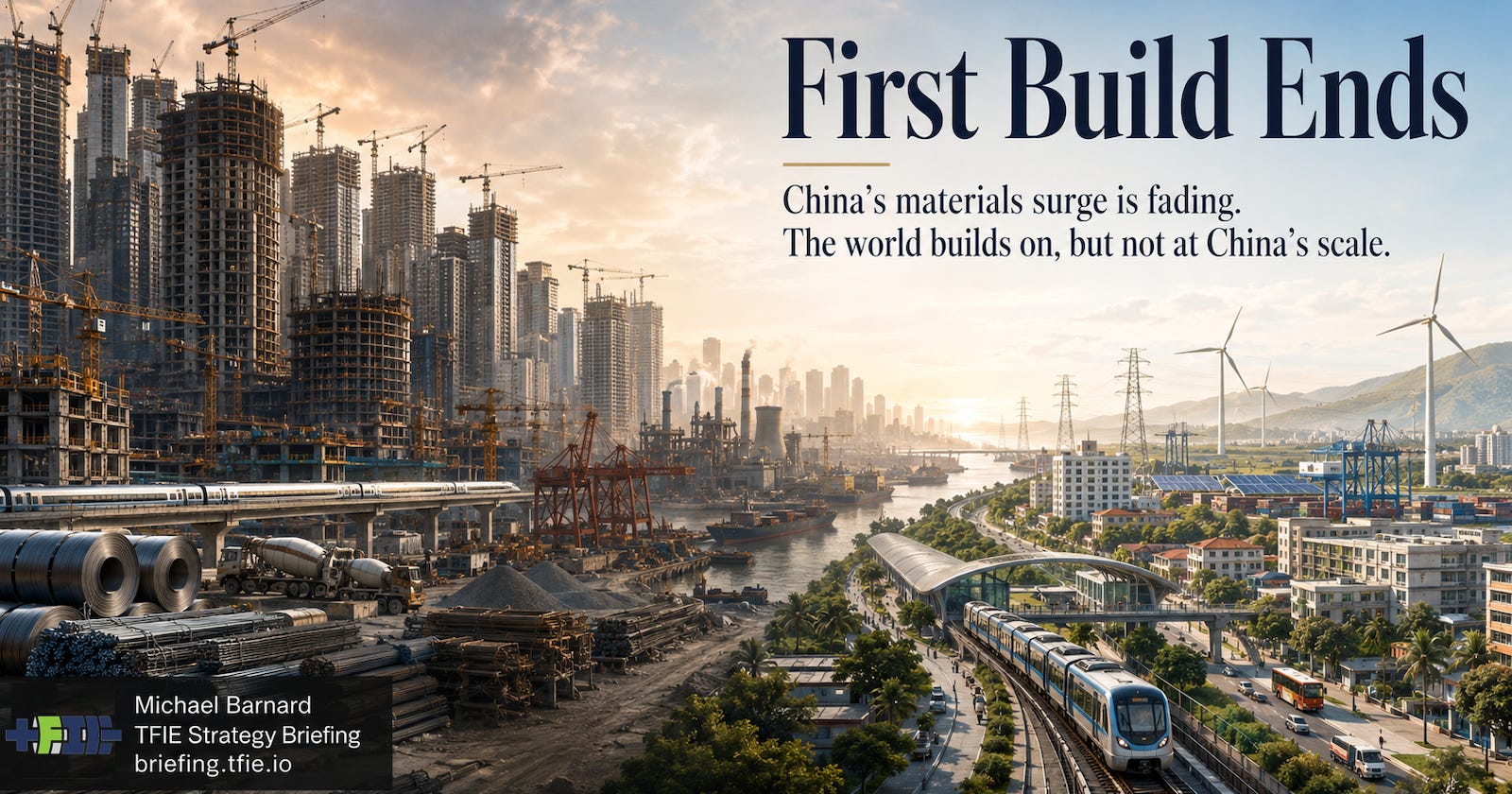
One of the easiest ways to get 2100 wrong is to treat first-build infrastructure demand as a permanent condition. Countries build their first stock of housing, highways, ports, rail, power systems, water systems, industrial parks, and concrete-and-steel cities once. After that, the demand structure changes. The economy still needs capital, labor, materials, maintenance, replacement, retrofits, resilience, and selective expansion, but it no longer behaves like a country building its first modern physical economy from a much lower base.
This is not theory. It is visible in the materials data. China has been the dominant denominator for steel, cement, coal-linked industrial demand, iron ore shipping, construction equipment, and much of the global bulk materials system. It still accounts for roughly half of global steel and cement markets, but the infrastructure and property cycle that created that position is now in decline. When a country that large moves from first-build acceleration to saturation, overbuild, and contraction, it is not a regional detail. It changes the global denominator.
China’s construction surge was historically unusual. It combined enormous rural-to-urban migration, state-directed finance, export-led manufacturing, local government land revenues, very high savings, coal-based heavy industry, rapid infrastructure permitting, and a property sector that became a central economic engine. The result was the most material-intensive development pulse in human history. Steel mills, cement kilns, iron ore mines, coal mines, bulk carriers, ports, and construction equipment makers all scaled around it. For a long period, China did not merely participate in global materials demand. It largely set the direction of it.
That cycle is no longer expanding. China has already built an enormous amount of urban housing and infrastructure, its population has peaked, household formation has slowed, and a lot of built stock is in the wrong financial or geographic position. Real estate starts, floor space under construction, land sales, developer balance sheets, and buyer confidence have all moved away from the old growth regime. Some of that is cyclical, but the deeper issue is structural. Building more of the same is no longer a clean development story.
Steel makes the scale obvious. China produced 960.8 million tonnes of crude steel in 2025, while India produced 164.9 million tonnes. India is now the second-largest steel producer and is growing quickly, but its crude steel output is still only a fraction of China’s, roughly 17% of China’s 2025 production. That denominator matters. A high growth rate from India is important, but a decline from China is larger in absolute terms because China’s base is so much bigger. Percentages are useful until they hide the denominator, at which point they become a polite way to mislead yourself.
Cement tells the same story in blunter form. China represented 51% of global cement production in 2022, after years of even higher dominance during its construction peak. Cement is the material of first-build urbanization: foundations, towers, roads, bridges, metros, ports, dams, water systems, and industrial parks. When China’s cement demand rolls over, there is no obvious second China waiting to absorb the same global share.
That is the part many long-range scenarios still miss. They look at population and GDP in India, Indonesia, Africa, and Latin America, then assume material intensity will follow the Chinese pattern. Some material growth will. Developing countries need housing, power, transport, water, sanitation, ports, industry, and public infrastructure. But the development pattern is already more infrastructure-light in many places than China’s was at the same income stage. More of the economy is services. More of the growth is digital. Urbanization is occurring under different demographic conditions. Clean electricity, distributed energy, efficient equipment, modular systems, and better logistics are already available. Capital is more constrained. Climate risk is more visible. No other country has China’s combination of scale, state capacity, industrial concentration, land finance, and manufacturing export dominance.
India is the important counterexample, because it is large, still growing, and still underbuilt in many areas. It needs massive investment in rail, metros, roads, ports, electricity, renewables, transmission, housing, water, sanitation, factories, logistics, and data centers. That is real demand. But India is not China in 2005 with a different flag. Its urbanization pattern, land politics, federal structure, services share, manufacturing position, capital constraints, and infrastructure delivery model are different. It will use a great deal of steel and cement. It is unlikely to recreate China’s share of global materials demand.
The same logic applies elsewhere. Indonesia matters, but its population, geography, and industrial base do not make it a second China. Latin America has substantial existing urban and infrastructure stock, so much of its task is maintenance, resilience, transit, clean power, water, housing quality, and selective new build. Africa is the largest high-side uncertainty because of population growth, infrastructure gaps, and urbanization, but the relevant question is whether it produces a China-scale material pulse large enough, fast enough, and fossil-heavy enough to offset China’s decline, OECD maturity, recycling, and more infrastructure-light development elsewhere. That is a high bar. While Africa will develop, it won’t do it at China’s frenetic pace.
The stock distinction is the discipline. First-build demand adds stock. Mature demand manages stock. In first build, material demand comes from additions: new towers, roads, ports, factories, grids, water systems, and industrial districts. In mature systems, demand comes from replacement cycles, utilization, retrofits, resilience, electrification, maintenance, and selective expansion. Those can be capital-intensive and strategically important, but they are not usually as steel- and cement-intensive per unit of service as a first national buildout.
China’s property boom produced useful infrastructure and housing, but it also produced overbuilt districts, weak developer balance sheets, land-finance dependence, debt problems, and stock that does not always match durable demand. The end of first build is a success of development when countries have built useful stock. It is a financial and industrial problem when too much of the wrong stock has been built. China has both realities at once, and the decline of that buildout is now visible in global materials markets.
For steel projections, this is the core denominator. Demand is not population times GDP with China’s historical material intensity pasted on top. The better starting point is China’s fading construction pulse, OECD saturation, India’s growth from a much smaller base, Africa’s uncertain but important buildout, and the rise of scrap, electric arc furnaces, and stock management. In my steel projection work, my working view remains that global crude steel demand plateaus and declines toward roughly 1.6 billion tons per year by 2050. That does not require steel demand to collapse. It only requires the largest material pulse in history to stop being treated as a permanent global condition.
For cement, the same logic applies. China’s demand was tied to first-build urbanization, property, and infrastructure. When that demand declines, lower-clinker substitutes, electrified heat, better concrete use, design efficiency, maintenance, and selective new build matter more. India and Africa still need concrete. Indonesia and Latin America still need concrete. But the denominator has changed because China’s half-of-global-scale buildout is not being reproduced elsewhere. That is why I have treated cement displacement and demand through 2100 as a stock, substitution, and regional-growth problem, not a simple continuation of China’s first-build curve.
The countercase is straightforward. If India, Africa, Southeast Asia, and other still-building regions collectively produce a sustained material pulse large enough to offset China’s contraction, OECD maturity, recycling, and more efficient infrastructure delivery, the range moves upward. If climate adaptation requires far more concrete and steel than current assumptions allow, the range moves upward. If recycling, asset life extension, substitution, and utilization underperform badly, the range moves upward. The view is not that material demand falls everywhere. The view is that first-build demand should not be treated as a permanent global condition.
Many forecasts preserve the old materials story without saying so. They assume development means China-style infrastructure intensity, that India’s growth rate offsets China’s decline, that Africa’s urbanization fills the gap, and that mature regions continue adding stock as if they were still in first build. Each assumption can be true in a specific region or period. Together they often become a disguised claim that China’s construction pulse repeats globally. That claim needs evidence, not momentum.
The better starting point is simple: first build ends. China’s infrastructure and property boom was the materials event of the modern economy. It is now in decline. Other regions will build, but not at China’s scale, speed, or material intensity. That does not make the future small. It makes it different: more about stock, replacement, utilization, resilience, and selective expansion than another half-global materials surge.
I do not claim to be right. I claim to be less wrong than most. In this case, being less wrong starts by counting the denominator correctly: China was more than half the story in key materials, China is changing, and the rest of the world is not simply China delayed by twenty years.
TFIE Strategy Briefing goes deeper into the pathway reviews, workbooks, assumptions, evidence tests, and update triggers behind these public arguments. If your work depends on better long-range views of transition capital, industrial demand, infrastructure, or materials, subscribe.