

Ports are being asked to make thirty- and fifty-year capital decisions while several of the assumptions that justified their existing infrastructure are changing at once. Ships are getting larger, requiring deeper channels, larger cranes and more capable tug fleets. Climate change is worsening some of the weather and water conditions that interrupt port operations and, just as importantly, the shipping and inland transport networks around them. Ports themselves have to decarbonize, both because of regulation and because customers increasingly care about the carbon intensity of supply chains. Meanwhile, some of the largest cargo streams moving across their quays are entering structural decline. None of those issues is news to a competent port manager. The strategic difficulty is that they interact, with several increasing capital requirements while others reduce the cargo volumes and revenues available to pay for them.
My maritime freight projections have had this tension embedded in them for years. Roughly 40% of maritime freight tonnage today is coal, oil, petroleum products, LNG and LPG, while raw iron ore adds roughly another 15%. Fossil-fuel cargo declines as the energy system electrifies, while raw iron ore comes under pressure from slower growth in steel-intensive infrastructure, increasing scrap availability, electric arc furnaces and more iron reduction occurring closer to mines and inexpensive renewable electricity.
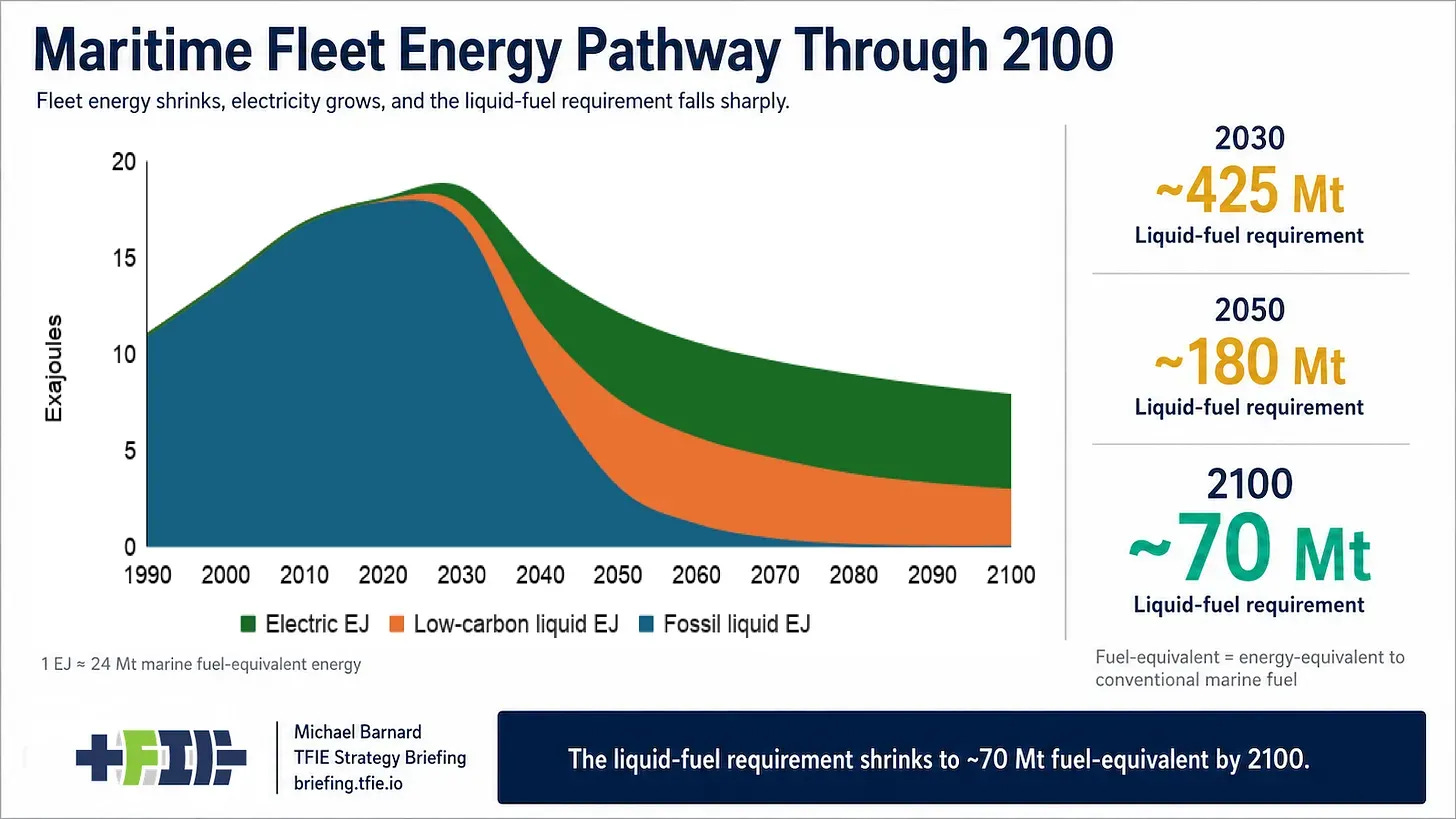
In my updated shipping fuel projection, the marine liquid-fuel requirement falls from roughly 425 million tonnes of fuel-equivalent in 2030 to about 180 million tonnes in 2050 and around 70 million tonnes by 2100. Those figures are about maritime energy rather than directly about port revenue, but the cargo-side logic matters enormously because coal, crude oil, petroleum products, LNG and raw iron ore have been paying for channels, berths, rail connections, harbour services, land and shared infrastructure. Those costs do not disappear proportionally when the tonnes do.
At the same time, the ships carrying the durable parts of maritime trade are becoming more demanding. Container ships in particular have grown dramatically, increasing berth, channel and crane requirements as well as windage during manoeuvring. In a recent sponsored Lloyd’s List discussion, Svitzer chief executive Kasper Friis Nilaus connected larger vessels, greater windage, constrained channels and difficult weather with rising towage requirements. My subsequent assessment, Tugboats May Be Where Port Electrification Comes Together First, found that the interesting part of Svitzer’s TRAnsverse design was not merely bigger bollard-pull numbers, but better directional control and dynamic force at the speeds where tugs actually work around large vessels. It reinforced something that has been sitting in my maritime projections for years: tugs are unusually good candidates for electrification because they combine short distances, repeated duty cycles, predictable charging opportunities and enormous power requirements for relatively short periods. The port of the future can therefore handle fewer tonnes of fossil bulk while requiring more capable equipment to handle the ships and cargoes that remain.
Climate disruption adds another claim on the same capital base. A 2023 Nature Climate Change study of 1,320 ports found that for roughly two-thirds of them, modeled delays arriving through disrupted trading partners exceeded their own direct weather-related downtime risk. That finding matters because a port can spend heavily hardening its quays, drainage, electrical systems and access roads and still lose traffic because another port in the service rotation is closed. China’s 2026 typhoon season offered a practical demonstration as Shanghai, Ningbo and Yantian suffered successive interruptions, carriers omitted calls and changed rotations, and some Chinese ports that had not themselves closed subsequently experienced large increases in cargo dwell. The port fence is not a meaningful boundary for climate resilience when ships, containers and schedules are networked globally.
The same problem runs inland. Vancouver’s rail and highway connections were severed during the 2021 atmospheric-river floods even though the port itself survived. Durban restored much of its port operation after its 2022 flooding while damaged rail and road connections continued constraining freight. Low Rhine and Danube water during 2026 reduced barge carrying capacity while ports remained open, leaving vessels to carry less cargo or requiring more sailings to move the same amount. Panama demonstrates the ocean-routing equivalent, with drought-related canal restrictions reducing transit and loading capacity and pushing some freight toward longer or more expensive alternatives. The climate fingerprint differs between those cases—human-caused warming has a much clearer role in aggravating European drought conditions than could be established for Panama’s 2023 rainfall deficit—but strategically they expose the same problem. Freight capacity can deteriorate substantially without anything inside the port being destroyed.
Western Pacific typhoons make that network exposure particularly consequential. Total typhoon counts do not have to increase for risk to ports to rise. A 2016 Nature Geoscience analysis of landfall-prone Northwest Pacific typhoons found intensification of 12–15% over the preceding 37 years, with the proportion reaching Category 4 or 5 doubling or tripling in the groups affecting East and Southeast Asia. Subsequent research has found northward shifts in parts of western Pacific cyclone exposure and a roughly threefold increase in rapid-intensification events close to coastlines globally between 1980 and 2020. The attribution and regional patterns require care, and the evidence does not say that every Asian coastline will see more typhoons. It does say that basin-wide storm counts are a poor proxy for port risk when intensity, tracks, rapid intensification, rainfall and higher coastal water levels are changing around a region that contains a disproportionate share of the world’s major container ports.
Port authorities are not oblivious to this. Rotterdam’s strategic work explicitly anticipates large reductions in fossil cargo, greater climate-resilience requirements, industrial transformation and continuing competition for containers. Newcastle, still heavily dependent on coal exports, is pursuing containers, clean-energy industries, automotive traffic and other non-coal business. Port Waratah Coal Services in Newcastle is already contemplating a future in which coal demand can be served through one terminal instead of two and aligning that possibility with lease expiry, asset life and rehabilitation provisions. The interesting weakness in port strategy is therefore not failure to notice that the world is changing. It is the collective arithmetic of what ports expect to replace the disappearing business.
Rotterdam expects containers to become more important and expects to maintain or strengthen its competitive position. Newcastle wants a major container terminal. Other ports serving overlapping hinterlands have their own expansion plans. There is historical evidence that these ambitions do not always add up: the European Court of Auditors found neighbouring ports investing in similar capacity without adequately testing whether their shared hinterlands contained enough traffic. The problem does not require port planners to be unaware of their competitors. Every port can know exactly who its competitors are and still build a business case in which it wins market share from them. If several competing ports make the same assumption, their individual strategies can each appear coherent while the combined strategy is impossible. Containers can replace declining bulk for particular winners, but they cannot replace declining bulk for the port sector simply because they appear in everyone’s diversification strategy.
The same arithmetic problem appears in green bulk. Ports routinely envisage hydrogen, ammonia, methanol, biofuels, captured carbon, biomass, circular raw materials and other transition commodities replacing some of the coal, crude oil, LNG and petroleum products moving through their terminals today. There will certainly be new commodity flows, but my projections find nothing resembling a tonne-for-tonne substitution of green molecules for the fossil energy system they replace. Electrification removes enormous quantities of fuel from the energy and transportation systems instead of replacing every tonne of fossil fuel with a tonne of another molecule, while the long-term shift toward scrap and electric-arc steelmaking puts additional pressure on raw iron-ore movements. A port strategy in which declining coal and oil are replaced by both rapidly growing container traffic and enormous new quantities of green bulk can be plausible for an individual winner. It becomes considerably harder to believe when every competing port expects to be that winner.
That makes electrification unusually attractive because its value does not depend strongly on which of those forecasts proves correct. I developed the port-side pathway systematically in From Quay To Sea: A Port Decarbonization Roadmap, where the sequence starts with the straightforward electrical substitutions in ground equipment and vehicles, moves through harbour craft and shore power, and extends outward into coastal and blue-water shipping. The ordering is important. Ports do not have to begin decarbonization by betting on which future maritime molecule wins. They can begin by removing diesel from equipment with known operating patterns, building electrical capacity and operational competence while moving into progressively harder applications.
The inland side is now producing the same result. In my upcoming European port inland bulk fleet transformation and electrification roadmap, the starting point is not today’s fleet with every diesel engine replaced by an electric motor. Cargo transition changes the denominator first. Declining fossil and other exposed bulk flows reduce the fleet that ultimately has to be replaced, while persistent dry- and wet-bulk routes are worked through vessel cohorts, replacement and retrofit windows, route energy, direct charging, battery exchange and terminal constraints. The emerging pathway is overwhelmingly electrical, with the port increasingly acting as an electrical-logistics platform connecting vessels, terminals, grid capacity, battery infrastructure and scheduling rather than as a filling station for a collection of new molecules. That work extends the From Quay To Sea roadmap beyond the waterfront and makes the same point from the other direction: electrical infrastructure can serve the port estate, harbour craft and the inland vessels connecting the port to its hinterland.
This is also why the competitive case I made earlier—that electrified ports will have an advantage as maritime trade changes—looks stronger rather than weaker as the other pressures accumulate. Electric cranes, yard tractors, material-handling equipment, drayage trucks, harbour craft, inland vessels and tugs reduce energy consumption, maintenance requirements, local pollution and exposure to carbon pricing. Shore power improves the emissions profile of vessel calls while helping justify electrical infrastructure that can also serve terminal equipment, charging, batteries and industrial customers. Ports with abundant, reliable and reasonably priced electricity also become more attractive locations for industrial processing as heat, vehicles and machinery electrify. The port and inland-shipping roadmaps increasingly look like parts of the same system rather than independent decarbonization exercises.
Crucially, those benefits survive forecasting errors elsewhere. A port can be wrong about whether ammonia, methanol or hydrogen becomes the largest traded green molecule and still benefit from efficient electric cargo handling. It can win less container traffic than expected and still lower the cost of handling every container it does receive. A battery-electric tug remains useful whether the ship alongside is carrying containers, food, steel products or machinery. A substantial grid connection initially serving yard equipment can subsequently support trucks, harbour craft, inland vessels, shore power and battery storage. Grid connections, substations, energy-management systems and charging infrastructure therefore support multiple plausible futures instead of depending on one commodity thesis being right.
That does not mean electrifying every legacy asset. A coal terminal with a short remaining commercial life should not automatically receive electrical infrastructure designed for another forty years, just as it should not automatically receive expensive climate adaptation intended to protect it into the 2070s. The investment case is strongest in the durable shared parts of the port: electrical distribution, general-cargo and container handling, road and rail interfaces, harbour craft, inland-vessel interfaces, tugs and other services whose usefulness survives changes in cargo composition. Ports have to decide which assets deserve protection and renewal, which require additional capability for bigger ships, which declining cargoes can continue paying their way, which replacement businesses are realistically theirs to win and which facilities should be converted or retired.
That is a much harder strategic problem than either a conventional growth plan or a conventional climate-adaptation plan. Ports are clearly aware of most of its components. The danger is that their answers do not add up across the sector, with too many strategies relying simultaneously on winning the same container growth and handling the same projected flood of green bulk while adaptation and ship-size requirements keep raising the capital needed to remain competitive. Electrification does not remove that uncertainty, but it reduces the penalty for getting the commodity forecasts wrong. It lowers the cost and carbon intensity of whatever durable freight business a port actually ends up handling, builds infrastructure useful across multiple modes and cargoes, and avoids making every capital decision dependent on correctly predicting the future molecule. In a period when so many other port investments require getting the future right, electrification is one of the clearer no-regrets bets.
Subscribe to TFIE Strategy Briefing for evidence-based analysis of how electrification, climate risk and shifting freight flows are reshaping ports, shipping and industrial strategy.