

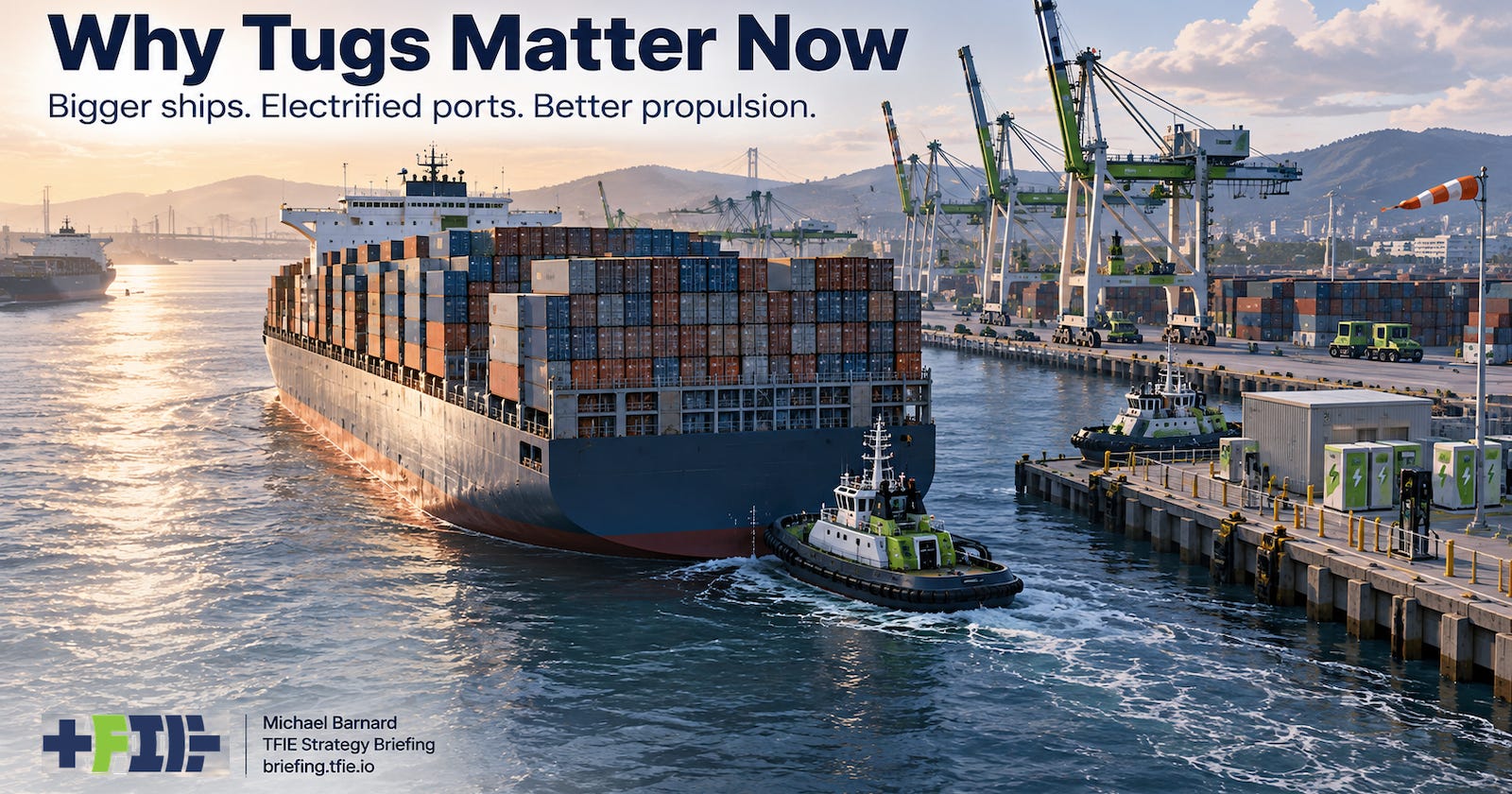
Tugboats have occupied a small and fairly obvious corner of my maritime decarbonization projections for years. They work over short distances, return repeatedly to the same ports, require enormous power for brief periods rather than enormous quantities of energy, and spend their lives inside industrial environments that are comparatively easy to connect to large electrical supplies. In my port electrification work, including Ports Plugging In: From Ground Vehicles To Ocean Shipping, harbour craft follow landside equipment naturally into electrification, while my longer-range shipping fuel projection has much of inland and short-sea shipping moving onto batteries as the total pool of liquid marine fuels shrinks dramatically through the century.
What I had been treating too narrowly was the tug itself. A recent sponsored episode of the Lloyd’s List Shipping Podcast with Svitzer CEO Kasper Friis Nilaus focused on port productivity and Svitzer’s TRAnsverse tug design. Vendor-sponsored discussions deserve the usual discount, but this one caused several things I had been considering separately to fit together. The interesting possibility is not simply replacing diesel engines in conventional tugs with batteries and electric motors. It is redesigning how the tug positions and generates force, electrifying that propulsion system, using batteries to supply its highly variable power requirements, and adding increasingly capable controls to coordinate the whole machine.
That combination matters because the job of the tug has been changing. Commercial ships have become much larger, especially container ships with enormous exposed sides for wind to act against. Tug fleets have moved toward greater power and more capable escort systems, while ports are under pressure to move those vessels through constrained channels and onto valuable berths reliably. The worldwide registered fleet of seagoing tugs over 100 gross tonnes was about 23,500 vessels in late 2025, so this remains a small marine segment in absolute terms, but the ships and infrastructure they protect are anything but small.
Bollard pull, the standard static measure of a tug’s pulling capacity, captures only part of what a pilot requires. The useful product is force in a particular direction, applied at the right place on the ship at the moment it is needed. An 80-tonne tug that has to spend time and propulsion energy getting itself into the useful position is providing something different from a tug that can maintain a high-leverage position beside the assisted ship and change its force vector quickly.
Modern azimuth stern drive tugs are already remarkably manoeuvrable machines. Two steerable propulsion units clustered toward one end can rotate through 360 degrees, providing capabilities that conventional shafts and rudders cannot approach, and ASD tugs became widespread for good reasons. Svitzer and Robert Allan changed the geometry by separating the two azimuthing propulsion units longitudinally toward opposite ends of the tug, then pairing them with a hull and towing arrangement designed to work over a broader range of orientations.
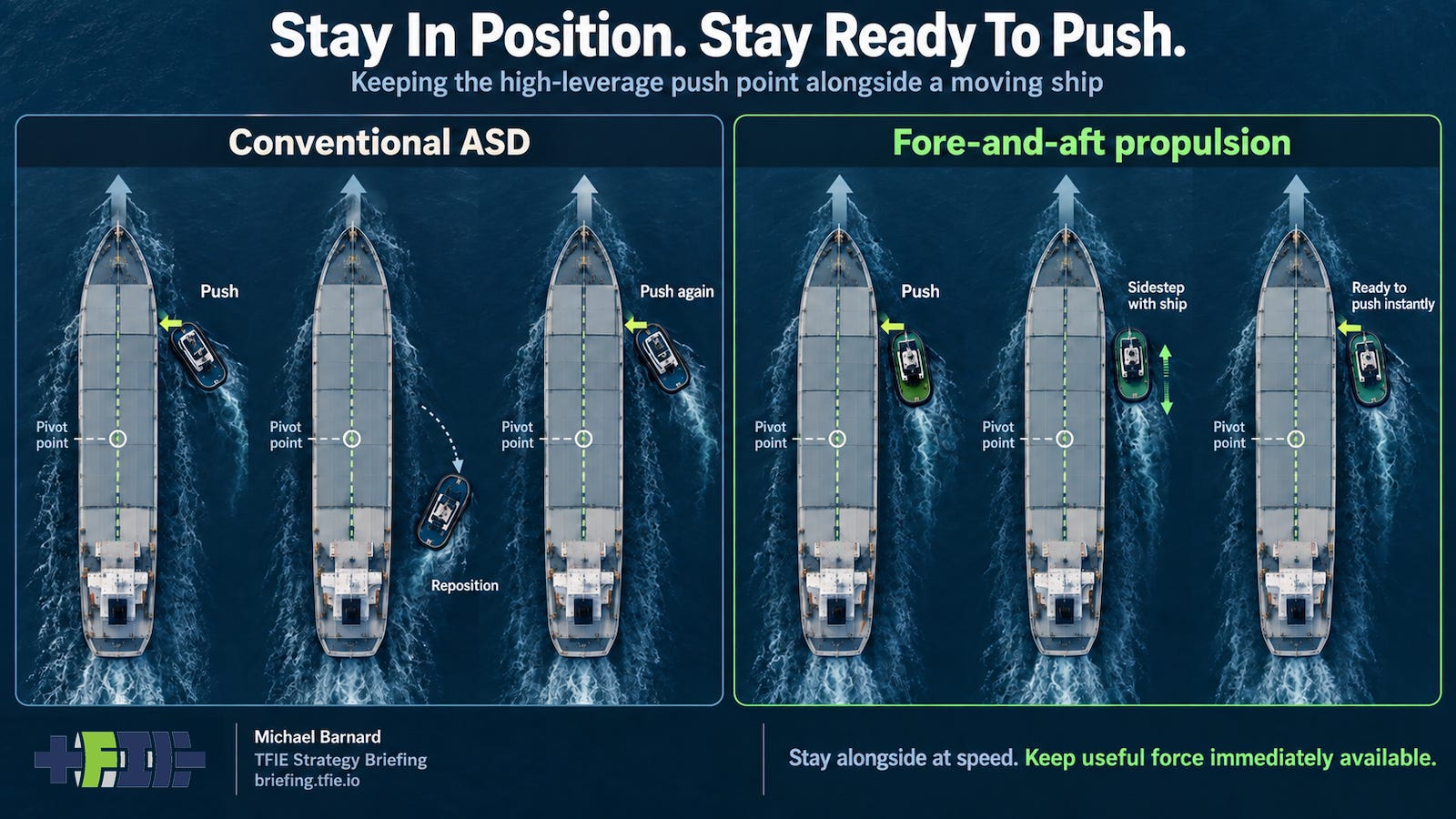
That difference becomes easier to understand in Svitzer’s push-and-sidestep mode than in a static propulsion diagram. A tug pushing near the bow or stern has a long lever arm around the assisted vessel’s pivot point, making each tonne of transverse force more useful for turning the ship. The challenge is remaining there as the ship moves. Svitzer says the TRAnsverse can side-push while travelling with the assisted ship at speeds approaching 10 knots, keeping itself in a useful position and ready to respond to another command instead of spending as much effort recovering that position.
Svitzer also reports substantially higher forces than comparably powered conventional ASD designs in some dynamic modes, along with lower power and fuel requirements during particular transitions such as moving around the stern from a six-o’clock to a three-o’clock towing position. Its early operational comparison found fuel consumption roughly 15% below its reference fleet. Those are Svitzer’s results, not an independent matched-job industry benchmark, so I would not transfer the percentages indiscriminately to every harbour. The physical mechanisms are more important: less propulsion is spent simply putting the tug where it can do useful work, while the hull and towing geometry can exploit hydrodynamic forces more effectively during higher-speed operations.
That reframes the design for me. TRAnsverse is not primarily interesting because it might save diesel. It is interesting because better vessel geometry can reduce part of the propulsion requirement before the choice of energy source is made. Every kilowatt-hour of unnecessary positioning energy eliminated is particularly valuable when the remaining energy has to be stored aboard the vessel.
That is where the tug becomes more interesting than a clever hull-and-thruster arrangement. Harbour tugs have an unusual relationship between peak power and total energy demand, electric motors handle that duty cycle very differently from large diesels, and the numbers from operating battery tugs are surprisingly favourable. The harder test is whether operators are buying them repeatedly, whether ports are building the electrical ecosystem around them, and whether regulation and forty-year hull lives will slow the transition.