

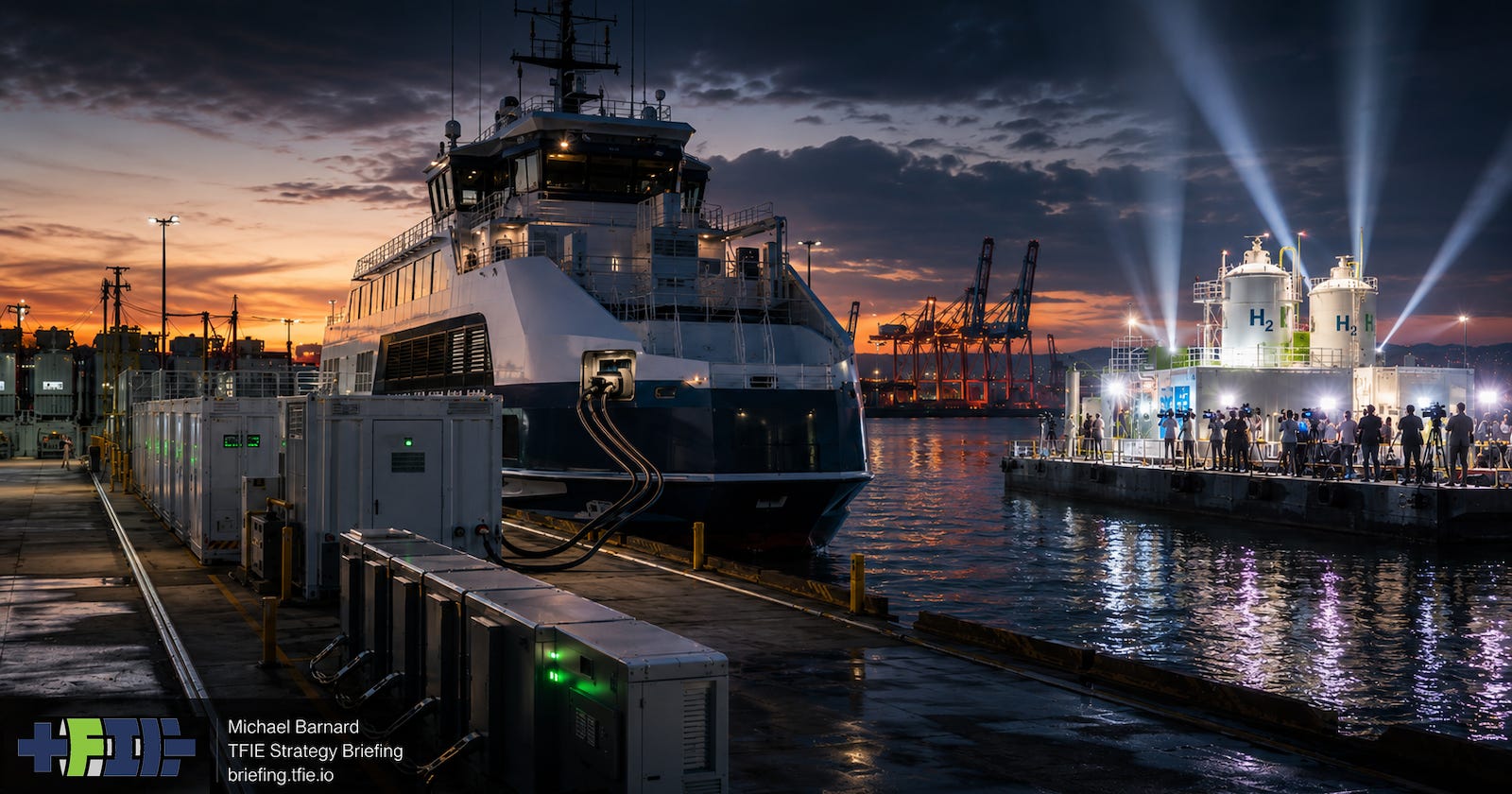
GeoPura has been promoting a striking maritime first at the Port of Tilbury on the Thames. Its HPU2 hydrogen power unit was placed on a floating platform and used to provide rapid charging to a commercial electric vessel, delivering 300 kW dockside from a system built around five Ballard fuel cells. The accompanying language stretches outward from that event toward shore-to-ship power, rapid vessel charging, port electrification, grid constraints and energy resilience. At an April hydrogen showcase at Tilbury, attended by more than 100 delegates, it made for an excellent demonstration: a barge, a hydrogen generator, a commercial vessel and a collection of technologies sufficiently unusual to merit photographs and headlines.
What it did not demonstrate was a maritime charging business. There is no stream of vessels using the floating system, published utilization, a charging tariff, repeat customers or a fleet whose operating model depends on it. The demonstration vessel was also not hydrogen-powered. It was battery electric. Strip away the event language and GeoPura demonstrated that a hydrogen generator can make electricity which can be fed through a charger into a battery. That is technically unsurprising. The interesting question is why hydrogen needs to be in that chain at all.
The engineering problem GeoPura says it is addressing is real. Ports can have substantial electricity supplies while lacking enough capacity at a particular berth to deliver a short burst of several hundred kilowatts or a few megawatts. Distribution upgrades can take years. Cables have to cross busy industrial sites, substations need capacity, and a ship may require much more power for an hour than the local connection can continuously provide.
Those characteristics describe an energy-storage problem unusually well suited to batteries. A modest grid connection can charge a stationary battery slowly between vessel calls, while the battery supplies the much higher charging rate when a ship arrives. The grid sees a manageable load; the ship sees a high-power charger. If the berth itself is awkward to electrify, the battery can be containerized or mobile. For suitable cargo operations, the battery can go one step further and move onto and off the vessel, separating the time required to charge batteries from the time the vessel spends alongside. That is why my review of maritime battery studies concluded that the practical battery boundary is moving outward, with port infrastructure increasingly becoming the constraint rather than battery chemistry.
GeoPura inserts a substantially longer chain. Renewable electricity makes hydrogen in an electrolyzer. The hydrogen is compressed, stored and transported or produced nearby, supplied to the HPU2 and converted back into electricity by fuel cells. The HPU itself combines fuel cells, battery storage and power electronics before electricity finally travels through the charger to the vessel battery. GeoPura’s own hydrogen efficiency explanation says that around 3.1 MWh of electricity used for electrolysis results in approximately 1 MWh of usable electrical output later through a fuel cell.
There is also a rather obvious question missing from the floating-charger story: how exactly does the hydrogen get to the barge? GeoPura’s normal supply model is to move compressed hydrogen by road in MEGC tube trailers or manifolded cylinder packs. Tilbury has announced an on-site green hydrogen production facility, but even hydrogen made inside the port still has to get from the electrolyzer to a mobile HPU sitting on the water. Does a tube trailer drive to the quay and refuel it through a high-pressure transfer system? Are cylinder packs moved onto the floating platform? Does the port install a dedicated hydrogen pipeline to the berth, undermining part of the claim that this avoids fixed infrastructure? Or does the barge periodically stop charging vessels and move somewhere else to refuel? A mobile electrical generator does not make its fuel logistics disappear. It merely moves the infrastructure problem upstream, while a battery buffer needs the electrical connection the port ultimately requires anyway.
That makes the Tilbury demonstration an unusually pure example of the hydrogen detour. Electricity is converted into hydrogen, moved through a specialized fuel chain and converted back into electricity, with a battery incorporated in the generator architecture before the electricity reaches another battery in the vessel. A battery buffer skips most of that equipment and most of those energy losses. This is exactly why my maritime fuel economics put electricity first: once useful propulsion energy rather than kilograms of fuel becomes the comparator, direct electricity has a formidable efficiency advantage wherever the operating geometry permits it.
There are places where this tradeoff can still be rational. GeoPura’s strongest application remains displacement of diesel generators where useful grid electricity genuinely is unavailable: temporary construction, events, remote sites and backup power where customers value quiet operation and elimination of local combustion emissions. GeoPura itself primarily describes the HPU family as generators for temporary, off-grid and grid-support applications. I described that as one of the remotely defensible hydrogen-for-energy niches when I assessed Ballard’s proposed acquisition of GeoPura. The company has real equipment, customers and operating experience. The problem was never whether fuel cells could generate electricity. It was whether the economics justified building a very large hydrogen production, distribution and HPU business around them. A port berth where the final requirement is high-power battery charging is a considerably weaker extension of that niche.
While hydrogen projects continue to generate firsts, battery maritime systems increasingly generate operating records. Zero Emission Services began commercial operation of the Alphenaar in the Netherlands in 2021 using standard interchangeable 20-foot energy containers. Its newer LFP ZESpacks have 2.9 MWh of capacity and charge at up to 1 MW. The operating model allows vessels to exchange packs instead of sitting alongside waiting for them to recharge.
China is pushing the same systems logic further. CATL’s Jining 6006 electric cargo vessel carries two containerized battery power sources totaling 3.919 MWh, has a stated 230 km range and can swap batteries in about 15 minutes. More important than the specifications is the architecture: CATL describes an integrated vessel, shore charging and operations system rather than a fuel product looking for places to be used.
These systems are not free of infrastructure requirements. Ports need electrical capacity, battery inventory, charging stations, power electronics, safety systems and operating procedures. None of that disappears because the word battery is involved. My maritime battery analysis found that ports increasingly become the constraint as viable battery range expands. The issue shifts from whether batteries can propel a vessel to how many megawatts can be supplied at the quay, how charging loads are managed and how batteries move through the logistics system. Buffering storage turns sharp vessel loads into steadier grid demand, while swapping allows packs to charge for hours without holding a vessel at berth.
That is what a system looks like. It accumulates common infrastructure, repeat users and operating experience. Each additional electric vessel can use some combination of the same grids, substations, chargers, batteries, power electronics and control systems already serving electric trucks, port equipment, buildings and stationary storage. This is the broader point in my practical pathway for maritime decarbonization: electrify fixed and shorter routes, hybridize the next band, build port electrical infrastructure early, and reserve molecules for the portions of shipping that actually need them.
Tilbury itself illustrates the contrast. In February, two months before the hydrogen showcase, a 5 MW electric HGV charging hub opened at the port, with 16 ultra-rapid charging positions capable of serving 16 electric trucks simultaneously. That is ordinary high-capacity electrical infrastructure intended for repeated commercial use. The fact that the same electrical capacity does not automatically extend to every quay is an infrastructure problem. It does not turn hydrogen into the obvious solution to the missing cable.
The timing gives the Tilbury demonstration another layer. It took place on April 30. Ballard announced its proposed £275 million acquisition of GeoPura on June 23. Ballard was already supplying fuel cells to GeoPura, so nothing about the acquisition enabled the Tilbury demonstration. Ballard itself describes the transaction as building on an existing partnership and combining its fuel cells with GeoPura’s hydrogen production, logistics and stationary-power business. In my analysis of the transaction, that existing relationship was central: buying GeoPura does not create the supplier-customer relationship. It internalizes it and wraps it in a much larger integrated-hydrogen-company narrative.
Ballard’s acquisition announcement makes that narrative explicit. It says the combination will maximize revenue per deployed megawatt through multiple customer touchpoints and give Ballard access to the stationary power market and recurring energy-as-a-service revenues. GeoPura, meanwhile, presents the same basic HPU platform across construction, film and television, events, data centres, EV charging, utilities and maritime.
There is nothing improper about selling the same equipment into multiple sectors. The investor problem comes when every place a generator can physically operate is treated as evidence of another scalable market. Put an HPU beside a film set and it is clean production power. Put one beside an EV charger and it becomes hydrogen-enabled electric mobility. Put one beside a data centre and it becomes resilient digital infrastructure. Put one on a floating platform and it becomes maritime electrification. The machine has not changed very much. The headline has.
That distinction matters for Ballard because the acquisition is being justified partly through addressable-market expansion while GeoPura itself remains a capital-intensive growth business. My earlier assessment found a company with substantial previous capital raises and asset-backed debt facing an ambition to deploy thousands of HPUs requiring billions more in investment. Ballard gets a new growth narrative extending beyond transport markets in which hydrogen has repeatedly failed to achieve broad commercialization. The Tilbury story does not prove that maritime charging belongs in that addressable market. It proves that the equipment can be placed on a barge.
This pattern is familiar from passenger rail. My recent global audit, Hydrogen Trains Have Headlines. Battery Trains Have Higher Utilization, found that hydrogen trains receive international attention for national firsts, world firsts and power records, while much of the evidence for battery trains sits in regional transport reports and routine operator notices. Germany already has substantially more battery-electric passenger trainsets operating than hydrogen ones, a larger battery orderbook and better practical fleet utilization in the evidence I could reconstruct, yet hydrogen launches remain disproportionately visible.
Hydrogen naturally produces publicity because every deployment is unusual. A new production arrangement, tube trailer, storage installation, dispenser or fuel-cell application can be announced as a project milestone. Electrification becomes less newsworthy as it succeeds. The first battery ferry is an event. The hundredth charging session is operations. A transformer feeding a battery behind a quay has little visual drama, especially when the same battery chemistry and power electronics are already appearing in trucks, buses, grid storage and industrial equipment.
That difference in visibility can badly distort perceptions of technological progress. Hydrogen transportation has accumulated enormous numbers of pilots without establishing broad commercial markets. In my review Hydrogen Transport Has Been Contained, Not Commercialized, I assessed 174 hydrogen transportation firms and projects. Of the 106 surviving entries, only three qualified as durable commercial niches, all in material handling and tiny, mostly legacy niches at that. Forty-seven remained demonstrations, pilots or proofs of concept, while another 36 were subsidy-shaped transport niches.
The point is not that demonstrations are useless. They are supposed to resolve uncertainties on the way to repeat deployment. When a sector continues producing firsts without producing enough seconds, thirds and hundredths, the demonstrations themselves become evidence about the weakness of commercialization.
The same standard should apply at Tilbury. How many vessels use the system after the showcase? How many megawatt-hours does it deliver in an ordinary month? What does that electricity cost at the vessel compared with grid power buffered through batteries? What utilization is required to recover the capital tied up in the hydrogen production, transport and fuel-cell chain? Does another port buy the system after seeing those numbers?
Until those answers exist, there is very little maritime significance to the demonstration. Hydrogen successfully generated electricity. An electric vessel successfully accepted it. Both technologies were already known to do those things.
My latest shipping energy pathway finds a much larger electric maritime system emerging as fossil cargo declines and the liquid-fuel requirement shrinks. Deep-sea shipping still has a hard liquid-fuel remainder, but charging an electric vessel at a berth is not part of that hard problem. Ferries, inland vessels, port craft, working vessels and much short-sea activity have exactly the operating patterns that make electricity attractive.
GeoPura has demonstrated a way to charge one of those vessels using hydrogen. The maritime transition will be demonstrated when charging them is so routine that nobody thinks it deserves a press release.
For analysis that separates transition infrastructure from transition publicity, subscribe to TFIE Strategy Briefing.