

India’s first hydrogen passenger train arrived with a superlative attached. It was described as the world’s most powerful hydrogen train, a large broad-gauge passenger set developed by adapting a diesel-electric platform rather than designing an entirely new train. That is a genuine engineering achievement, but it is also the wrong contest. Railway operators do not need the most powerful hydrogen train. They need trains that leave the depot, cover the timetable, receive fuel or charge without drama, return promptly after maintenance and remain supported by their manufacturers. The useful metric is not peak power. It is how often the train works, what other equipment is needed to keep the service running when it does not, and whether anyone buys another fleet after seeing the operating results.
That question leads away from the launch ceremony and toward Germany, where almost the entire commercial hydrogen passenger fleet has accumulated several years of operating evidence. It also leads toward battery-electric trains entering service across Germany, Denmark, Britain, the Czech Republic and elsewhere. The comparison is not tidy. Operators rarely publish clean monthly technical-availability data. Some report trains delivered, some report trains used, and others report the percentage of passenger services operated even when replacement diesels or buses did the work. Battery trains attract less international attention, so much of their operating evidence sits in regional transport notices and local-language reporting rather than in global press releases. The available evidence remains sufficient to say something useful, provided the metrics are not blurred together.
Battery-electric passenger fleets are generally achieving higher practical utilization than hydrogen fleets. Battery introductions have included serious failures, delays and reduced timetables, but several of those fleets have moved into comparatively stable operation. The two largest hydrogen fleets have instead required prolonged fuel-cell repairs, replacement-component programmes and extensive diesel substitution. Hydrogen trains clearly work. What the evidence does not show is hydrogen becoming the general replacement for diesel passenger rail.
The global hydrogen passenger fleet is measured in dozens, not hundreds. There are about 50 hydrogen trainsets assigned to operating or scheduled passenger fleets. Lower Saxony has 14, the RMV Taunus network has 27, NEB’s Heidekrautbahn has seven, and the United States and India each have one. A time-limited Bavarian passenger trial adds another trainset. Forty-eight of the 50 commercial or scheduled units are concentrated in three German deployments, making the global hydrogen passenger fleet roughly the size of a single modest regional order.
The denominator is conventional electrification. Germany has thousands of fixed-electric passenger trainsets operating under overhead wires. Europe has tens of thousands. Globally, the electric fleet is measured in the tens of thousands before metros and trams are counted. The off-wire market matters, but it is the remainder of the railway system after heavily used routes have been electrified. The practical hierarchy is straightforward: wire busy routes, use batteries to cross gaps and branches where full catenary is not justified, and consider a separate fuel system only where those two approaches genuinely fail.
Battery trains are already moving further into that residual market. Germany has an identifiable floor of about 124 operating battery trainsets and at least 140 more ordered or contractually specified. Its hydrogen passenger fleet is about 49 trainsets when the Bavarian passenger trial is included, with no comparable next wave of procurement visible. Hydrogen rail nevertheless receives attention out of proportion to that footprint. World-first announcements, ceremonial launches and power claims are easy stories. A battery train moving from overhead electricity to stored electricity halfway along an ordinary regional route is less theatrical.
The battery train is also closer to the railway’s existing architecture. It draws electricity from wires when they are available, stores it and continues beyond them. Hydrogen requires production, delivery, compression, storage, refuelling, specialist safety systems and fuel-cell maintenance in addition to the electric traction system still required on the train. The traction motors do not run on hydrogen. Hydrogen is converted back into electricity aboard the train, usually with a battery smoothing power demand between the fuel cells and the motors. That extra machinery and fuel infrastructure do not prove the train will fail, but they do increase the number of systems that must work together every day.
This is where the word “availability” becomes dangerous, because the public discussion routinely combines three different numbers. Technical availability is the share of delivered and accepted trainsets fit to operate. Deployment utilization is the share of the purchased or assigned fleet actually used in passenger service. Service reliability is the share of the passenger timetable that operates, including services delivered by substitute diesel trains, buses or other rolling stock. Those numbers can move in opposite directions.
An operator might own 27 hydrogen trains but use only 12 of them while 16 leased diesels protect the timetable. Passenger service reliability could remain above 90%, but that would not mean more than 90% of the hydrogen trains worked. This is the trap in the RMV Taunus statistics. The network’s service performance improved after replacement diesels arrived, while much of the hydrogen fleet was in a manufacturer-supported repair programme. The passenger got a train, but it was often not a hydrogen train.
The comparison here therefore uses deployment utilization where direct technical availability is unavailable. It asks how many trainsets of the target technology were being used relative to the fleet purchased or assigned. That remains an estimate because no operator publishes a complete, standardized quarterly series. The evidence book uses reported fleet counts, delivery and acceptance milestones, trains known to be in service, required diagrams where available, substitution patterns and point observations such as “four of 14 operational.” Unsupported metrics remain blank. The aim is not to manufacture precision, but to make the evidence comparable enough to test the claim.
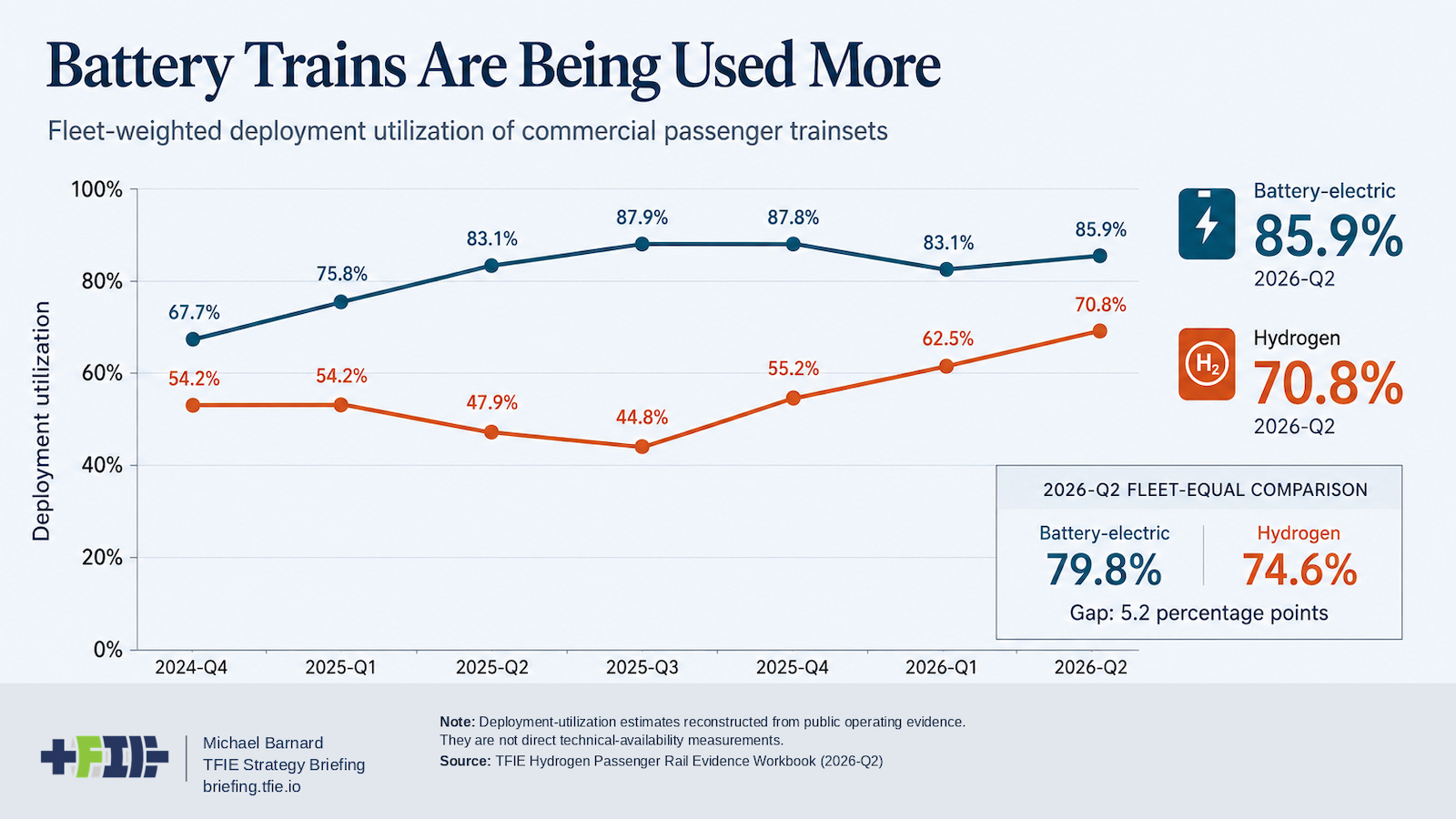
The commercial multiunit fleets with usable evidence show a practical-utilization advantage for batteries. In the fourth quarter of 2024, battery fleets averaged an estimated 67.7% fleet-weighted deployment utilization. Hydrogen fleets averaged 54.2%. By the second quarter of 2026, the battery figure had increased to 85.9%, while hydrogen had recovered to 70.8%. The 15.1-point difference is meaningful. Across the trainsets represented in the comparison, battery trains were more likely to be deployed in passenger service.
That is not the only valid way to weight the evidence. The battery comparison includes several large fleets, including 55 trains in Schleswig-Holstein, 31 in East Brandenburg and 27 in Ortenau. If every fleet receives equal weight regardless of size, batteries average 79.8% and hydrogen averages 74.6%. The difference falls to 5.2 points. The fleet-weighted result asks what share of the actual trainsets is being used. The fleet-equal result asks whether the typical fleet is performing better without allowing a 55-train deployment to dominate the calculation. Both favour batteries, but neither establishes a universal engineering law.
The hydrogen result also contains a strong positive case. NEB’s seven-train Heidekrautbahn fleet is estimated at 85.7% deployment utilization in the second quarter of 2026, above several battery fleets. Hydrogen performance is not uniformly poor. The problem is concentration. The hydrogen pathway is represented primarily by three fleets. One appears to be performing reasonably well after an early fuel-supply failure. The other two, representing 41 of Germany’s 48 commercial hydrogen trainsets, have experienced deeper and more persistent problems.
The battery record is not a victory parade either. Schleswig-Holstein’s 55-train programme had a poor introduction, with software problems, resets and low initial vehicle fitness leading to reduced timetables and replacement transport. Merseyrail described its early battery service as very unreliable before restoring the intended frequency. Other battery deployments have suffered late delivery, charging constraints and staged introductions. These are material failures, but several of the larger fleets subsequently moved toward normal operation. That recovery pattern, rather than an absence of trouble, is the strongest evidence favouring batteries.
Battery-electric passenger trains therefore have the stronger operating record in the available evidence. Direct technical-availability data remain sparse for both technologies, battery problems may be underreported, and the smaller fleet-equal gap prevents a sweeping claim that battery hardware is universally more reliable. Even with those cautions, the direction is clear. Battery fleets are being deployed more consistently, several large programmes have recovered from poor launches, and the forward orderbook is larger. Hydrogen passenger rail remains technically real, but it has not demonstrated that it is the general replacement pathway for diesel regional trains.
The public verdict is niche-valid for hydrogen passenger rail, with medium-high confidence and mixed, geographically narrow evidence. The primary comparator is not an aging diesel train in isolation. It is overhead electrification combined with battery-electric trains.
Below the paywall is the professional layer: the fleet-by-fleet utilization ranking, the launch-versus-persistence test, the hydrogen and battery failure evidence, the global trainset denominator, the supporting evidence workbook, procurement implications, update triggers and the Hydrogen Passenger Rail Pathway Scorecard I will use to judge whether the pathway is scaling, niche-valid, stalled or defensive. The public comparison does not assume that battery trains arrived without trouble. Several had ugly launches, and one remains a clear underperformer.
