

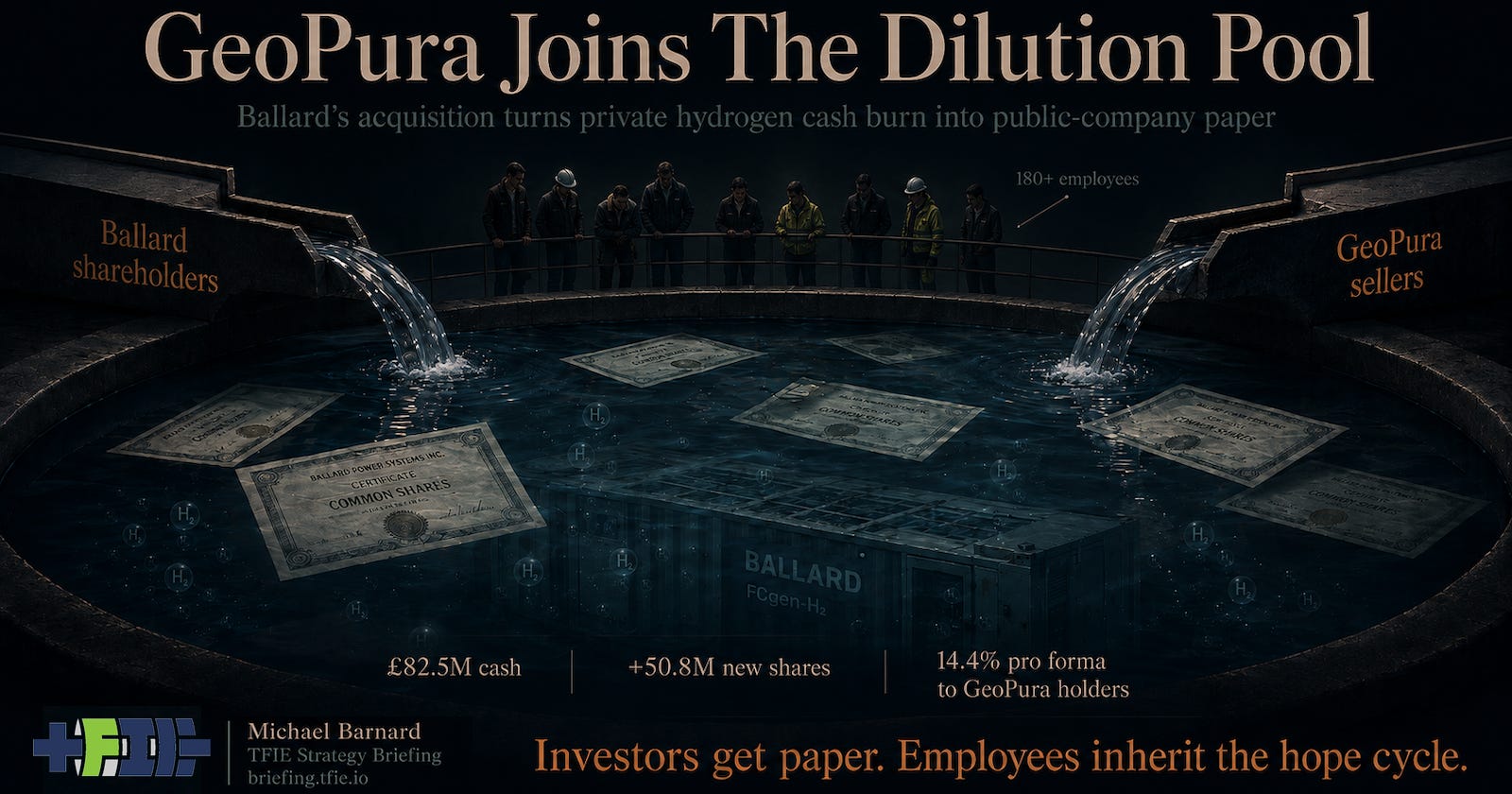
Ballard Power’s acquisition of GeoPura is being sold as transformation. Ballard says it is becoming an integrated hydrogen ecosystem provider, moving from fuel-cell supply into hydrogen production, distribution, logistics, refuelling and stationary power generation. The more useful reading is harsher. Ballard is issuing another large block of stock to buy a new hydrogen story, while GeoPura’s investors take what looks like an exit but is mostly locked exposure to Ballard’s next dilution cycle.
The terms are the denominator. The deal is £275 million upfront, but only £82.5 million is cash. The rest is about 50.8 million newly issued Ballard shares, giving GeoPura holders about 14.4% of the pro forma company. Those shares are subject to lock-up agreements after closing. A clean strategic exit would convert years of private-company risk into cash. This converts much of that risk into Ballard paper.
That matters because the acquisition is not primarily a technology story. GeoPura’s hydrogen power units are one of the remotely plausible hydrogen-for-energy niches. Replacing diesel generators at construction sites, film sets, events, military facilities, hospitals, data centres and grid-constrained locations is more defensible than hydrogen cars, hydrogen home heating or ordinary hydrogen trucking. Diesel generators are dirty, noisy and increasingly awkward for customers with public climate commitments. Batteries as a service are constrained by regulation per my discussions with film industry service providers. GeoPura has equipment, customers, employees, field experience and an operating team. Those facts explain why the story is marketable. They do not prove the economics.
GeoPura was not being acquired from obvious financial strength. It had raised £36 million, then £56 million, then £22 million of asset-backed debt, for roughly £114 million raised over two years. At the same time, its own CFO had been talking about a 3,600-unit ambition requiring more than £2.5 billion of capital over the next decade. That is not normal growth capital. That is a financing wall with hydrogen branding.
Ballard’s investor deck says GeoPura has more than 60 HPUs, about 20 electrolyzers, 75 tube trailers, 150 manifolded cylinder packs, more than 180 employees and expected 2026 revenue of about £38 million. Put those figures beside the 3,600-unit ambition and the £2.5 billion capital requirement, and the shape of the deal changes. This was not a self-funding platform choosing the strongest strategic partner from a position of power. It looks like a capital-hungry private hydrogen company whose next cheque had become the problem.
That does not make GeoPura fake. It makes it a poor investor-return story unless someone else is willing to fund a very large expansion before the business has proved self-funding economics. The company may have a genuine diesel-generator displacement niche, but the capital requirement had run far ahead of the proven revenue base. GeoPura’s investors appear to have found an exit door, but it opened into Ballard.
Ballard is the other half of the same pattern. It still had cash at the end of Q1 2026, but cash is not a business model. Ballard also had modest quarterly revenue, continuing losses and a multi-billion-dollar accumulated deficit. Its own filings describe a liquidity strategy based on maintaining enough cash for at least six quarters of forecast operating cash use and contractual commitments while securing additional financing as needed until sustainable profitable operations are achieved. That is the formal version of the public hydrogen treadmill: preserve the runway, keep the story alive, point to the next market and finance the journey.
GeoPura gives Ballard a better next story. The old public hydrogen story has moved through fuel cells for mobility, buses, trucks, rail, marine, stationary power, resilience, data centres and energy-as-a-service. GeoPura gives Ballard a more defensible application and a more attractive customer narrative. It does not change the financing mechanism. Existing Ballard shareholders are diluted to buy the story, and GeoPura’s sellers become Ballard shareholders inside the same story.
The seller-side due diligence failure is not that GeoPura’s investors or advisers could not read Ballard’s filings. The risk was public. Ballard’s loss history, accumulated deficit, future financing language and share-issuance risk were not hidden. The failure was accepting Ballard shares as if they were strategic-buyer currency rather than dilution-cycle paper.
There are only two plausible explanations. Either GeoPura’s investors genuinely believe the combined company will re-rate and make Ballard stock a better asset than it looks today, or their alternatives were worse: another private raise, a down round, more asset debt, slower deployment, a narrower business or a buyer unwilling to pay mostly cash. The public evidence makes the second reading hard to dismiss.
The synergy story is the wrapper. Ballard already supplied fuel-cell engines to GeoPura. That was the obvious industrial overlap, and it already existed. Buying GeoPura does not create that relationship. It internalizes it and turns it into an acquisition story.
The hard part of GeoPura’s business is not merely the fuel-cell stack. It is hydrogen production, compression, storage, tube trailers, refuelling, deployed fleet operations, rental utilization, uptime guarantees, maintenance, site logistics and customer operations. That is GeoPura’s operating base, not Ballard’s demonstrated one. Ballard is not buying a missing component. It is buying the appearance of synergies, along with the operating team needed to make the appearance credible.
Andrew Cunningham’s move makes the structure clearer. GeoPura’s founder and CEO is expected to become President of Ballard, reporting to Marty Neese as CEO. That is part of the transaction architecture. Ballard needs Cunningham because GeoPura contains the operating story Ballard does not have. GeoPura needs Ballard because GeoPura’s capital requirement had outgrown the private growth story. Cunningham becomes the human bridge: founder credibility for Ballard, continuity for GeoPura customers and employees, and reassurance for sellers taking Ballard shares instead of clean cash.
But Cunningham is not becoming CEO. Neese remains CEO. Cunningham gets title, status, operational burden and public association with the new story. He also inherits the job of making GeoPura validate Ballard’s dilution. That is a good role if the stock re-rates and the economics work. It is a much worse role if the acquisition becomes another public hydrogen hope refresh with a later financing attached. That’s the reality of his new gig.
The employees get the hope refresh too. GeoPura has more than 180 employees. These are not abstract “green jobs.” They are engineers, technicians, logistics staff, operators, apprentices, commercial people and manufacturing partners. They were recruited into a company that promised UK industrial growth, green hydrogen skills and hundreds of future jobs. Now they are being folded into Ballard’s public-market survival story.
For them, the acquisition may feel like validation. There is a larger listed owner, global expansion language, founder continuity and a promise that GeoPura’s model will scale. That is the hopeful version. The harder version is that they become the buffer between the press release and the economics. If utilization disappoints, hydrogen costs remain high, Ballard stock weakens, synergies fail to materialize or the combined company needs another financing round, the pressure will not land first on the language in the investor deck. It will land on hiring plans, expansion roles, projects, support functions, discretionary spending and eventually headcount.
Hydrogen hype cycles do not just dilute shareholders. They recruit workers into industrial futures that will never arrive. These are real people, usually believing that they are doing real and positive work. This perpetuates their belief, keeps them out of the useful economy and defers their inevitable pivoting to actually positive engagement.
That is what makes this acquisition such a clean specimen. It compresses the hydrogen capital cycle into one transaction. Private hydrogen cash burn meets public hydrogen dilution capacity. GeoPura’s investors get partial cash and mostly locked Ballard paper. Ballard shareholders get diluted. Ballard gets a new growth story. Cunningham gets a bigger title. Employees get another round of faint hope. The market gets a larger total addressable market, another profitability target and another promise that this version of hydrogen is different.
GeoPura may be one of the less hopeless hydrogen for energy niches. That does not make it a self-funding business at the scale its investors needed. Ballard may be the logical buyer. That does not make it a strong buyer. Cunningham may be the right operator. That does not make the currency good. The employees may be doing real work. That does not make the financial structure healthy.
The simplest read is still the ugliest: GeoPura’s investors had a capital-hungry asset, Ballard had listed paper, and the transaction turned private hydrogen cash burn into public hydrogen dilution. The exit is not cash. It is entry into the next dilution cycle.
Use TFIE Strategy Briefing as a diligence layer before the next hydrogen story becomes someone else’s dilution.