

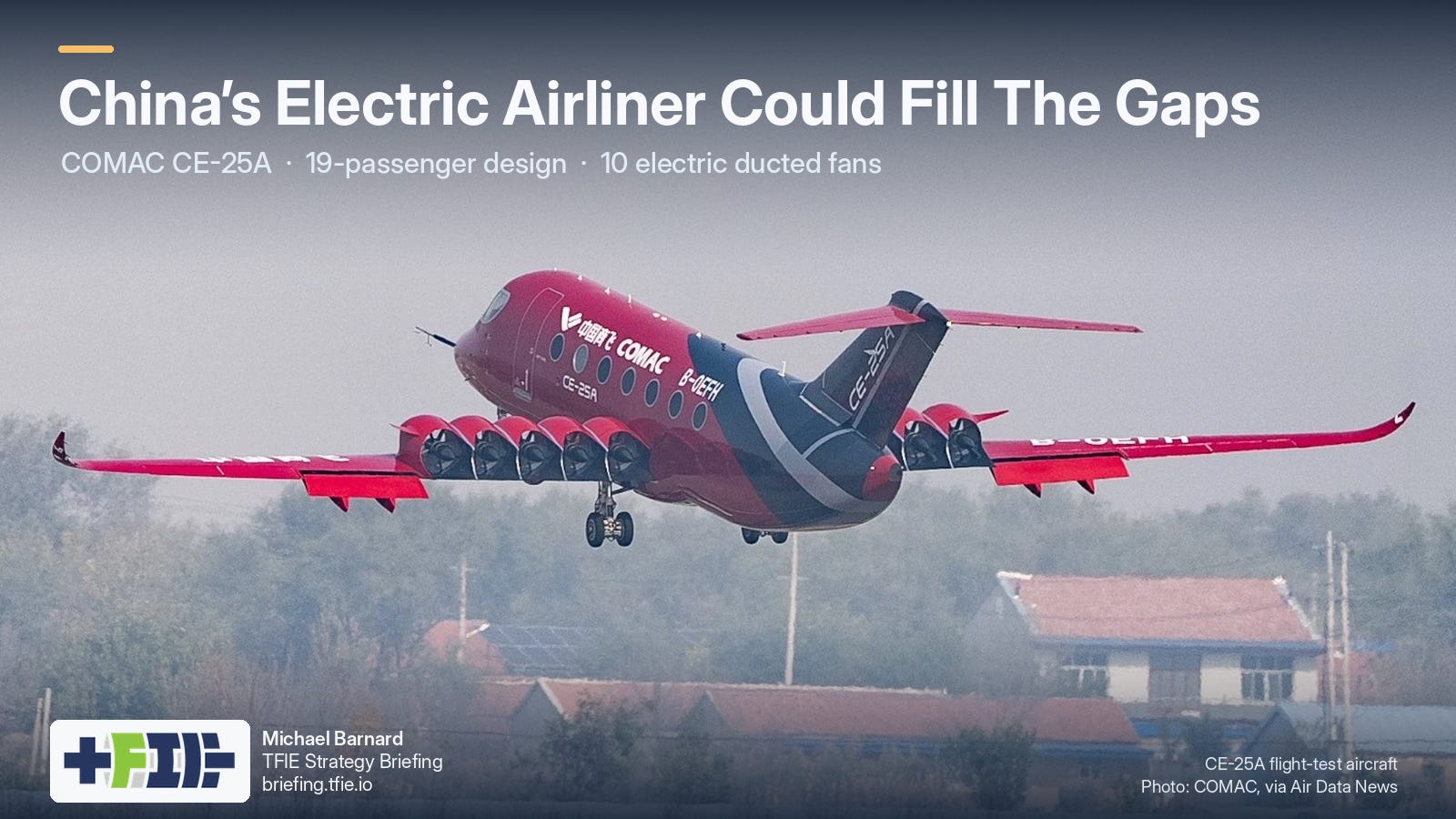
On November 14, two pilots and a flight-test engineer took to the air in a ten-ton battery-electric aircraft in Binzhou, in China’s Shandong province. The flight lasted just under 17 minutes and covered 60 km, following 19 uncrewed flight validations. In its November 16 report, the Civil Aviation Administration of China confirmed that it had accepted COMAC’s application for a type certificate for the CE-25A, an aircraft designed to carry 19 passengers at 300 km/h over distances of up to 400 km.
Acceptance of a type certificate application is not certification, and the aircraft remains a demonstrator. But COMAC is pursuing certification under China’s CCAR-25 transport-category airworthiness regulations, the same category that applies to its C919 jetliner. Working with CATL and Shanghai Jiao Tong University, it has developed a full-scale flying aircraft with a propulsion architecture that looks more like defunct evtol startup Lilium’s than a conventional regional turboprop.
For those who have been following the electrification of aviation, the aircraft’s passenger capacity and advertised range should sound familiar. In 2021, I spent a couple of hours discussing electric aviation with Heart Aerospace founder and CEO Anders Forslund for a two-part CleanTechnica podcast (part one and part two). Heart was developing a 19-passenger battery-electric aircraft with a 400 km range and a target of commercial operations in 2026. Forslund’s approach was to retain as much conventional aircraft engineering as possible to reduce certification risks and accelerate entry into service.
Heart’s original inspiration was Norway, with its fjords, islands and dependence on short regional flights. As I’ve documented in subsequent assessments, including Heart Flew on Batteries. Its Airliner Still Needs Turbines., the company moved from the ES-19 to the 30-passenger hybrid-electric ES-30 and, in September of this year, to the 36-passenger ES-36, with two gas turbines generating electricity to supplement its batteries.
Heart flew its battery-electric X1 demonstrator in August, an aircraft of comparable mass to COMAC’s CE-25A. Both companies have demonstrated battery-electric flight at this scale, but their intended commercial products differ. Heart has moved to a larger hybrid-electric aircraft, while COMAC is pursuing the passenger capacity and battery-electric range Heart originally proposed. China’s investment in electrified surface transportation provides some context for that choice.
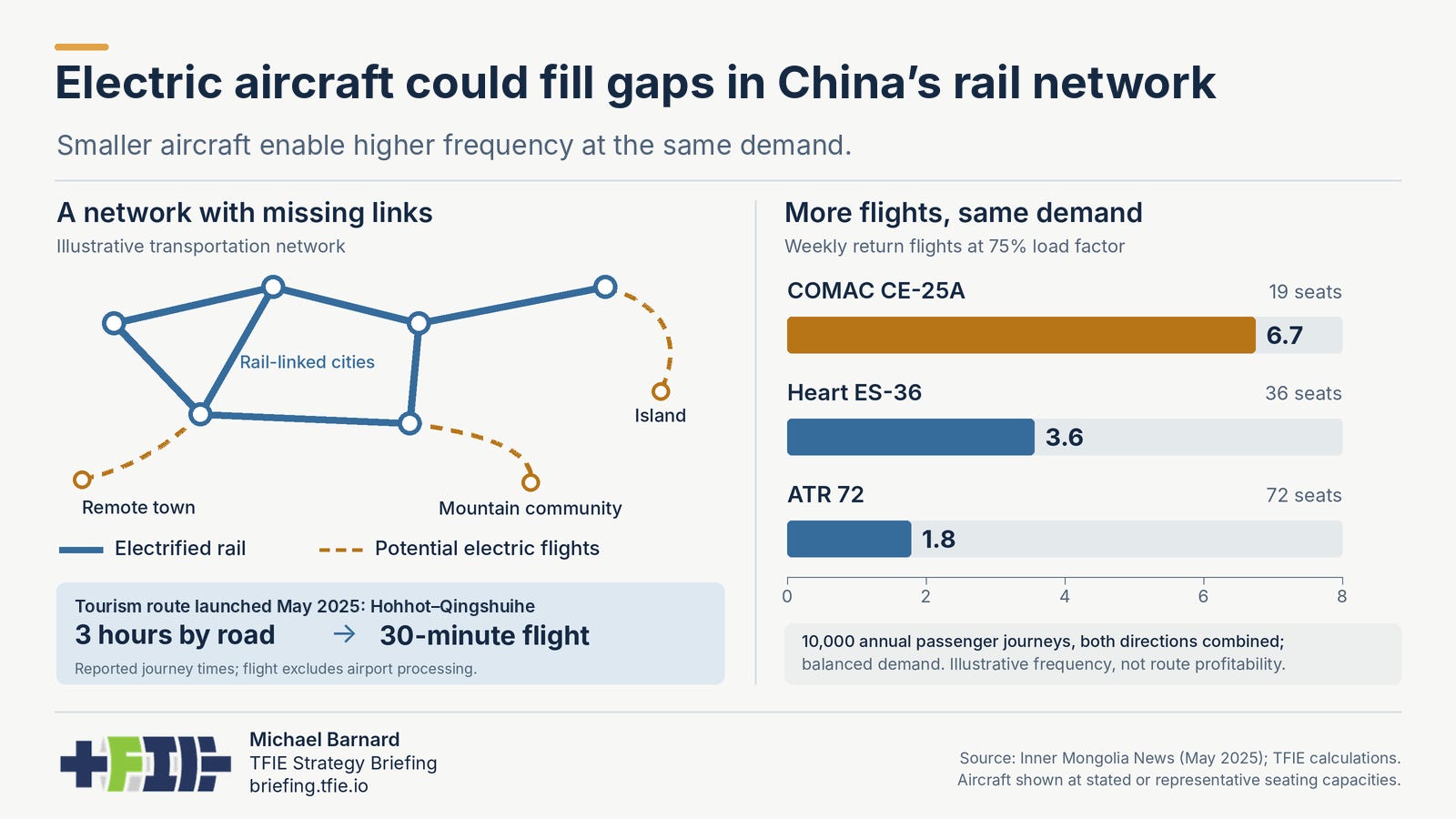
China has spent much of the past two decades building alternatives to short-distance aviation. By the end of 2025, it had more than 50,000 km of high-speed rail, in addition to electrified conventional rail, extensive urban metro systems and increasingly electrified road transportation. As I argued in July in China Moves People First, Then Decides Whose Planes It Needs, this investment changes where aviation is needed. Dense corridors that support fleets of commercial aircraft elsewhere are increasingly served by trains in China.
Not every pair of communities justifies a railway, let alone a high-speed one. Islands, mountain ranges, sparsely populated regions and awkward surface connections leave gaps in the transportation network. China is already developing small-aircraft services to fill some of them.
In May 2025, a short-distance air service opened between Hohhot and Qingshuihe in Inner Mongolia, using a seven-passenger Pilatus PC-12 turboprop to provide access to the Laoniuwan Yellow River Grand Canyon tourist destination. A three-hour road journey became a 30-minute flight, with connecting ground transportation arranged at the destination. The introductory fare was RMB 189, about US$28.
In Xinjiang, a regional aviation integration pilot supported the establishment of a small aviation operator with two PC-12 turboprops. It launched six short-distance routes, including connections between Kashgar and Yarkant and between Kashgar and Tumxuk, complementing the existing regional aviation network.
In 2024, China’s aviation regulator and Ministry of Finance revised regional aviation subsidies, shifting from passenger-based calculations to subsidies based on flight hours. The previous approach disadvantaged smaller aircraft. The revised policy prioritizes remote communities, islands and regions without high-speed rail access, recognizing the value of connectivity rather than maximizing the number of people on each flight. However, the national subsidy framework excludes general aviation airports, and not all small-aircraft services would qualify.
Heart’s ES-36 has a deposit-backed purchase agreement for 50 aircraft from JSX, with purchase rights for another 50. It is designed to fly 200 km on batteries or 1,200 km with its turbogenerators, with operational reserves additional to both stated ranges. The additional seats and longer range give an airline more opportunities to generate revenue and spread fixed operating costs across more passengers.
COMAC describes the CE-25A as an aircraft for intercity commercial flights and has yet to announce a launch customer. Its potential to address the gaps left by China’s surface transportation network is my assessment of where the aircraft could fit, not a stated COMAC deployment strategy. It is consistent with the argument I made in September in China Is Most Likely To Build Electric Aviation At Scale First, that the first substantial commercial opportunities for fully electric aviation are likely to be in small, conventional takeoff and landing aircraft.
Forslund’s original choice of large, slow-turning propellers was a pragmatic one for maximizing propulsive efficiency at regional aircraft speeds and reducing engineering and certification risks. Heart has retained that approach through three generations of commercial aircraft designs. COMAC, pursuing a longer battery-electric range than Heart’s current design, has chosen ten small ducted fans mounted above its wings.
Why did COMAC choose ducted fans over propellers? Can its aerodynamic design offset their efficiency penalty? What range does it actually need to serve China’s underserved communities? Subscribe for the engineering and commercial assessment.