

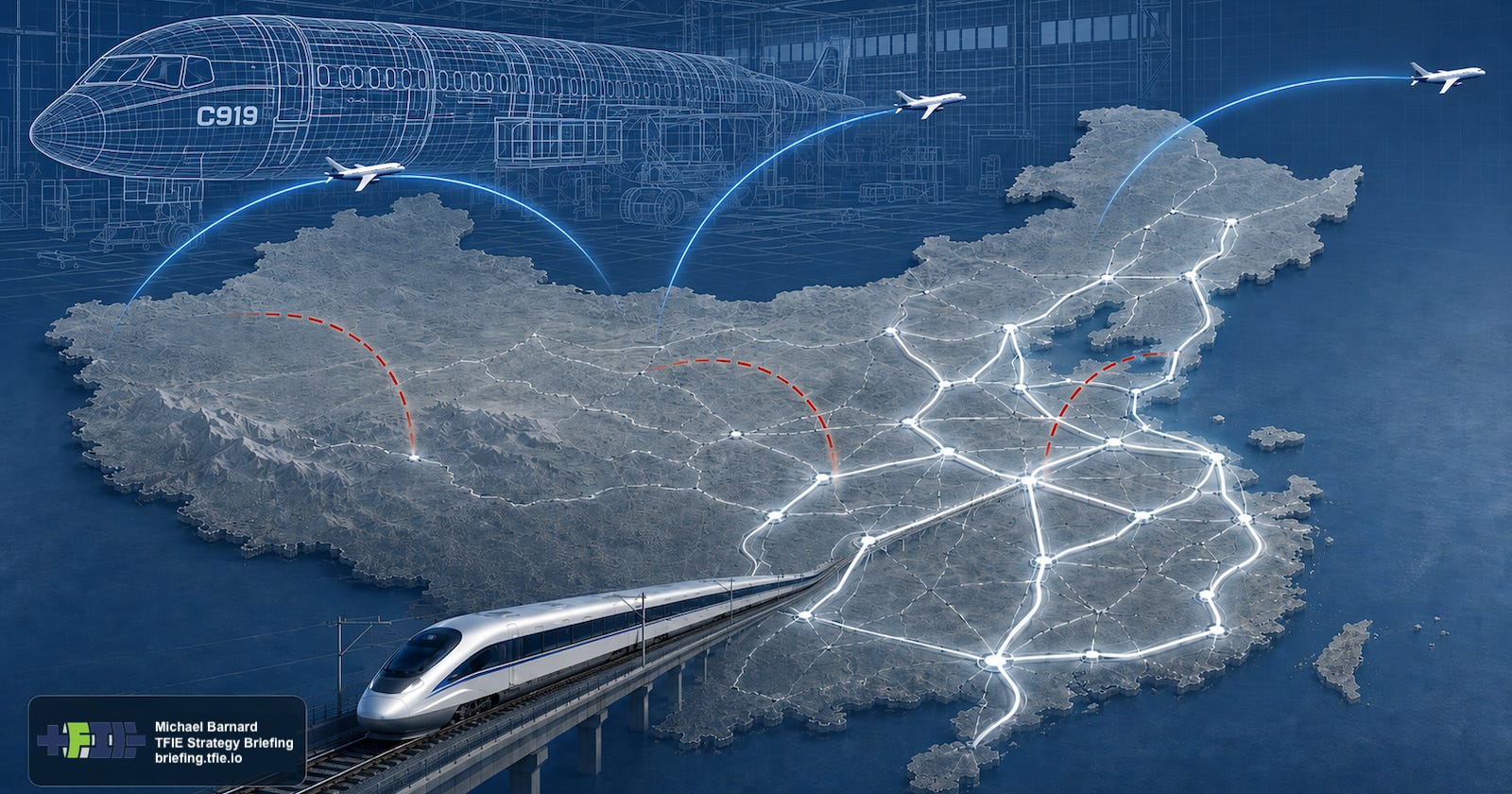
The easiest way to misread Chinese aviation is to start with aircraft demand. Boeing’s China-specific market outlook calls for Chinese airlines to need 8,830 new commercial aircraft by 2043, a number that sounds plausible if China is treated as a normal aviation growth market. But China is not optimizing for aircraft demand first. It is optimizing for moving people, reducing strategic dependence, and controlling the industrial systems that remain necessary after the modal split is changed.
That distinction matters because China has already built the strongest competitor to short-haul aviation on the planet. In China’s 2025 transport data, railways carried 4.601 billion passenger trips and 1.640 trillion passenger-kilometres, while civil aviation carried 770 million passengers and 1.399 trillion passenger-kilometres. Aviation remains important, but the average trip length tells the story: rail is doing the mass movement of people, while aviation is increasingly pushed toward the longer-distance layer where speed over distance still wins.
The sub-1,000 km market is where Boeing-style aviation growth curves are weakest. A 600 km or 900 km flight can look efficient in an aircraft demand model, but passengers do not travel from runway to runway. They travel from a district in one city to a district in another, through airport access, security, delays, bags, transfers, and city-centre recovery time. High-speed rail does not need to eliminate every short-haul flight to damage the aviation denominator. It only needs to become the default choice on enough dense corridors that airlines are left with thinner, more connection-dependent, or more geographically awkward routes.
China is still expanding that rail system from an already continental base. By the end of 2025, China had about 165,000 km of national railway, roughly 50,000 km of high-speed rail, and a network that was 76.8% electrified. Current planning points toward roughly 60,000 km of high-speed rail by 2030. That additional build does not just add passenger capacity. It removes more trips from the future pool of routes that Western aircraft manufacturers would prefer to count as narrowbody demand.
This is not an argument that Chinese aviation collapses. The transport data says the opposite. Aviation passenger-kilometres remain large because aircraft carry longer trips, and international travel has been recovering from a lower base. The point is narrower and more consequential: Chinese aviation growth becomes more selective. It shifts toward longer domestic routes, western and less rail-served corridors, international recovery, hub traffic, freight, and places where geography still favours aircraft. Dense short- and medium-distance domestic routes are being contested by state-built electric rail, not left for airlines to fill by default.
COMAC sits inside that same mobility strategy. The C919 does not need to defeat the 737 MAX or A320neo globally this decade to be strategically useful. It needs to fly domestic Chinese routes, build airline operating experience, train pilots and maintenance crews, mature CAAC certification practice, and turn state-airline procurement into industrial learning. Even the current production numbers show the scale gap. The C919 is moving from demonstration to early fleet absorption, not to Airbus-scale production, while COMAC is still ramping C919 production capacity from a much smaller base.
That is the link between modal shift and aerospace sovereignty. Rail reduces the size of the domestic short-haul aviation pool. COMAC is being assigned a growing share of the domestic narrowbody pool that remains. Low-altitude aviation, drones, electric aircraft, and eVTOLs are the adjacent learning layer rather than the core passenger story. They matter because they give China more battery, autonomy, airspace-management, certification, and aviation-manufacturing experience. Some flying-taxi claims will age badly, as they usually do, but the industrial learning is real even when the pitch deck is not.
China’s geographically awkward short hops are the place where the next aviation denominator shift should appear. Routes that are too short for jets to be efficient, too awkward for high-speed rail to serve well, and too important to abandon are natural candidates for hybrid-electric turboprops. China already has a certified four-seat electric civil aircraft in the RX4E, a low-altitude aviation sector being pulled into formal regulation, and battery giants such as CATL pushing higher-energy-density aviation batteries. My expectation is that China is more likely than the United States or Europe to be first to build, certify, and deploy an up-to-100-passenger hybrid-electric aircraft for inconvenient regional routes. That would hit Boeing’s China projection from the other side. High-speed rail erodes the dense sub-1,000 km corridors, while hybrid-electric turboprops can take the thinner short-hop routes that rail does not reach. The result is not fewer Chinese passengers moving. It is fewer of those passengers requiring Boeing-style narrowbody jets.
Boeing is the obvious collateral damage. During the tariff war, Chinese customers refused new Boeing deliveries and Boeing began redirecting aircraft. China accounted for about 10% of Boeing’s commercial backlog; Boeing had roughly 50 China deliveries scheduled for the rest of the year, 41 already-built or in-production jets to reassign, and 130 unfilled Chinese orders, including 96 737 MAXs. That was not a routine ordering pause. It showed how easily Boeing aircraft could become instruments in a wider sovereignty negotiation.
The later signal of a 200-jet Boeing tranche did not restore the old model either, because the important detail was not just the aircraft. It was the requirement for parts support. Boeing said it could provide aftermarket parts support for the order, with its services chief adding that there would be no problem supplying China “if it’s a part that we’re allowed to sell globally.” China may still buy Boeing aircraft, but it increasingly buys them as conditional capacity inside a managed supply-chain bargain.
Airbus is the completeness case, and for now the stronger Western supplier. It has less direct exposure to U.S.-China conflict, a deeper local industrial presence through Tianjin, and recent order momentum from Chinese airlines. China Eastern’s A330neo order followed a much larger A320neo-family agreement and was explicitly tied to international-route growth from Shanghai Pudong. That gives Airbus the bridge role Boeing has made harder for itself to hold.
Bridge is the key word. China’s strategy is not to replace Boeing dependency with Airbus dependency. Airbus buys time, capacity, and political flexibility while COMAC and the domestic aerospace supply chain mature. This is the same pattern that showed up in high-speed rail, batteries, solar, EVs, shipbuilding, and grid equipment: foreign technology or foreign suppliers can be useful on the way to domestic capability, but they are not the intended endpoint.
The useful question is no longer how many aircraft China needs in a generic passenger growth model. It is how many aircraft China needs after high-speed rail has removed a large share of sub-1,000 km demand from the pool, how much of the remaining domestic narrowbody market COMAC can absorb, how much of the geographically inconvenient short-hop market moves to hybrid-electric turboprops, how much Western capacity is still needed for reliability and international growth, and how much political risk Beijing is willing to tolerate in each supplier relationship.
That framing does not make Boeing irrelevant. It makes Boeing optional. Boeing will probably keep selling aircraft to China in tranches when the political price is right, airline fleet needs are pressing, or Beijing wants leverage in a broader negotiation. Airbus will likely sell more smoothly through the late 2020s. COMAC will remain slower and less globally certified than the incumbents for some time. But the direction is not hard to see. China is moving people with rail where rail works, flying people where flying still makes sense, electrifying awkward regional aviation where batteries can change the economics, and building the aircraft industry it needs for the part of mobility that remains in the air.
Boeing’s China projection becomes collateral damage because it preserves the old denominator. China is changing it. That is the point most aircraft demand forecasts miss: China is not merely a future aircraft customer. It is turning passenger mobility into an electrified rail system where possible, an aviation system where necessary, and an aerospace sovereignty project where dependence remains.
Free posts carry the public argument. Paid subscribers get the professional layer: scorecards, evidence notes, denominator checks, update triggers, and decision-grade context for people working around the transition.