

On August 12, 2026, Heart Aerospace put a very large battery-powered airplane into the air from Plattsburgh International Airport in upstate New York. The X1 weighed more than 25,000 pounds, had a 106-foot wingspan and flew for 27 minutes. It climbed to 1,100 feet above ground level and put more than a megawatt through its electrical propulsion system while taxiing, taking off, climbing, maneuvering and landing. There were no hydrogen tanks, fuel cells or gas turbines aboard as propulsion insurance. For 27 minutes, batteries flew an aircraft roughly the size of the regional machines Heart ultimately wants airlines to operate.
That matters because aviation electrification has spent much of the past decade surrounded by distractions. Billions went into electric vertical takeoff and landing aircraft whose economics, certification burdens, infrastructure requirements and constrained payload-range combinations made them poor substitutes for existing transportation. My expectation has long been that aviation will electrify first through comparatively boring fixed-wing aircraft operating short, repetitive routes. My 2021 interview with Heart founder Anders Forslund reinforced that view. Heart’s original ES-19 was not an attempt to reinvent the airplane. It was a conventional-looking 19-seat regional aircraft with electric motors, lithium-ion batteries and a claimed 400-kilometre range.
The important complication is that Heart’s commercial programme has not actually been purely electric since 2022. The company replaced the ES-19 with the 30-seat ES-30 and added two turbogenerators, describing the configuration as reserve hybrid. The propellers remained electrically driven, but fuel-powered generators could keep the electrical system supplied after the battery reached its operational limit. Heart claimed 200 kilometres of battery-electric range, 400 kilometres at full passenger load using the hybrid system and as much as 800 kilometres with 25 passengers.
That first ES-30 was a genuine series hybrid. Fuel went into a turbine, the turbine drove a generator, electricity moved through the electrical system and an electric motor finally turned the propeller. There is an unavoidable efficiency penalty in doing that rather than connecting a turbine through a gearbox directly to the propeller. Generator, power-electronics and motor efficiencies can all be high, but they multiply rather than disappear.
Heart then changed direction. In 2024 it moved to what it called Independent Hybrid propulsion, with two battery-electric propellers and two separate conventional turboprops. At the aircraft level it was effectively an independent parallel hybrid. The turbines no longer generated electricity. They directly drove their own propellers, while a separate pair of electric motors supplied battery-electric propulsion. That solved one problem while making another highly visible: the aircraft had four nacelles, four propellers and two complete forms of propulsion. An electric flight carried unused turbines, gearboxes, propellers and fuel-system machinery, while a long hybrid flight carried an electrical propulsion system powerful enough to fly the aircraft independently. Heart had avoided the conversion losses and some of the integration problems of series hybridization by creating an aircraft with a lot of duplicated equipment.
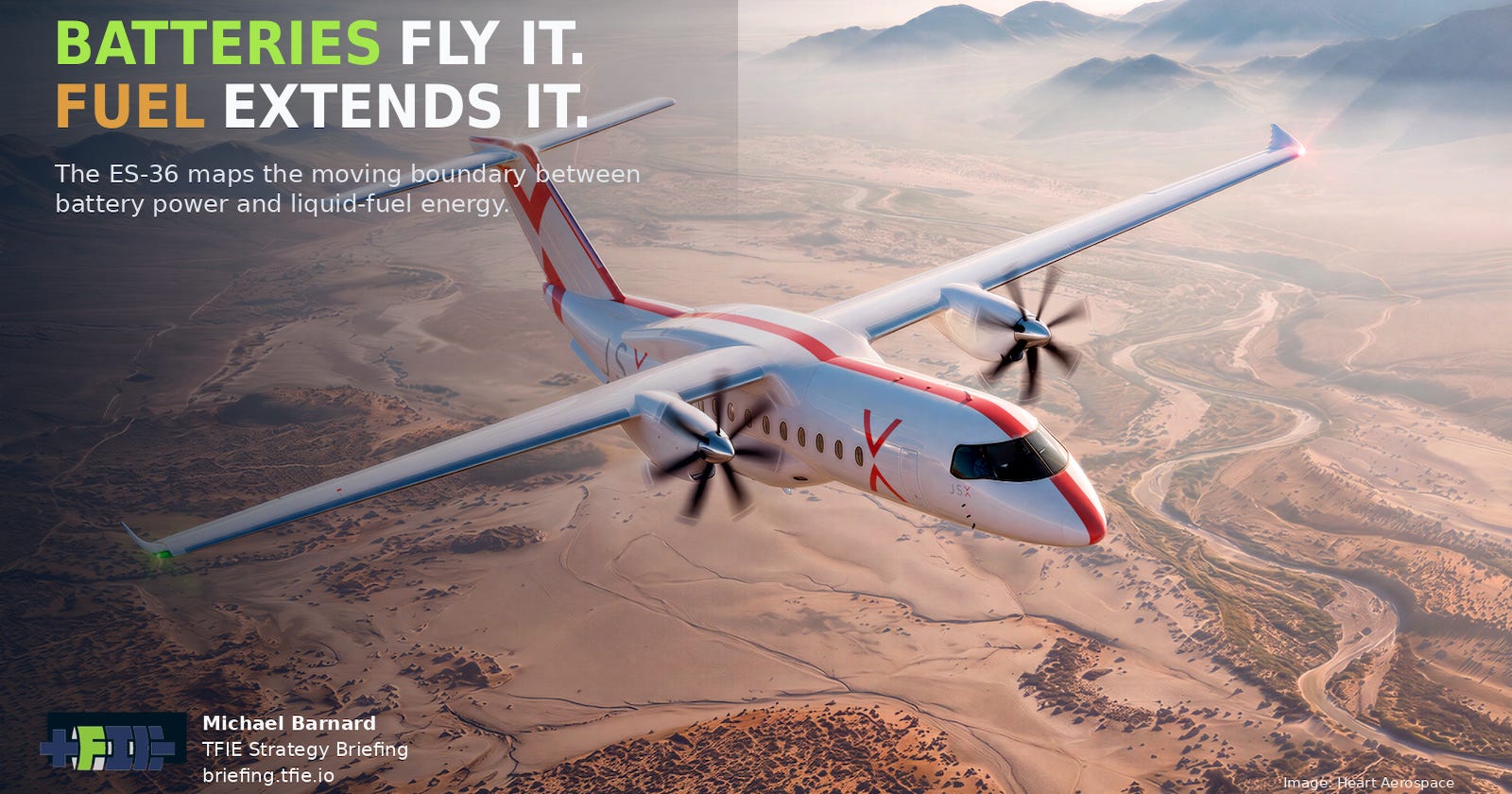
The newly revealed ES-36 reverses that decision. Heart has returned to series hybridization, but now with only two nacelles and two propellers, both permanently driven by electric motors. Each nacelle contains an electric propulsion motor and its own turbogenerator system rather than the aircraft carrying another pair of mechanically driven thermal propellers. Heart says the redesign adds six passenger seats and 1,415 pounds of payload while retaining the preceding aircraft’s maximum takeoff weight and battery capacity, and reduces wingspan by about 11 feet.
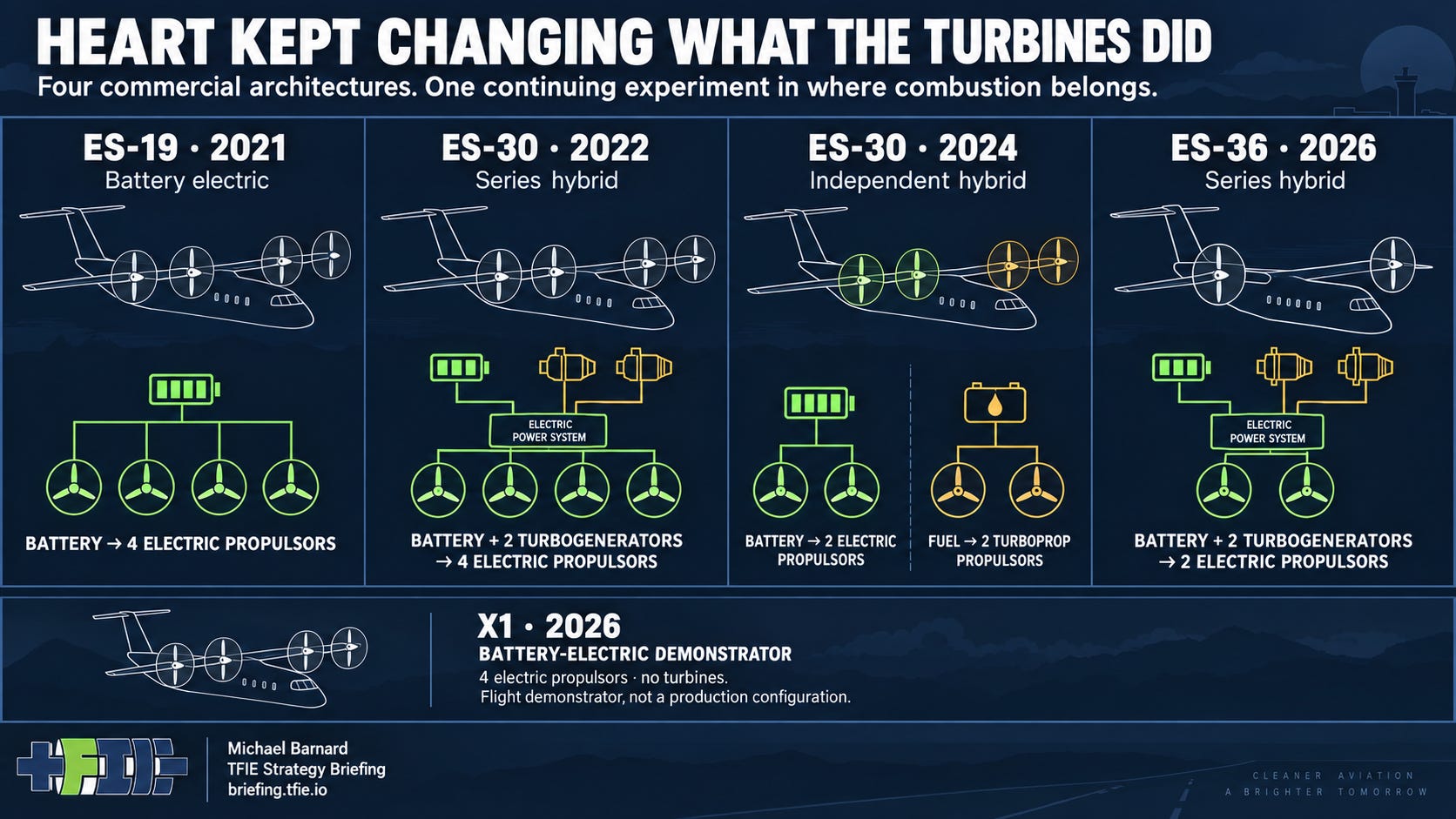
The architecture has zigzagged because Heart has repeatedly changed where combustion sits in the propulsion chain. The 2022 ES-30 separated combustion from propeller drive by using generators, the 2024 Independent Hybrid put turbines mechanically back onto two propellers, and the ES-36 separates them again. In the current architecture, gas turbines no longer drive propellers mechanically. Their function is to make electricity when the mission requires more energy than Heart considers practical to carry in batteries.
That leaves the interesting contradiction at the centre of the aircraft. X1 has demonstrated that batteries can provide enough power to fly a regional-aircraft-scale machine, yet Heart still considers turbines necessary for a commercially flexible airplane beyond about 200 kilometres. The explanation is not simply that batteries are “too heavy.” It lies in a distinction that gets blurred constantly in electric-aviation discussions: the amount of power an aircraft needs at one moment is not the same thing as the amount of energy it needs over the whole flight. How Heart exploits that distinction determines what the ES-36 actually is at 200, 600 or 1,200 kilometres—and how much better batteries could change the answer.
The interesting question, then, isn’t whether the ES-36 is “really electric.” It’s how quickly its fuel-burning portion shrinks as batteries improve, which missions actually benefit most, and whether the hybrid machinery still earns its place once the comparison is made against an efficient turboprop rather than an easy-to-beat regional jet.