

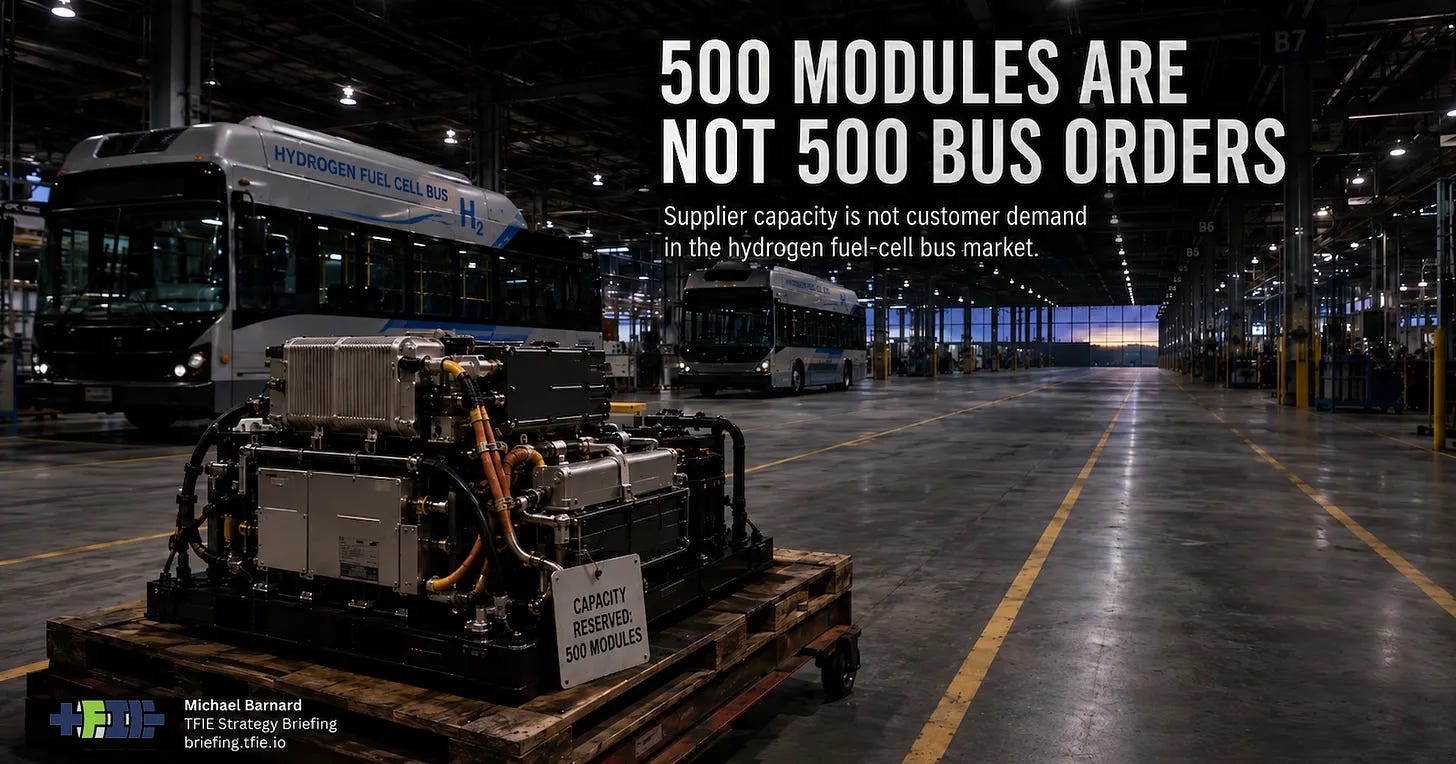
Five hundred fuel-cell power modules sound like evidence of 500 buses. They are not. Ballard Power Systems and New Flyer announced a commercial framework covering up to 500 fuel-cell power modules, or roughly 50 MW of capacity, for hydrogen transit buses beginning in 2026. Ballard described it as its largest single commitment from New Flyer, but not as backlog, a firm purchase order or a take-or-pay agreement. As the original announcement and market assessment made clear, the agreement reserves supply if customers appear. It does not establish that transit agencies have committed to buy the buses.
That distinction is the central commercial issue. A supplier framework can make sense when both companies want to preserve an option on future demand. Ballard wants to protect one of the transport segments where its fuel cells remain relevant, while New Flyer wants modules available if funded projects materialize. Both benefit from signalling confidence to customers, investors and policymakers. None of that turns hoped-for demand into an order book.
The North American full-size hydrogen transit-bus market is nowhere near large enough for 500 additional buses to be treated as an ordinary supply commitment. Public sources frequently mix buses that are funded, announced, ordered, delivered and operating, making the market appear larger and more stable than it is. CALSTART’s adoption counts are useful for understanding the total pipeline, but they are not a clean record of annual customer commitments.
When the market is reconstructed from identifiable public awards, board approvals and procurements, it is small and lumpy. Visible North American orders reached 288 buses in 2023, fell to 96 in 2024 and dropped to 45 gross orders in 2025 before known reversals were deducted bringing it. A reconstruction using only currently visible 2025 commitments produced a figure closer to 15. The precise final number may move as records are clarified, but neither interpretation looks like a market scaling steadily toward 500 additional buses.
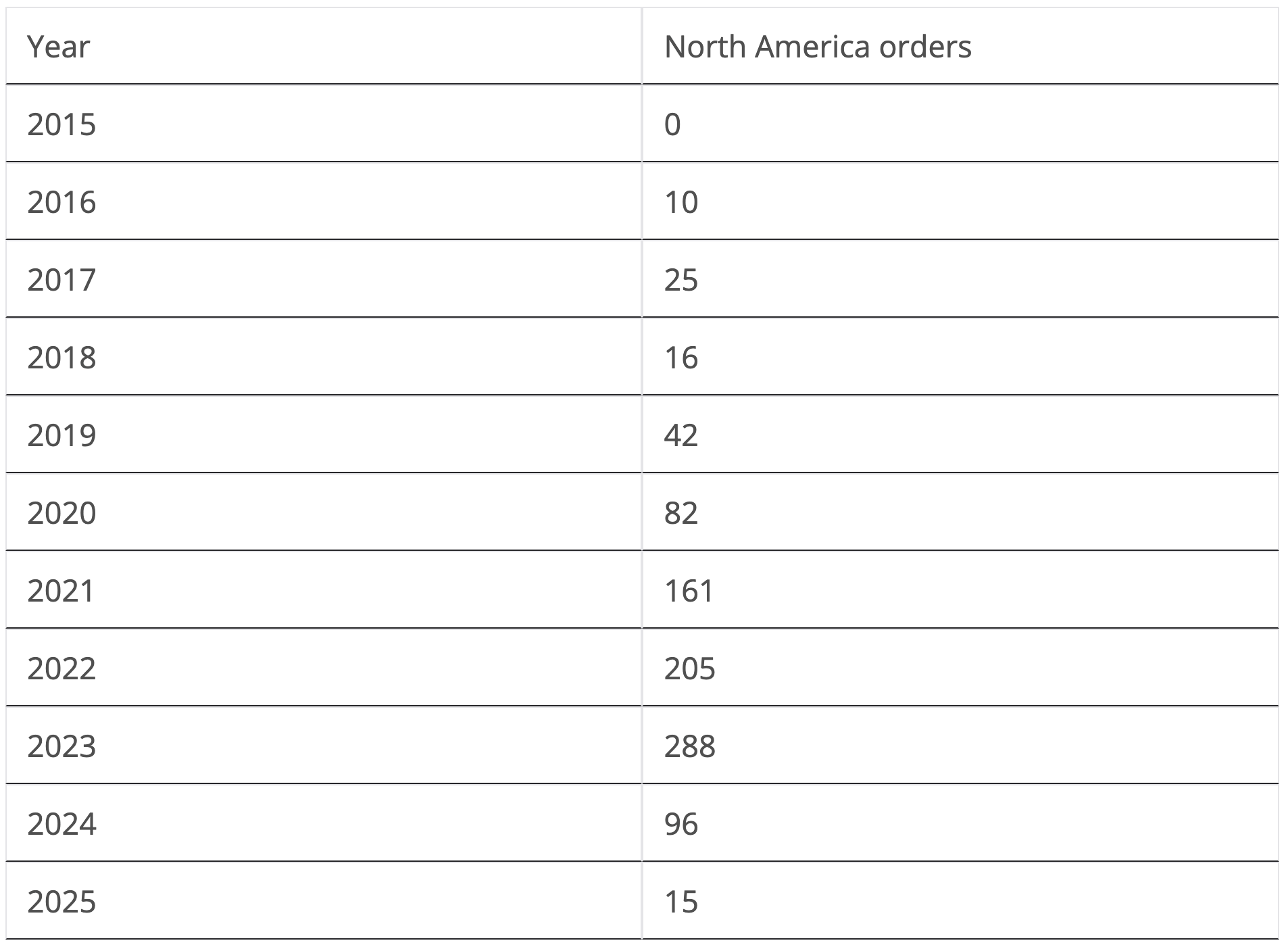
The 2023 peak itself was dominated by a few large procurements. SamTrans’ order for 108 buses represented more than a third of the annual total. In a broad and scaling market, a single customer order of that size would be important without determining the shape of the entire year. Here it did. The apparent growth curve was largely a sequence of policy-supported projects rather than expanding repeat demand across many agencies and jurisdictions.
The market also cooled while unusually favourable US policy remained in place. Orders dropped sharply in 2024, when Inflation Reduction Act support and hydrogen subsidies were still available. That does not prove annual demand can never recover, especially in a market small enough for one project to produce a large percentage swing. It does make the 500-module figure a poor proxy for demonstrated adoption.
The same pattern is visible in Europe. Hydrogen-bus deliveries plateaued in 2024 and 2025 while the order book behind them had already weakened. Because buses often arrive one or two years after procurement, delivery announcements can make the market look healthy after new customer commitments have begun to disappear. Europe’s broader experience increasingly shows battery-electric buses winning on lifetime economics and availability while hydrogen fleets remain exposed to costly fuel and specialized infrastructure. The hidden cost of Europe’s hydrogen-bus experiment was fragmented investment and delayed scale in the stronger electric pathway.
North America’s hydrogen-bus market is also concentrated to an unusual degree. CALSTART’s 2025 full-size transit-bus data counted 690 California fuel-cell buses somewhere in the funded, ordered, delivered or deployed pipeline, compared with about 920 across the United States. Roughly four-fifths of the national pipeline was therefore located in one state. Outside California, only 165 buses were spread across 15 states, with Nevada accounting for 52 and most other states in the low double digits or single digits.
This is not a diversified continental market. It is a California-centred market with a small outer ring. That matters because California has provided the country’s strongest and most persistent policy support for hydrogen transportation. If hydrogen buses were going to develop durable commercial footing anywhere in North America, California was the obvious proving ground.
Even there, the economics remain fragile. The California Transit Association’s 2025 legislative program said transit agencies faced financial and operational pressure from zero-emission deployment and specifically asked for action to reduce the prohibitive cost of hydrogen fuel. NREL’s analysis of California’s Innovative Clean Transit transition found that a 25-bus fuel-cell fleet replacing compressed-natural-gas buses retained a negative net present value even with Low-No funding. A comparable battery-electric case produced positive net present value and a discounted payback a little over six years against the diesel baseline because of lower operating and maintenance costs.
The issue is not whether hydrogen buses can be made to operate. They can. The question for a transit agency is whether they deliver enough operational value to justify higher vehicle costs, a separate fuel system, specialized maintenance, supplier concentration and continuing exposure to hydrogen prices. That is why hydrogen buses should be treated as a procurement risk premium rather than a transit-decarbonization shortcut.
Foothill Transit provides the clearest recent demonstration. It was not an outside critic of hydrogen. It was an early California adopter with buses, staff experience and hydrogen infrastructure already in place. When US Department of Energy support associated with California’s ARCHES hydrogen hub was terminated, Foothill reported the loss of about $300,000 per bus, $4 million for a new hydrogen station and $1 million for upgrades to an existing station. The federal program cuts exposed how much of the economics depended on stacked public support.
At the same time, California’s HVIP point-of-sale subsidy program was oversubscribed and uncertain. Foothill staff told its board that converting a proposed 30-bus hydrogen procurement and its fueling work to compressed natural gas would save about $27.6 million upfront and about $1.8 million annually in fuel. Moving from a nominally zero-emission technology back to a fossil-fuel bus was not a climate success, but the decision exposed the commercial structure. The buses, stations and fuel all required separate layers of assistance for the project to remain viable.
Battery-electric buses also receive public support, but their infrastructure is less brittle. Charging equipment connects to the electricity system that already serves every depot. Capacity can be expanded in stages as buses arrive. Agencies can sequence chargers, grid connections, storage and fleet replacement rather than committing early to a fuel-production, delivery and dispensing chain sized around uncertain utilization. The electricity system is becoming larger, cleaner and more capable regardless of whether a particular transit procurement proceeds.
California’s own fleet pipeline reflects that difference. As of July 2025, CALSTART counted 1,933 battery-electric transit buses in the state, compared with 690 fuel-cell buses. Even in the strongest hydrogen-bus jurisdiction on the continent, battery-electric buses outnumbered fuel-cell buses by almost three to one.
The wider vehicle market makes the divergence clearer. California had about 10,659 deployed zero-emission medium- and heavy-duty trucks by mid-2025, while the entire United States had only 197 deployed hydrogen trucks. California registered 378,216 new zero-emission light-duty vehicles in 2025, with battery-electric vehicles representing 20.9% of the market. Fuel-cell vehicles rounded to 0.0% in the same reporting. CARB counted 14,128 active fuel-cell cars in April 2025, the first recorded year-over-year decline in the active fleet.
Hydrogen road transport has not broadened from cars to trucks and buses. It has been progressively contained in a handful of supported fleets and applications. The wider pattern is examined in Hydrogen Transport Has Been Contained, Not Commercialized.
Infrastructure follows demand. California had more than 200,000 public and shared electric-vehicle charging ports by September 2025, in addition to an estimated 800,000 Level 2 chargers at single-family homes. The state had 61 hydrogen stations in August 2025, of which only 50 were open for retail service and 11 were temporarily unavailable.
In early March 2026, about 70% of the retail hydrogen stations were unavailable after a combination of a hydrogen-delivery truck explosion, compressor failures, seal failures and other disruptions. The outage received limited attention because the network serves so few customers. The episode showed how a geographically visible hydrogen network can remain commercially and operationally fragile.
The problem is not simply the number of stations. Hydrogen refueling is a specialized overlay requiring production, purification, compression or liquefaction, distribution, storage, dispensing, maintenance and enough utilization to pay for the equipment. Assessments of hydrogen-station economics in British Columbia found operating and maintenance costs exceeding hydrogen-sales revenue before recovery of capital expenditure was considered.
Supply concentration creates another risk. New Flyer is not the only manufacturer ever to have supplied a fuel-cell transit bus in North America, but it is now effectively the only active full-size bus original-equipment manufacturer in the market. ElDorado National–California previously supplied buses, including vehicles for SARTA, but subsequently wound down bus manufacturing. Canadian transit agencies have similarly identified New Flyer as the only current Canadian supplier of full-size fuel-cell buses.
A sole supplier may be acceptable for a pilot. It is a warning sign for a supposed growth market. Transit agencies have to consider vehicle price, parts availability, warranties, midlife support and what happens when the supplier changes strategy. New Flyer’s hydrogen position is especially awkward because it risks allowing the company to win a narrow fuel-cell segment while losing share in the much larger battery-electric market.
Other hydrogen-vehicle manufacturers have already left the field. The repeated failures, restructurings and withdrawals across cars, trucks, buses and trains are not independent accidents. They reflect weak end-user economics and the burden of building a vehicle and a parallel fuel system at the same time. Hydrogen transportation did not fail in only one market in 2025.
Canada adds little volume to change the assessment. On a strict public-order basis, the Canadian full-size fuel-cell transit-bus market between 2015 and 2025 amounted to about 20 confirmed orders, with only 10 confirmed physical deliveries or receipts during that period. The market has also been influenced by guidance from CUTRIC, a transit organization whose members and funders included Ballard, New Flyer and a major gas utility while it advocated blended fleets that required hydrogen buses. Those conflicts should have been much more visible to transit agencies.
Edmonton and Strathcona County each received one bus for an Alberta pilot, but subsequent hydrogen-bus plans were cancelled as costs rose. The buses were not placed into ordinary scheduled service, and the hydrogen station south of Edmonton on which the program depended closed. Temporary fueling shifted to hydrogen produced from methanol, creating emissions far above those of low-carbon electricity and potentially above diesel on a service-equivalent basis. The Alberta trial contracted before it became a fleet.
Winnipeg ordered eight New Flyer fuel-cell buses and had received them by 2025 after previously cancelling purchases when program costs rose. Temporary tube-trailer delivery of grey hydrogen left the buses with fuel-cycle emissions estimated at 60%–70% of diesel, vastly higher than battery-electric buses operating on Manitoba’s very low-carbon electricity. Winnipeg’s broader procurement history also demonstrated that high zero-emission bus costs can push agencies back toward diesel.
Mississauga ordered 10 fuel-cell buses expected in 2026. Before adding more, the city should require a complete accounting of delivered hydrogen cost, carbon intensity, station utilization, backup fueling, maintenance, route availability and long-term supplier exposure. Those are among the questions in the hydrogen workshop transit agencies actually need.
Brampton’s planned hydrogen buses do not materially change the continental denominator. The recommendation emerged from CUTRIC modelling that imposed a blended battery and hydrogen fleet while excluding or understating major system costs. The analysis avoided roughly C$1.5 billion in costs while producing a fleet with higher emissions. Even when planned Canadian projects are included, Canada represents only around 5%–6% of the reconstructed North American market.
The demand evidence therefore remains concentrated overwhelmingly in the United States and especially California. For anything close to 500 additional buses to emerge, the procurement trail should already show a widening group of states, repeat orders from experienced operators, stable fuel support, funded station projects and annual volumes approaching the framework’s scale. It does not.
The update trigger is conversion, not repetition of the 500 figure. The agreement becomes evidence of market formation when identifiable transit-agency awards, board approvals, firm bus orders, funded depots, contracted hydrogen supply and delivered vehicles appear at corresponding scale. Until those categories fill, the 500 fuel-cell power modules belong in the supplier-capacity column rather than the customer-demand column.
Projecting current conditions forward points to battery-electric buses becoming the standard compliance pathway. Hydrogen may persist at agencies with sunk refueling infrastructure, political commitments or unusual reluctance to redesign charging and operations. Persistence at a few agencies is not scale, and sunk infrastructure does not guarantee continuation. Aberdeen had operating experience, refueling equipment and long-standing political commitment, yet abandoned its hydrogen-bus fleet after years of high costs and poor availability.
Rail provides a similar supplier lesson. Alstom invested heavily in hydrogen trains and became the segment’s best-known manufacturer, then retreated as orders failed to develop beyond a small group of subsidized projects. Winning most of a shrinking market is not necessarily a sound industrial strategy.
Solaris faces the same tension in Europe. Its fuel-cell buses have secured orders, but the organization and engineering capacity required to maintain hydrogen as a parallel platform can weaken competitiveness in battery-electric buses. Solaris is winning the wrong race when fuel-cell leadership comes at the expense of the technology taking most of the market.
Wrightbus illustrates the more likely direction of travel. Its public identity remained closely associated with hydrogen, but the company increasingly became an electric-bus business because that was where the orders were. The hydrogen story turned into an electric-bus business when customer demand, rather than political branding, determined the product mix.
Ballard and New Flyer have rational reasons to preserve optionality. Ballard wants to defend one of the remaining transport applications for its fuel cells. New Flyer wants to respond if funded procurements appear. Both firms benefit from a large headline number that reassures policymakers and investors that the market may yet emerge.
Transit agencies have to apply a different test. They procure a bus-plus-fuel system, not a fuel-cell power module. The relevant comparison includes vehicle cost, depot infrastructure, energy supply, fuel-chain reliability, operating expense, maintenance, uptime, warranties, supplier diversity and continuing dependence on public support. On those measures, battery-electric buses are becoming the repeatable procurement platform while hydrogen remains concentrated in a small number of heavily supported fleets.
The broader hydrogen transition is narrowing in the same way. Hydrogen remains necessary for fertilizer, refining during its decline, selected chemical processes and a limited number of other molecular applications. It does not become the new oil merely because suppliers need growth markets. The transport contraction is part of the longer pathway assessed in Hydrogen Demand Through 2100.
The 500-module framework should trigger a search for 500 funded bus orders. Until the customers, depots, fuel contracts and procurement approvals exist, it is a statement of supplier optionality in a market that has not demonstrated the ability to absorb anything close to that volume.
Subscribe to TFIE Strategy Briefing for decision-grade analysis of transit procurement, hydrogen claims and the practical electric alternatives.
Originally published at CleanTechnica.