

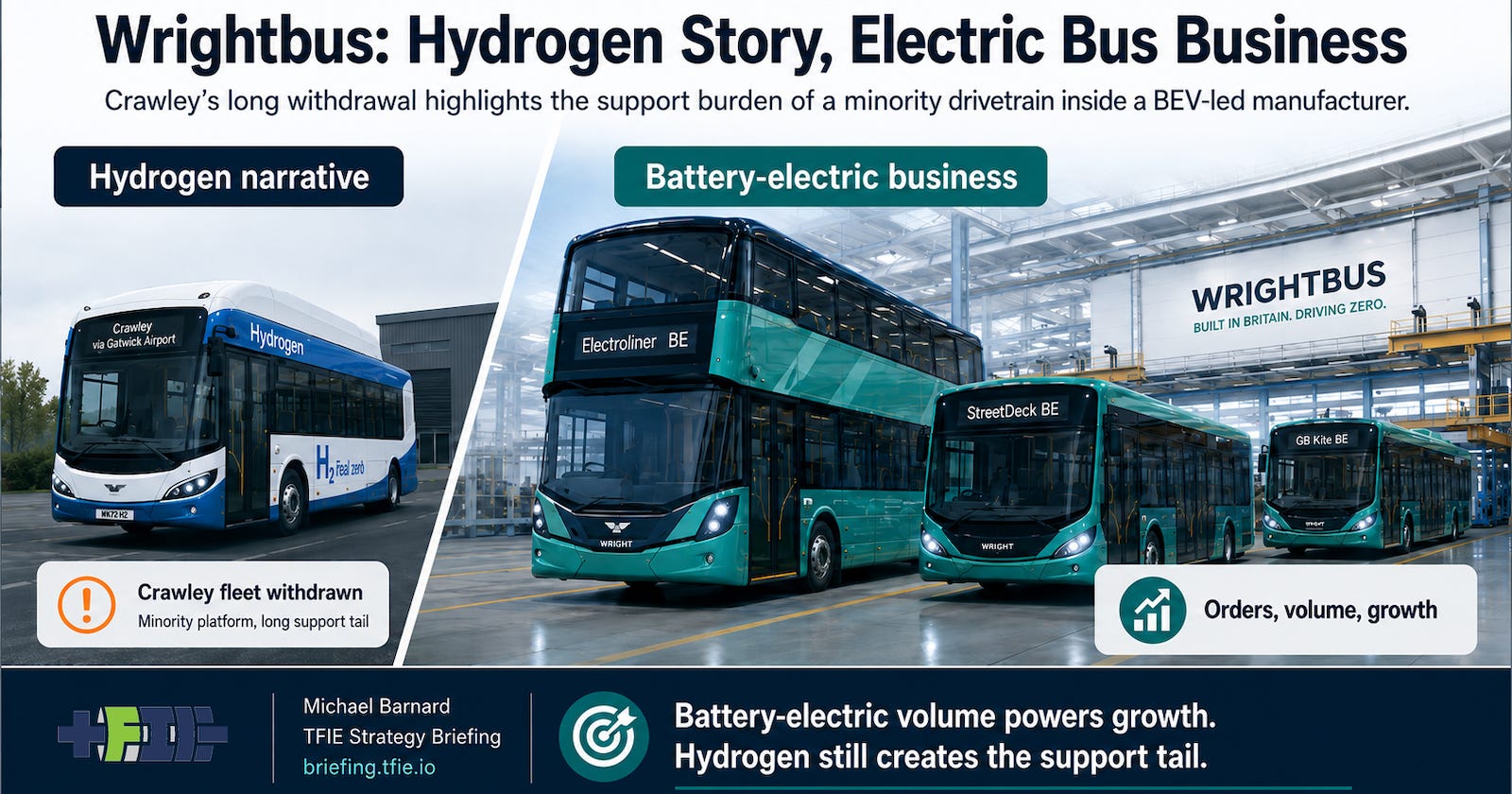
Wrightbus is one of the more interesting contradictions in Britain’s hydrogen story. The company was rescued from administration by Jo Bamford, surrounded by one of the loudest hydrogen advocacy networks in the UK, and rebuilt with hydrogen buses as part of its public zero-emission identity. Yet the company that has actually emerged from the rescue is, by volume and commercial gravity, mostly a battery-electric bus manufacturer.
That matters because Wrightbus is not a fringe startup trying to find product-market fit in public. It is a storied Ballymena bus maker founded in 1946, long embedded in UK and Irish fleets, visible in London through the New Routemaster, and now one of Britain’s more prominent examples of industrial-policy revival. Wrightbus’s turnaround is real. The interesting question is not whether the company survived, because it clearly did. The useful question is what actually carried the turnaround.
The Crawley hydrogen bus fire gives that question a concrete edge. Metrobus’s hydrogen fleet in the Crawley and Gatwick area has been sidelined for months after a serious incident, and public reporting so far points more toward an electrical or battery-overheating investigation than a hydrogen tank or hydrogen release event. That distinction matters. A hydrogen fuel cell bus is still an electric bus, with high-voltage equipment, power electronics, thermal management, and a battery buffer, so a lazy “hydrogen bus caught fire” framing misses the technical point.
Wrightbus’ rebirth has often been wrapped in hydrogen language, and that was unsurprising. The Bamford orbit has been one of the loudest hydrogen voices in Britain, with JCB’s Lord Bamford pushing hydrogen hard for heavy machinery and hydrogen combustion. Jo Bamford came to Wrightbus with hydrogen ventures and hydrogen branding around him, and Wrightbus’s hydrogen double-decker gave the company a clean industrial-policy story at exactly the moment governments wanted visible green manufacturing, domestic jobs, and public transport decarbonization. Hydrogen was useful politically, commercially, and narratively.
But the market has been doing something more prosaic. It has been buying electric buses. Wrightbus reported turnover rising from £257.8 million in 2023 to £455.1 million in 2024, with the company saying production efficiencies and a full order book drove the 77% revenue jump. The Irish News reported that Bamford Bus Company, trading as Wrightbus, swung from a £10.2 million pre-tax loss in 2023 to a £31.1 million pre-tax profit in 2024. This is not a current distress story. It is a rescue-to-scale story, and the scale is coming mostly from battery-electric buses.
The drivetrain denominator is the useful one. Wrightbus built 427 buses in 2022, 623 in 2023, 1,016 in 2024, and expected more than 1,200 to leave the factory in 2025. Public reporting on Wrightbus’s own 2025 plans described around 95% of 2025 production as expected to be battery-electric vehicles. The big customer signal is just as clear. Go-Ahead announced a £500 million investment in up to 1,200 UK-built electric buses from Wrightbus over three years. That is the kind of order that fills factory lines, supports supplier commitments, justifies financing, and gives management something real to plan around.
Hydrogen is still present, and the caveat matters. Wrightbus still markets the Hydroliner, still has German hydrogen customers, and is still improving the hydrogen double-decker, including commonality with its single-deck Kite Hydroliner to make mixed fleets less complex to maintain. It is not credible to say Wrightbus has abandoned hydrogen. It is credible to say that hydrogen is no longer the commercial centre of the story, if it ever was. Hydrogen gave Wrightbus visibility, political utility, and early differentiation. Battery-electric buses gave it volume.
That is what makes Crawley more interesting than a simple fire story. Metrobus’s hydrogen fleet in the Crawley and Gatwick area was not a toy deployment, as a 54-bus hydrogen fleet is material in UK hydrogen bus terms. But it is small beside the BEV order book now shaping Wrightbus’s future. A months-long withdrawal of hydrogen buses after a serious fire therefore sits in an uncomfortable place. It matters to passengers, operators, local authorities, insurers, firefighters, and Wrightbus’s reputation, but it does not define the company’s growth engine.
This is the minority-platform support problem. When a manufacturer sells a minority drivetrain into public service, it does not get to treat it as a demonstration forever. The buses still need warranty support, parts, root-cause analysis, safety assurance, software or hardware fixes, depot procedures, operator confidence, and eventually a defensible return-to-service decision. Hydrogen vehicles have the usual electric-drive failure modes plus the added fuel-cell and hydrogen-storage layer. When something goes wrong, the recovery path can be slow even when hydrogen itself is not the initiating fault.
Aberdeen makes the same point from a different angle. The city’s 25 Wrightbus hydrogen double-deckers were launched as a world-first fleet, with the first 15 entering service in early 2021 and a further 10 following in 2022. The project had the full hydrogen-transition treatment: public funding, civic ambition, a hydrogen-hub narrative, and buses presented as proof that the pathway was moving beyond demonstration. But the fleet was parked for more than a year after hydrogen supply and refuelling problems, and Aberdeen City Council moved in 2026 to sell the buses after ending its joint venture with BP. That is not the same failure mode as Crawley, but it is the same professional lesson. Hydrogen buses do not just require buses. They require a fuel system, repair ecosystem, specialized support, and a market for used assets when the first owner gives up.
That support-tail problem is one reason hydrogen buses are a procurement risk premium, not a transit decarbonization shortcut. Transit agencies do not buy press releases. They buy service hours, reliability, maintainability, fuel supply, training, depot operations, and the confidence that the asset will still be supportable after the ribbon-cutting has faded. That is where hydrogen buses keep running into the same denominator problem: higher delivered energy cost, more specialized infrastructure, thinner supplier support, and fewer repeat-procurement signals than the battery-electric alternative.
The same pattern shows up in the operating-cost evidence. In Poland, hydrogen buses became a fuel-cost problem, not merely a technology-choice curiosity. In Germany, hydrogen refuelling looks impressive until the utilization denominator is applied. Those are not identical cases to Crawley, but they point in the same direction. Hydrogen transport projects often look coherent at the announcement stage and much less coherent when fuel cost, reliability, infrastructure utilization, and fleet availability are measured in service.
The broader hydrogen transport pattern has been visible for a while. My assessment has been that hydrogen transport has been contained, not commercialized. The phrase matters. Contained does not mean absent. There are real buses, trucks, trains, ferries, refuelling stations, pilots, grants, and operating fleets. It means the pathway remains concentrated in narrow niches, subsidy-shaped procurements, long pilots, and public-sector programs that struggle to become broad repeat markets when battery-electric options are available.
The same structural lesson showed up in European hydrogen rail. Lower Saxony’s hydrogen trains did not merely run into the usual cost and infrastructure problem. They exposed reliability and supplier-support problems in real public service. Alstom could not shrug and say the market had moved on, because Alstom had trains in service, customers to satisfy, and obligations to maintain. Once hydrogen vehicles are delivered, the product line becomes a long-term support commitment.
Wrightbus is not Alstom, and buses are not trains, so the analogy should not be pushed too far. But the business logic is similar. A company can decide that the future volume is battery-electric while still owning the operational consequences of hydrogen fleets already sold. That is not abandonment. It is the inconvenient arithmetic of a minority platform, especially when safety, warranty, public confidence, and field reliability all become visible at the same time.
There is also an important limit to what the public record supports. It does not prove that Wrightbus has deprioritized Crawley, and it certainly does not prove intentional neglect. Serious vehicle fires involving high-voltage systems can take a long time to resolve because the bar is not “we think we know what happened.” The bar is closer to “we know what happened, know which vehicles are affected, know the remedy, have applied it, have tested it, and can defend putting passengers back on board.” That is a higher standard, and rightly so.
Still, the broader interpretation is hard to avoid. Wrightbus’s recovery is often narrated as a hydrogen-adjacent green manufacturing success. More precisely, it is a battery-electric bus scale-up with a continuing hydrogen hangover. Hydrogen remains useful for political storytelling, selected routes, and a handful of customers with funding and infrastructure appetite. Battery-electric buses are where the volume is, where the orders are, and where the company’s post-administration recovery is being anchored.
That should be the lesson for policymakers and investors. Announcements are not the same as operating fleets. Demonstrators are not the same as repeat procurement. A visible hydrogen brand is not the same as a hydrogen-led business. The practical denominator is production mix, order book, service reliability, and which product line customers keep buying when they have alternatives. That is why denominator discipline shows up across the transition, from hydrogen buses hurting the people they are meant to help to China’s hydrogen trucks remaining a policy side bet, not a market winner.
Wrightbus deserves credit for surviving, rebuilding, and scaling manufacturing in Ballymena. That is not a small achievement, especially in a country that spends a lot of time talking about industrial strategy and rather less time successfully doing it. But the irony is sitting in plain sight. One of Britain’s most prominent hydrogen-linked industrial stories is increasingly being carried by batteries, while the hydrogen fleet in Crawley sits as a reminder that minority drivetrains do not disappear when the market moves on.
Crawley does not prove that hydrogen caused the fire. It does show why minority drivetrains become awkward when the main market has chosen a different road. The hydrogen buses still have to be fixed, supported, insured, explained, and either returned to service or replaced. Meanwhile, the factory story has moved toward electric buses in volume. The hydrogen narrative helped sell the rebirth. The battery-electric order book appears to be paying for it.
Free posts carry the public argument. Paid TFIE Strategy Briefing posts provide the professional layer: evidence notes, denominator checks, update triggers, and decision-grade context for people working around the transition.