

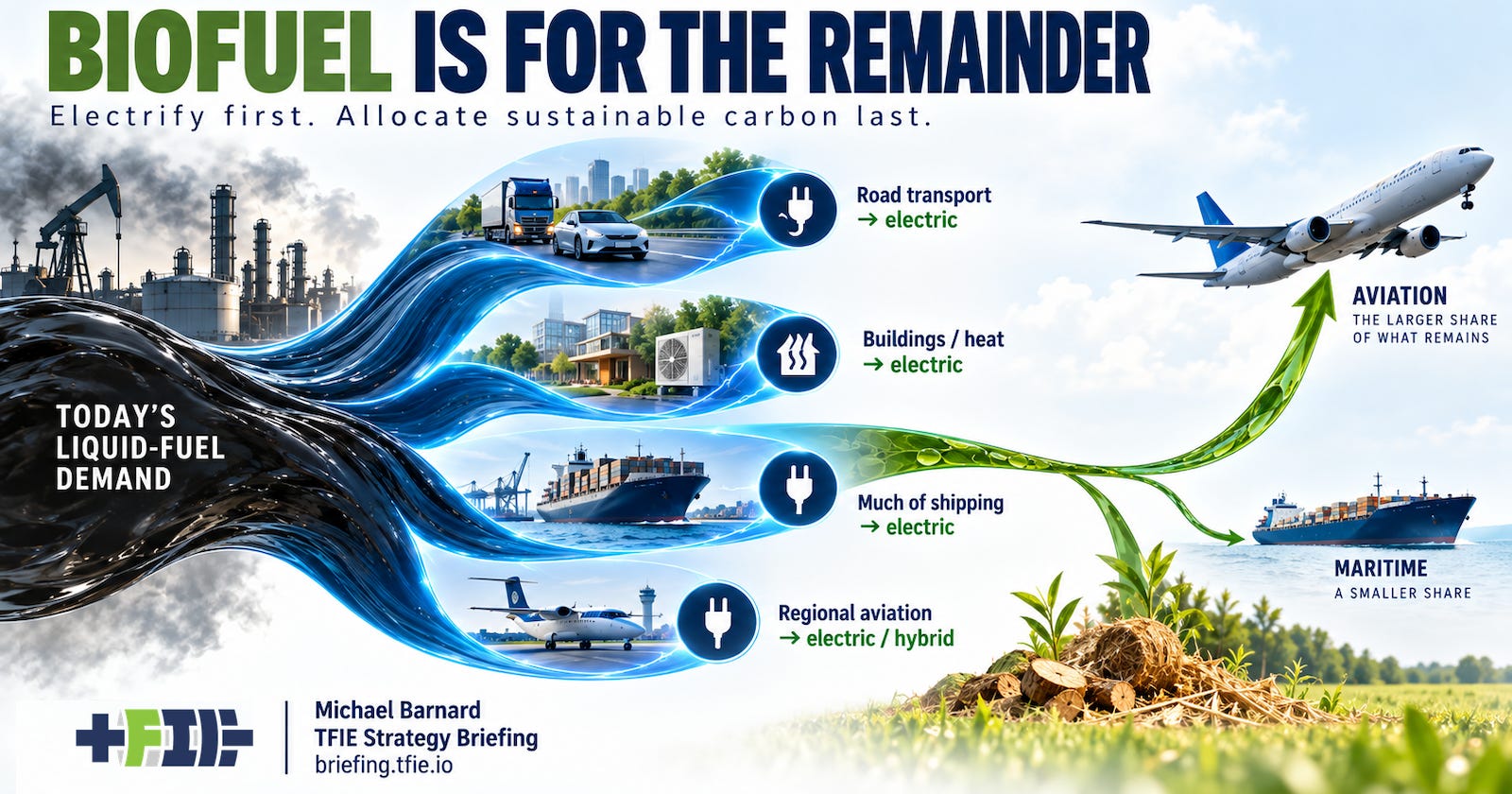
Three and a half years ago I published a CleanTechnica article with a title that left little room for ambiguity: “Yes, There Will Be Enough Biofuels; No, They Won’t Impact Food Supplies.” The core insight behind it has aged reasonably well, but the certainty of the second claim has not. My argument was that most assessments started with the wrong denominator. Cars, trucks, buses and much of rail did not need low-carbon replacements for every litre of gasoline and diesel because they were going electric. A substantial portion of inland, coastal and working-vessel shipping would electrify too, while aviation would increasingly split between electric or hybrid-electric regional service and liquid-fuel long-haul flying. Once those direct-electrification wedges were removed, biofuels only had to serve the difficult remainder. I still think that is the right framing.
Where I was too casual was on the supply side. I treated roughly half of global corn, wheat and rice stalks as potentially available for fuel production, compared that resource with my then-projected aviation demand and concluded that the numbers were obviously adequate. I also argued that residues did not compete with food and that aggregate global calorie production made broader food-security concerns largely beside the point. That collapsed several different constraints into one convenient number. Residues already perform agronomic and economic functions, food security depends on prices and purchasing power as well as global tonnage, and non-food biomass can still compete for land, water and fertilizer. Above all, a tonne of biological material somewhere in an agricultural system is not equivalent to a tonne of specification fuel available at an airport or port.
Since then I have rebuilt my aviation energy pathway through 2100, corrected the projection after the post-COVID rebound proved substantially stronger than I had assumed, and substantially reworked my maritime energy pathway as better fleet-wide electrification evidence became available. Those revised pathways leave roughly 18 EJ per year of aviation and maritime liquid-fuel demand in 2050, falling to about 11 EJ per year by 2100. That is radically smaller than trying to replace the existing petroleum economy molecule for molecule, but it is large enough that feedstock availability, conversion efficiency, competing uses and industrial scale still matter.
The arithmetic is more reassuring and less comfortable than the old headline suggested. Once electrification has removed most of the easy combustion demand, the remaining biofuel problem looks physically manageable. But getting from gross biomass potential to sustainable, specification fuel exposes constraints in soils, food systems, feedstock logistics and industrial conversion that disappear when everything is reduced to a headline number of tonnes.