

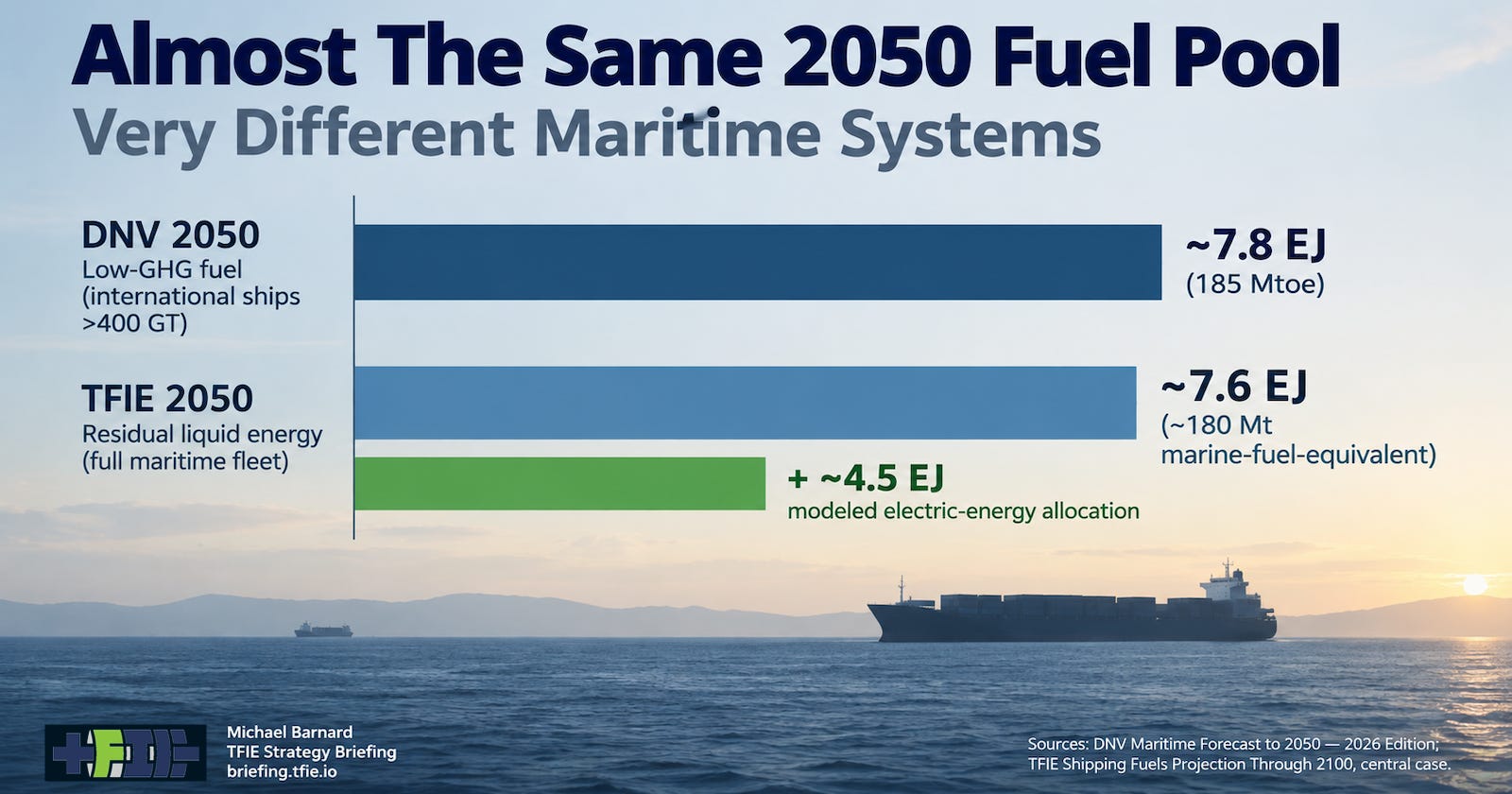
DNV’s new Maritime Forecast to 2050 contains a number that looks remarkably close to the one in my rebaselined maritime energy pathway. In DNV’s strongest global-regulation case, international shipping requires 185 million tonnes of oil equivalent of low-GHG fuel in 2050, equivalent to roughly 7.7 to 7.8 exajoules. My updated TFIE fleet-energy pathway leaves about 7.6 EJ of residual liquid energy in the same year, roughly 180 million tonnes of conventional marine-fuel-equivalent. Those numbers are close enough that a casual comparison could suggest that two very different analyses have independently converged on essentially the same answer. They have not. The model boundaries are too different for that near-match to validate either result, but the coincidence is useful because it exposes how differently the two analyses arrive at a similar amount of remaining molecular energy.
The TFIE pathway starts from the full maritime fleet rather than international shipping alone. It includes deep-sea cargo, coastal and inland cargo, passenger vessels, working boats and recreational vessels. By 2050, total maritime fleet energy in the central case is about 12.1 EJ per year, with roughly 4.5 EJ assigned to a modeled electric-energy wedge and about 7.6 EJ remaining as liquid energy. The electricity number is an energy-pathway allocation, not a forecast that ports will meter exactly 4.5 EJ of grid electricity into ships. By 2100, total fleet energy falls further to about 7.9 EJ, the modeled electric wedge rises to about 4.9 EJ, and residual liquids decline to about 2.9 EJ, or roughly 70 million tonnes of conventional marine-fuel-equivalent.
DNV is answering a narrower question. Its principal fuel-demand model covers internationally operating ships above 400 gross tonnes and calculates how much low-GHG fuel is required under different regulatory outcomes, given seaborne trade, fuel and technology prices, efficiency measures and emissions constraints. Its high-demand case assumes the IMO Net-Zero Framework is adopted and drives the fleet toward its annual Base targets. Under that scenario, low-GHG fuel demand rises from 22 Mtoe in 2030 to 175 Mtoe in 2040 and 185 Mtoe in 2050.
The near-match in the 2050 quantities is more interesting than it first appears. DNV’s 185 Mtoe is the low-GHG fuel required under its high-regulation scenario for internationally operating ships above 400 GT. My roughly 180 Mt marine-fuel-equivalent is the residual liquid requirement of a broader maritime energy system after structural changes in activity, efficiency improvements and substantial electrification have already been applied. My pathway still contains fossil liquids in 2050 and cleans the residual pool later, while DNV’s high-regulation case is more aggressive about the emissions intensity of the molecules that remain by mid-century. There is an important caveat to that comparison: DNV assumes its generic low-GHG fuel falls from 15 gCO₂e/MJ through 2040 to zero in 2050 because of a modelling constraint required to reach the assumed IMO target, rather than deriving that zero-emissions endpoint from a demonstrated future fuel-supply mix.
Two models can land within a few percent of the same 2050 molecular-energy number and still imply very different markets for ports, batteries, vessels and fuel producers. The interesting question is not whether 7.7 EJ is close to 7.6 EJ. It is which freight flows have already shrunk, which vessel work has moved onto electricity, how much energy efficiency has removed, and what work is actually left for molecules to perform.