

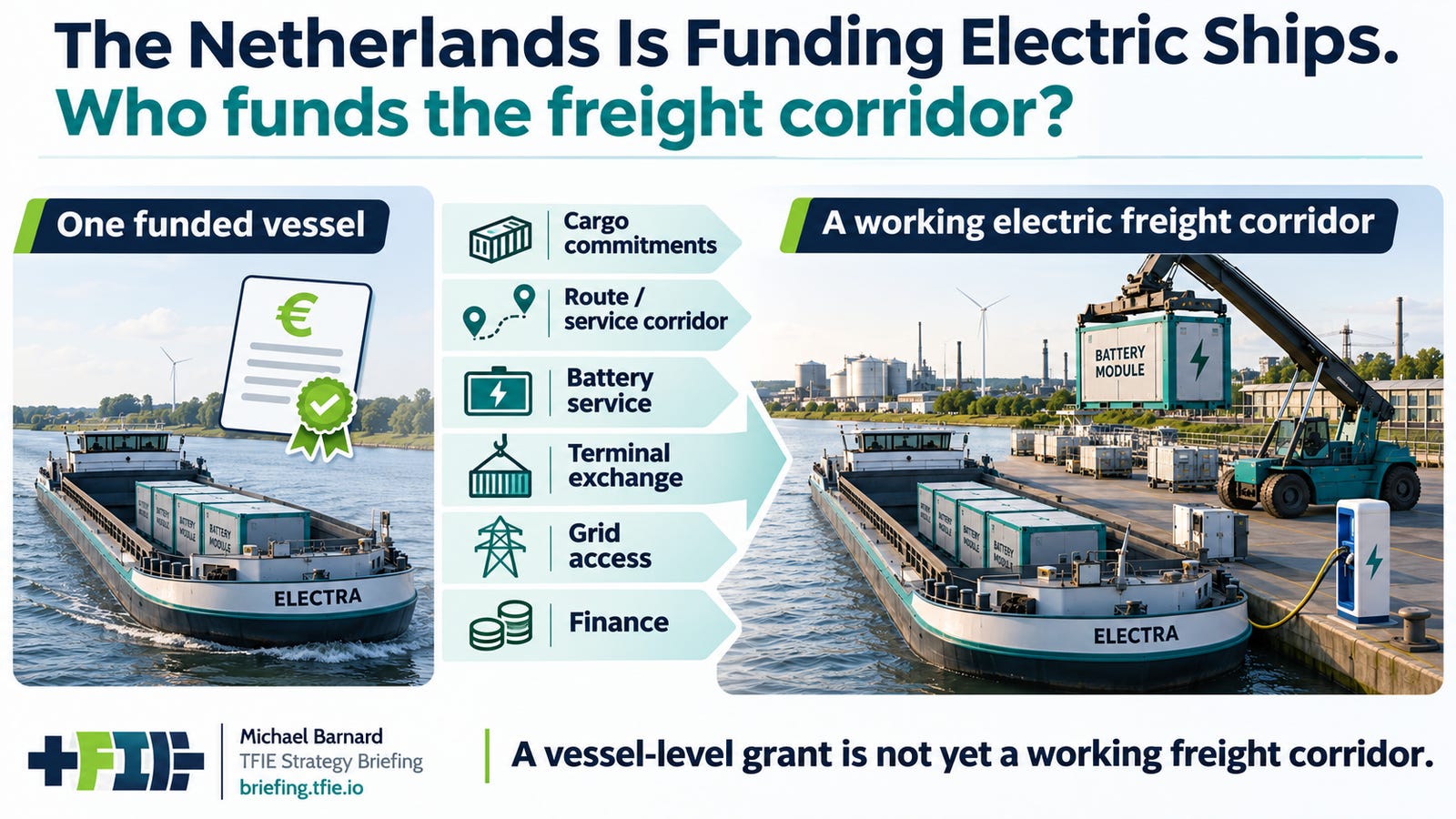
The Netherlands is about to open the first round of a €231.2 million programme to accelerate the energy transition in inland shipping. Applications will be ranked primarily by expected carbon reductions per euro of propulsion subsidy. The government’s own methodology excludes supporting shore-infrastructure subsidies from that calculation. This is a defensible way to compare vessel investments, but a less complete way to assess what an electric freight corridor costs and delivers.
The distinction is increasingly important. Electric vessels are no longer speculative technology. The Netherlands already has battery-electric inland cargo vessels, swappable battery containers and charging infrastructure. Yet an individual vessel cannot provide dependable commercial freight service without energy availability, terminal access, cargo commitments and operating arrangements along its route.
The new programme administered by RVO opens on November 17, 2026. Its first round offers approximately €36.93 million. Eligible investments include battery-electric propulsion, hydrogen fuel-cell systems, methanol and hydrogen combustion engines, and certain hybrid-electric retrofits. Supporting charging and refuelling infrastructure can also qualify.
This is a more thoughtful programme than one that finances equipment and leaves operators to resolve everything else. The Netherlands has included criteria for commercial collaboration, cargo-owner agreements, infrastructure access and project quality. Its regulatory explanation also gives priority to electrification where feasible, rather than treating every alternative fuel as equally appropriate.
The unresolved issue is the unit of investment. Funding is allocated through applications for individual vessels and their propulsion systems. A vessel has an identifiable owner, a conventional propulsion comparator and a measurable emissions-reduction potential. The commercial service it performs may depend on several terminals, a shared battery operator, utilities, cargo owners and infrastructure that serves many vessels.
Under the published ranking criteria, up to 40 of 100 points concern maximum potential CO₂ reductions relative to the requested propulsion subsidy. Another 30 assess expected actual reductions per subsidy euro. The remaining 30 assess supporting evidence, including commercial partnerships and cargo agreements, and the quality of the project and infrastructure arrangements.
Those last categories are substantive requirements. Applications must earn at least eight of fifteen points in each of the two quality categories to avoid rejection. The government is not indifferent to whether the proposed investment can work in practice.
Nevertheless, the highest-weighted criteria remain tied to individual propulsion investments. When calculating emissions reductions per subsidy euro, the scheme excludes any separate public contribution to the associated charging or refuelling infrastructure. That is an administratively consistent way of comparing propulsion subsidies, but it does not measure the total public and private investment needed to operate a complete corridor.
The programme offers up to €800,000 for an eligible battery-electric propulsion system, rising to €2.5 million when purchased batteries are included, subject to the scheme’s other limits. Supporting shore infrastructure can receive up to 40% of eligible costs, capped at another €600,000 per vessel project. The first round allocates €8.11 million to battery-electric propulsion and €10 million to charging and refuelling infrastructure across the eligible technologies.
These are meaningful contributions to early investment. The commercial challenge is to make sure they reinforce one another rather than produce a collection of individually attractive projects whose operating dependencies remain unresolved.
Zero Emission Services provides a useful example of what the next stage requires. Its ZESpack system separates much of the propulsion-battery investment from the vessel through swappable battery containers, shared charging locations and an energy-service model. The Alphenaar demonstrated the approach between Alphen aan den Rijn and Moerdijk, with Heineken and inland-freight partners helping establish commercial demand.
ZES has described a growing network of charging stations and a pipeline of additional vessel conversions. Operating vessels, awarded conversion subsidies, commissioned charging stations and planned locations are different indicators of progress. They should not be counted interchangeably. A vessel with a grant is not necessarily in service, and a charging station may precede the freight demand needed to use it economically.
The development of a charging station at Moerdijk makes the dependencies visible. ZES reached an agreement with the port authority and Combined Cargo Terminals, which would handle battery exchanges using a crane and share its electricity connection with ZES. The port says the charging station became operational in mid-April 2026. That is a practical arrangement between a battery-service provider, terminal operator and infrastructure owner, rather than an equipment purchase by a shipowner alone.
For a complete corridor, such arrangements must work across the operating cycle. A shipowner needs dependable charging or exchange availability at the required locations. A battery-service provider needs enough contracted demand to finance containers, chargers, reserves and balancing inventory. Terminal operators need workable exchange windows and safe procedures. Utilities must provide the right electrical capacity, and cargo owners need to commit volumes and service terms long enough to make investment financeable.
I have argued previously, including in my analysis of China’s emerging electric-shipping infrastructure, that electric inland freight needs coordinated corridors rather than isolated vessels. The Dutch programme recognizes much of that problem. The useful next question is how to connect its individual grants to measurable corridor-level outcomes.
My new 98-page TFIE report on inland-freight electrification examines the system at programme scale. It uses a stylized European industrial port corridor, rather than forecasting the future of any named Dutch port. The scenario starts with about 57.8 million tonnes of bulk cargo and 1,150 powered vessel-equivalents in a 2025-style baseline. By 2050, those decline to approximately 34.4 million tonnes and 664 powered vessel-equivalents.
That reduction reflects the assumed decline of fossil-linked cargo and changes in industrial demand. The remaining services still need propulsion, but the fleet and infrastructure should be sized for the freight task that survives rather than for today’s fossil-cargo economy.
The reference architecture uses shared swappable battery containers, with fixed batteries and shore charging remaining alternatives for suitable routes. The modelled shared pool peaks at about 1,579 containers in 2045. Its terminal-pressure screen reaches approximately 311 exchanges and 623 handling moves on a peak day in 2035–2040. These are scenario results, not predictions for ZES or Dutch terminals. They demonstrate how substantially the surrounding operating system can grow when electrification is considered at fleet scale.
The economics also differ by route. Under the report’s illustrative assumptions, a high-utilization reference case produces about €1.75 million in positive net present value at a 7% discount rate. Major-port and long inland industrial corridors are near breakeven at 7% and become positive at 4%. Lower-utilization routes remain weaker even with cheaper financing.
That variation creates a challenge for subsidy design. Two vessels could offer similar electrical performance and attractive modelled emissions reductions, but one might have committed freight, established terminal arrangements and a dependable battery service. The other might still depend on several organizations making investments that none is prepared to commit to first. Their practical readiness and the additional investment they require would be different.
The Netherlands does not need to discard its vessel-level grants to address this. It needs a way to connect them to a common corridor-development register. Port authorities or designated programme partnerships could track named routes, cargo agreements, vessel conversion windows, battery-service commitments, terminal availability, grid connections, approvals and financing milestones.
Such a register would let public financiers distinguish a complete early service from a collection of promising projects. It would also identify investments that deserve support because they enable several vessels or routes rather than benefiting only one applicant.
The useful evidence would be operational: contracted cargo volumes, dependable charging and exchange availability, completed commercial freight services, utilization, delays and operating costs. Converted hulls and installed charging stations would remain important milestones, but they would be assessed alongside evidence that the infrastructure is delivering freight services.
Early grants need not wait for every detail of a future network to be settled. Demonstrations and first commercial routes generate learning, help standardize equipment and establish confidence among owners and financiers. The point is to make their contribution to the developing network explicit so that public spending builds toward repeatable service.
The Netherlands has made several sensible choices in the new programme. Its preference for electrification where feasible, recognition of cargo commitments and provision for shared infrastructure make it more credible than technology-neutral subsidy schemes divorced from operating conditions. The remaining challenge is to establish whether funded projects combine into commercially durable electric freight corridors.
The first application round will reveal which projects attract applicants and how well they meet the programme’s technical and commercial criteria. The more consequential test will emerge as those investments enter service and begin sharing infrastructure.
The complete TFIE Inland Freight Electrification report is open, including the cargo and fleet assumptions, route-energy analysis, battery-pool sizing, terminal operating screens, economics and programme-delivery framework.
For ports, operators and financiers developing specific corridors, TFIE Strategy also undertakes scoped programme-definition and independent investment assessments. Contact Michael Barnard to discuss a corridor or investment decision.
A vessel-level grant is not yet a working freight corridor, and the scoring shows why that matters. As you note, up to 40 of 100 points reward maximum CO₂ reductions relative to the propulsion subsidy, while shore infrastructure support is excluded from that calculation. That could favor the cheapest propulsion project even when its charging dependency is unresolved. Would it help if applicants had to show a signed energy availability or cargo agreement for the route before the carbon-per-euro score counts? The quality categories already require eight of fifteen points, so it may be a small step.