
A quantified pathway from shrinking fossil cargo and vessel fleets to battery-electric freight, shared energy infrastructure and commercially viable corridors.
Open TFIE Strategy report | Michael Barnard | November 2026 | 98 pages
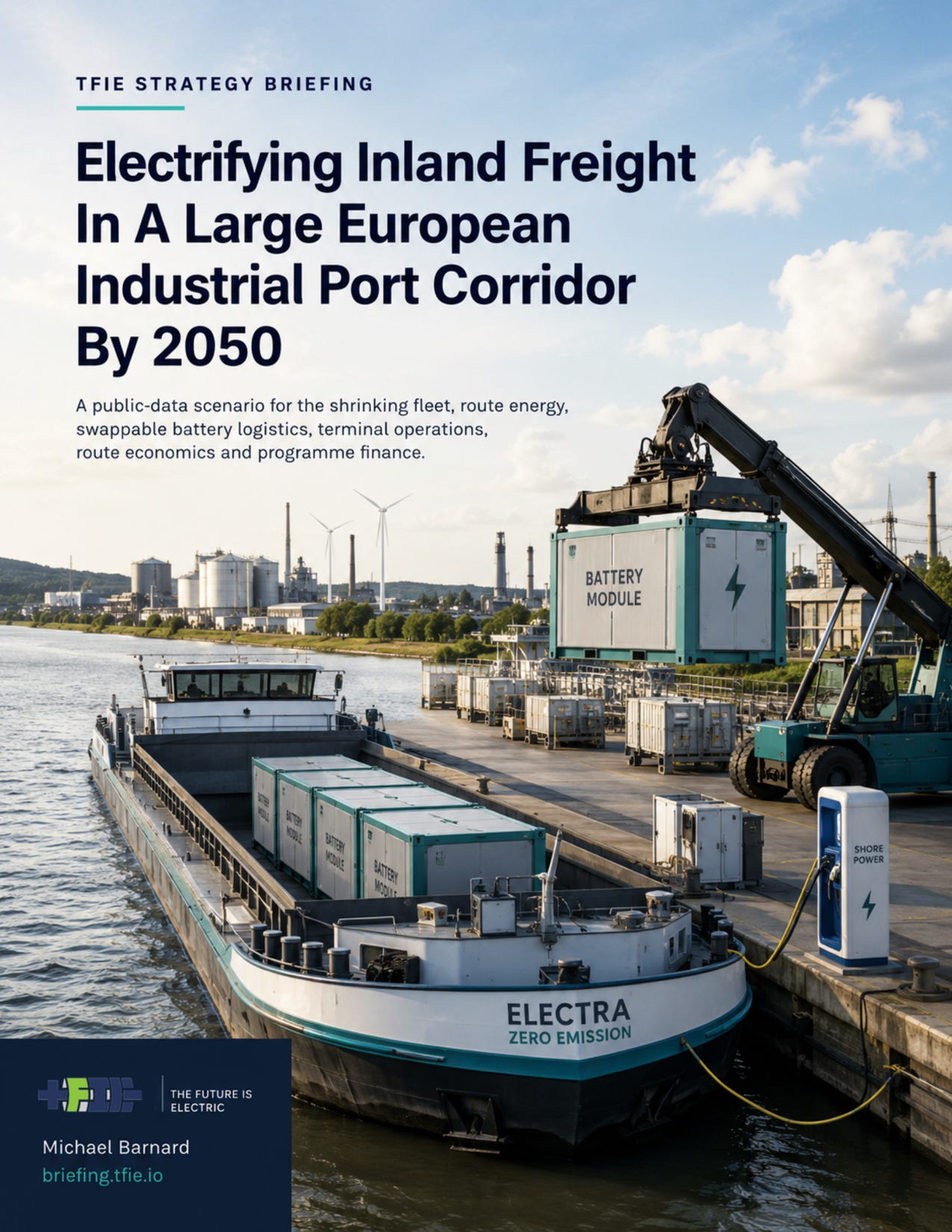
Electric inland freight is a port-corridor system, not just a vessel
Electric inland cargo vessels are already operating. Battery containers can be exchanged at terminals, electric propulsion equipment is commercially available, and ports are beginning to make electricity part of their freight infrastructure. The individual technologies have passed important tests. What remains much less clear is how to electrify the inland-freight services of an entire large industrial port corridor while preserving normal commercial operations.
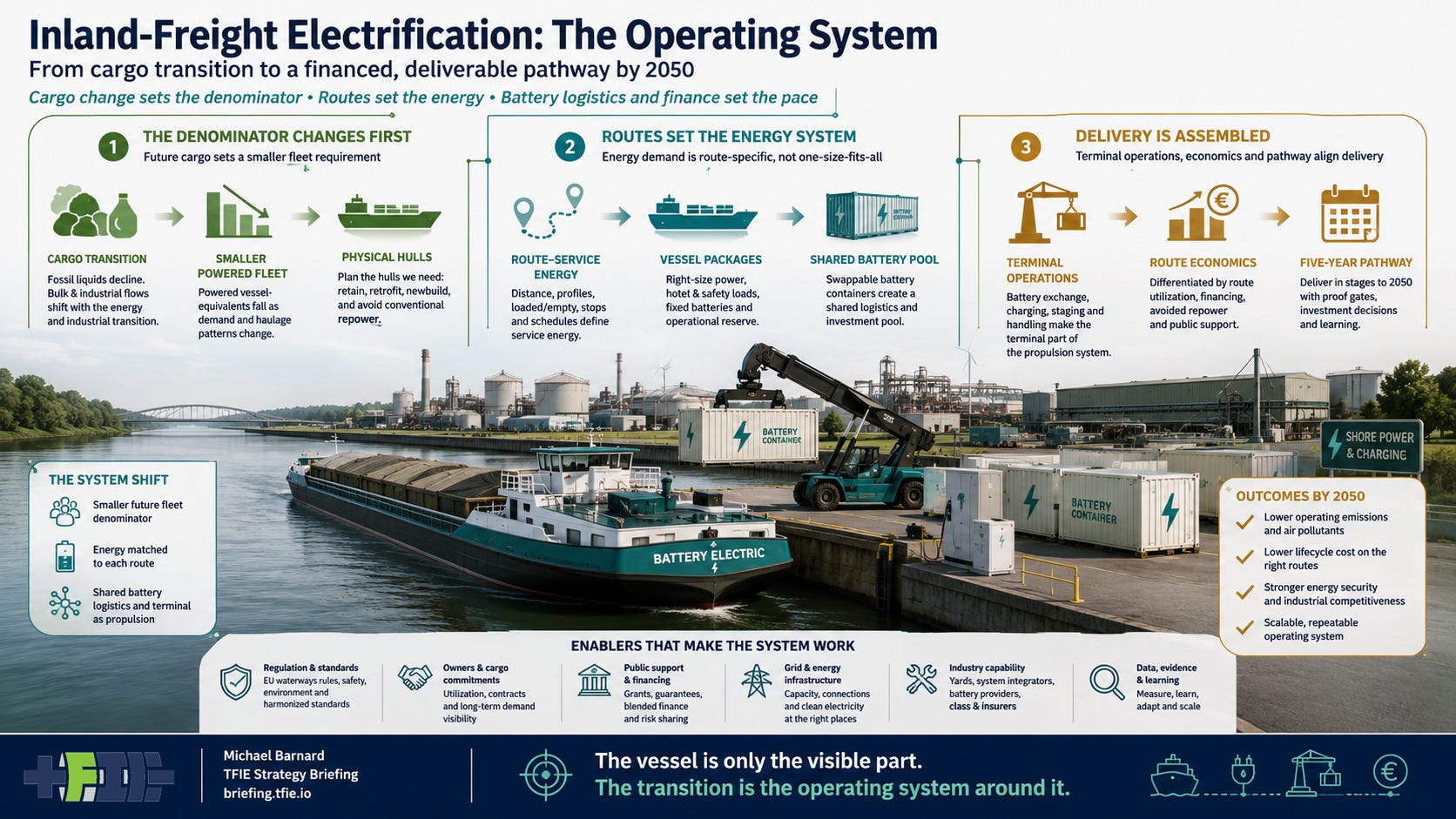
That was the question behind this report. I wanted to connect future cargo demand, vessel numbers, route energy, battery logistics, terminals, financing and institutional responsibilities in one coherent pathway to 2050. Demonstrating that a vessel can run on batteries is useful evidence. Showing how hundreds of vessels could operate through a network of terminals, cargo contracts and energy-service providers is a different analytical task.
The report uses a stylized public-data scenario for a large European industrial port-corridor system. It is broadly comparable in scale to established European industrial ports but is not an engineering, investment or operating plan for North Sea Port, Amsterdam or any other specific port. The 2050 fully electric endpoint is a policy backcast used to test what delivery would require, not a prediction that the transition will happen without coordinated action.
Five findings that change the planning problem
1. The freight fleet shrinks before it electrifies.
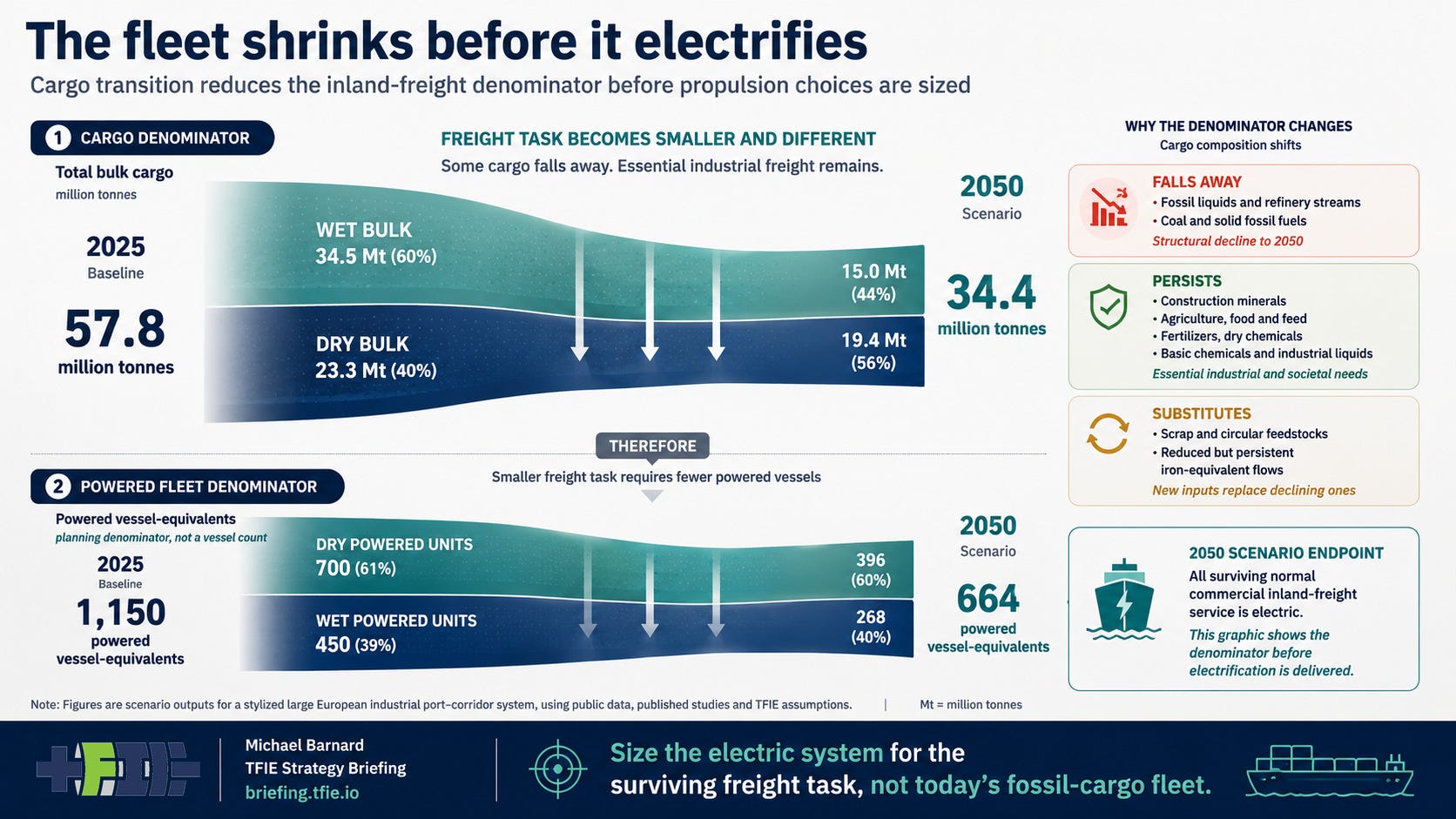
The first step is to determine which freight will still need moving. In the central scenario, bulk cargo declines from approximately 57.8 million tonnes in the 2025-style baseline to 34.4 million tonnes in 2050. The powered inland-freight requirement declines from about 1,150 to 664 vessel-equivalents.
Most of that contraction reflects declining fossil fuels, refinery-related cargoes and coal, rather than inland-shipping policy. Agriculture, food and feed, construction minerals, chemicals, industrial liquids, scrap and other industrial cargoes continue to require transport. The future electric fleet should serve that surviving freight system instead of preserving today’s fossil-cargo fleet indefinitely.
These are scenario results, not named-port cargo forecasts. Powered vessel-equivalents are activity-based planning units, not a count of surveyed physical hulls.
2. Routes determine the electrical architecture.
Battery size alone is not a sufficient measure of electric-vessel readiness. The loaded journey, empty or lightly loaded return, operating conditions, reserve requirements, charging opportunities and terminal access determine what a service needs.
The model’s representative round-cycle energy requirements range from approximately 1.8 MWh for a local port-canal shuttle to 13.1 MWh for a major-port corridor and 36.8 MWh for long inland industrial service. A short, lightly used route may be straightforward to electrify but financially unattractive. A longer, regularly used corridor may require much more infrastructure while offering stronger returns.
This is why the report evaluates complete routes and operating services rather than treating all inland vessels as interchangeable.
3. Shared batteries create a freight-logistics business.
The reference architecture uses repeatable electric propulsion packages, fixed onboard storage for supporting functions and swappable battery containers provided through a shared operating pool. Fixed onboard propulsion batteries and shore charging remain valid alternatives where route conditions favour them.
The central modelled pool peaks at about 1,579 containers in 2045. That includes more than batteries carried on vessels. Containers must also be charging, waiting ready for service, moving between locations, undergoing maintenance or held in reserve.
A shared pool can avoid placing all battery capital on individual vessel owners. It also requires an accountable service provider with contractual availability obligations, maintenance arrangements, balancing rules and a commercial model.
4. Terminals become part of the propulsion system.
Exchanging a battery container requires handling equipment, staging space, safe procedures, ready inventory and operating windows that fit commercial freight schedules.
The central scenario reaches approximately 311 exchanges and 623 handler moves on a peak day during 2035–2040. Handling pressure is more significant than charger occupancy in that modelled period. Those values are programme-level screens identifying where terminal-specific studies are required, not a capacity assessment of any named terminal.
The quay, yard, charger, grid connection and operating schedule are now part of the energy-service architecture.
5. Economics and institutions determine the sequence.
Electrification is not equally attractive on every route. In the report’s illustrative owner-economics screen, a high-utilization reference case produces approximately €1.75 million in positive net present value at a 7% discount rate. Major-port and long inland industrial corridors are close to breakeven at 7% and become positive at 4%. Lower-utilization routes remain weaker under the tested assumptions.
Gross modelled programme capital is approximately €3.326 billion through 2050. The net incremental transition cost is approximately €2.299 billion after selected conventional spending and secondary values are accounted for. An illustrative public-support envelope of €863 million tests how coordination and capital risks might be shared. It is not approved or available funding.
The proposed sequence is to develop higher-utilization, repeatable services first, while resolving the contracts, infrastructure, finance and approval requirements of the harder routes. Cargo commitments, terminal access, battery-service availability and finance must be developed alongside vessel investment.
Who should read the report?
Port authorities and programme sponsors can use it to frame corridor priorities, common infrastructure requirements, governance and the evidence needed before fleet-scale commitments. The executive summary and Chapters 7 and 10–14 provide the most relevant starting points.
Vessel owners, operators and cargo interests can examine route energy, repower and replacement windows, utilization, cargo contracts and the conditions under which an electric service becomes financeable. Chapters 4–6 and 8–10 are particularly relevant.
Terminal operators, battery-service providers and utilities can examine exchange operations, battery inventory, charging locations, readiness, grid capacity and operating obligations. Chapters 6–7 and 13 provide the principal framework.
Governments, EU institutions, financiers, yards, class societies and insurers can use the capital, approval, evidence-gate and institutional sections to identify what must be demonstrated or contractually allocated before a project moves into procurement.
The report includes a one-page reader map linking eleven stakeholder groups to their decisions, relevant chapters and next-stage work products.
Read the full report
Electrifying Inland Freight in a Large European Industrial Port Corridor by 2050
Michael Barnard | TFIE Strategy Inc. | November 2026
Open report | 98 pages | PDF

The report includes the executive summary, fourteen chapters in four parts, technical and economic figures, detailed methodology, appendices, scenario assumptions and evidence requirements.
A companion analytical workbook supports the modelling and source discipline. Do not publish the internal workbook. Access to additional working material may be discussed by contacting Michael Barnard.
From scenario to programme
The public analysis establishes the planning framework. A real port-corridor programme needs named routes, vessel records, cargo commitments, terminal capacity, grid connection evidence, engineering and class approvals, supplier quotations and financing terms.
A credible first programme should identify a small set of candidate corridors and assign an accountable owner to each missing evidence item. Each route should have a clear decision: proceed into detailed development, revise its service and investment structure, or stop before capital is committed.
The study is designed to make those choices more structured. It is not a substitute for vessel surveys, terminal engineering or investment due diligence.
Seven Briefings will unpack the argument
The report is the foundation for a short series of public TFIE Strategy Briefings examining specific conclusions and their implications for ports, governments, cargo owners, vessel operators and financiers.
Each article will be useful independently and will link back to this report. As articles are published, this section will become a permanent reading guide. All seven Briefings below are forthcoming.
The Dutch Inland-Shipping Transition Needs Corridors, Not Isolated Grants
How the Netherlands’ electrification experience reveals the need to finance complete operating corridors, not only vessels and isolated infrastructure.
Europe’s Inland-Freight Fleet Will Shrink Before It Electrifies
Why declining fossil cargo and changing industrial freight should be included before sizing electric fleets and infrastructure.
A Multi-Fuel Port Does Not Need a Multi-Fuel Inland Fleet
Why a large port may serve several marine-fuel markets while direct electricity remains the appropriate reference pathway for inland freight.
The Cheapest Electric Vessel Is Not Always the Best First Route
Why annual utilization, avoided repower, terminal readiness and financing can matter more than a low headline vessel-conversion cost.
Battery Swapping Is a Freight Logistics Business, Not Just a Battery Choice
How shared inventory, charging, balancing, reserve stock, handling obligations and service contracts determine whether battery exchange can scale.
FAME and HVO Are Bridges, Not a Permanent Inland-Freight Strategy
What renewable liquid fuels can contribute during the transition, and why feedstock competition and long-term fleet economics limit their role.
Cargo Contracts Have to Come Before the Next Electric-Vessel Pilot
Why committed freight demand and enforceable service obligations are essential to scaling from pilots to bankable corridors.
An additional technical Briefing may examine the special difficulties of electrifying tanker and hazardous-cargo services, including safety cases, approvals and vessel-package complexity.
Related TFIE Strategy work
This assessment builds on the broader maritime sequence in From Quay to Sea: A Port Decarbonization Roadmap.
The earlier Briefing China Is Turning Electric Ships Into Freight Infrastructure examines the emerging integration of vessels, battery systems, ports and charging infrastructure. The new report tests what the corresponding transition pathway might require in a stylized large European industrial port corridor.
Applying the findings to a real corridor
TFIE Strategy works with port authorities, operators, cargo interests, financiers and public institutions on transition pathways, programme definition, investment screening and independent evidence review.
A scoped engagement can test the actual freight and vessel denominator, assess candidate routes, identify infrastructure and approval dependencies, and develop the capital and institutional arrangements needed to turn a scenario into a programme.
For a port, freight or infrastructure decision approaching a capital commitment, contact Michael Barnard.
Methodology, attribution and use
This is a stylized public-data scenario. Its numbers are conditional model results rather than predictions, surveyed fleet records, vendor quotations or financing commitments.
The full PDF distinguishes public facts, proxies, supplier-reported evidence, TFIE assumptions and model-derived results. Named-port and investment decisions require further verification and specialist work.
Suggested citation: Barnard, Michael. TFIE Inland Freight Electrification. TFIE Strategy, 2026.
The report may be shared and quoted subject to the terms on its copyright page. Its analysis does not imply endorsement by any named port, contributor or organization.