

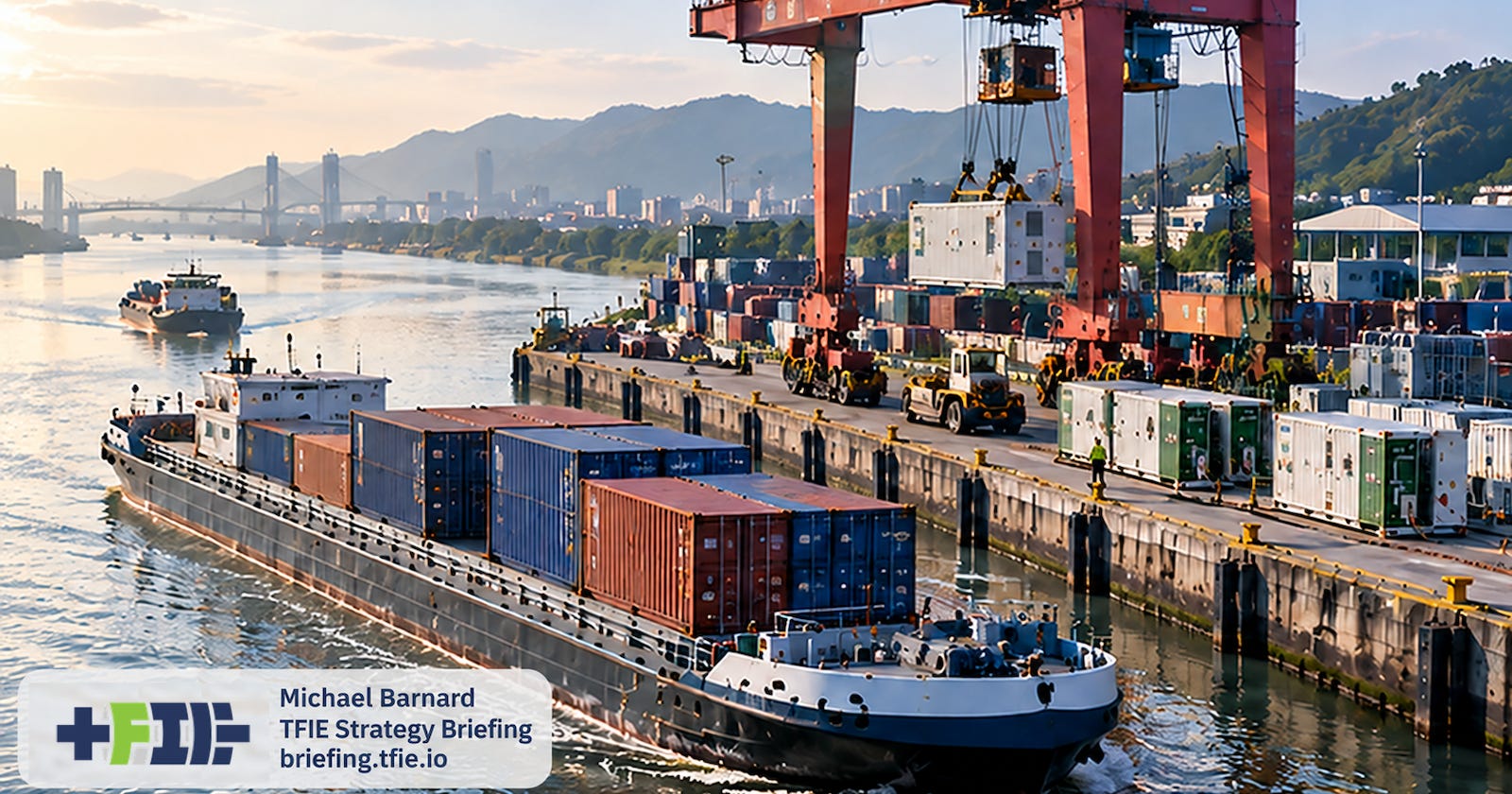
China’s battery-electric shipping industry is starting to look less like a collection of unusual vessels and more like a coordinated industrial transformation. Inland cargo ships are entering service, standardized battery containers are being exchanged at terminals, and major battery manufacturers are becoming involved in infrastructure, financing and fleet management rather than simply selling equipment to shipbuilders. The individual ships are interesting, but the more consequential development is the business being assembled around them.
In March 2026, Hubei province launched its Thousand Sails programme, bringing together port operators, shipbuilders, energy companies and financial institutions. Two additional electric container ships in the Huahang Xinneng series had completed their first voyages, following the first vessel entering service earlier, and a battery-exchange trial demonstrated a ten-minute turnaround. The province is targeting 1,000 green and intelligent inland vessels by 2030, at least ten demonstration routes and energy-supply infrastructure covering major ports on its sections of the Yangtze and Han rivers. The target includes more than battery-electric cargo vessels, and the ten-minute exchange is a trial result rather than an established commercial average. The significant development is the effort to coordinate all the elements of a freight network.
Then, on September 16, the 134.2-kilometre Pinglu Canal opened to navigation, providing a new connection between southwestern China’s inland waterways and the Gulf of Tonkin. CATL had already signed an agreement with the canal operator covering electric vessels, battery leasing, charging and swapping, renewable generation, energy storage and microgrids. The canal is open, but the proposed electric-vessel and energy-service network is still being developed. Its importance lies in the attempt to plan navigation infrastructure and vessel energy supply together rather than wait for individual shipowners to solve electrification independently.
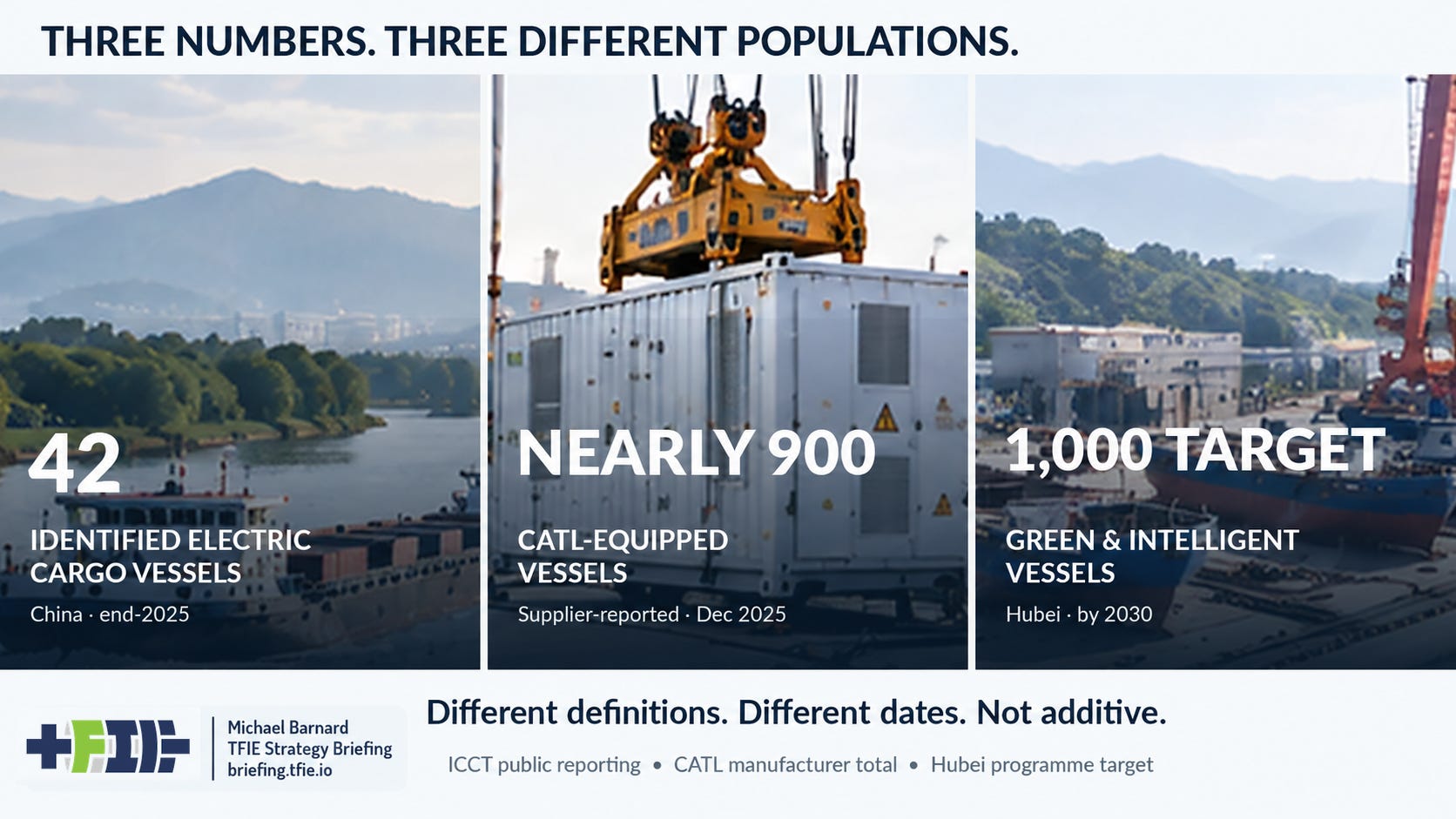
The scale of the transition needs careful interpretation. The International Council on Clean Transportation’s June 2026 assessment identified 42 electric cargo ships in China by the end of 2025, up from four in 2022. About 86% operated on inland waterways, with the largest identified vessels approaching 14,000 deadweight tonnes and some reported ranges reaching 500 kilometres. Those are meaningful advances, but 42 cargo vessels remain a small beginning relative to China’s enormous inland fleet.
CATL’s numbers are much larger because they describe a different population. The company reported nearly 900 battery-equipped electric vessels in December 2025, including passenger vessels, ferries, harbour craft and cargo ships. Its March 2026 annual-report announcement subsequently described nearly 1,000 equipped electric vessels worldwide. These figures demonstrate a substantial marine battery business, not hundreds of electric Chinese cargo ships operating on commercial freight corridors. Passenger and harbour vessels are providing experience with batteries, electrical systems and classification while cargo vessels gradually extend electrification into heavier, longer-distance operations.
The battery technology is also revealing. CATL’s published marine battery catalogue lists lithium iron phosphate, or LFP, cells and modules across high-power, energy-oriented and long-life configurations. China’s enormous automotive and stationary-storage battery industry provides manufacturing scale, while containerized systems allow energy storage to be handled as part of the freight operation. CATL’s ship–shore–cloud offering extends further, combining onboard batteries, shore charging, swapping, leasing, maintenance and digital management. The commercial proposition is that vessels can use shared energy infrastructure and potentially lease batteries rather than each owner purchasing and maintaining an entire propulsion battery system.
Europe has already demonstrated parts of this approach. The Netherlands’ Zero Emission Services has operated interchangeable battery containers on inland vessels since 2021. Its partners reported in September 2025 that operating costs remained above conventional shipping, making utilization, charging optimization and network scale critical. China is not inventing the architecture, but its industrial scale and coordinated infrastructure development could allow it to deploy the components more rapidly and economically.
That is the emerging competitive challenge for Europe. Ports must determine which freight routes justify electrical infrastructure and how their terminals can serve those routes. Policymakers must establish regulations, standards and financing arrangements that enable complete electric services rather than disconnected equipment projects. Investors must determine who owns the batteries, guarantees their availability, carries the replacement risk and earns a reliable return from the energy service. None of those questions can be answered by comparing battery specifications alone.
They are central to my forthcoming TFIE Inland Freight Electrification Report, which tests a complete transition pathway through 2050 for a stylized European industrial port-corridor system. The analysis begins with the freight that will still need to move after the energy transition changes the cargo mix. It then determines the surviving vessel requirements, route energy, battery infrastructure, terminal operations, economics and financing needed to achieve a defined all-electric service endpoint. It is a quantified scenario and implementation framework, not a prediction that electrification will happen automatically.
China is demonstrating more of the system that makes electric freight possible. The challenge for Europe is making those services commercially durable. What follows examines where ports should invest, how policymakers should coordinate and finance the transition, and what investors need to see before committing capital.