

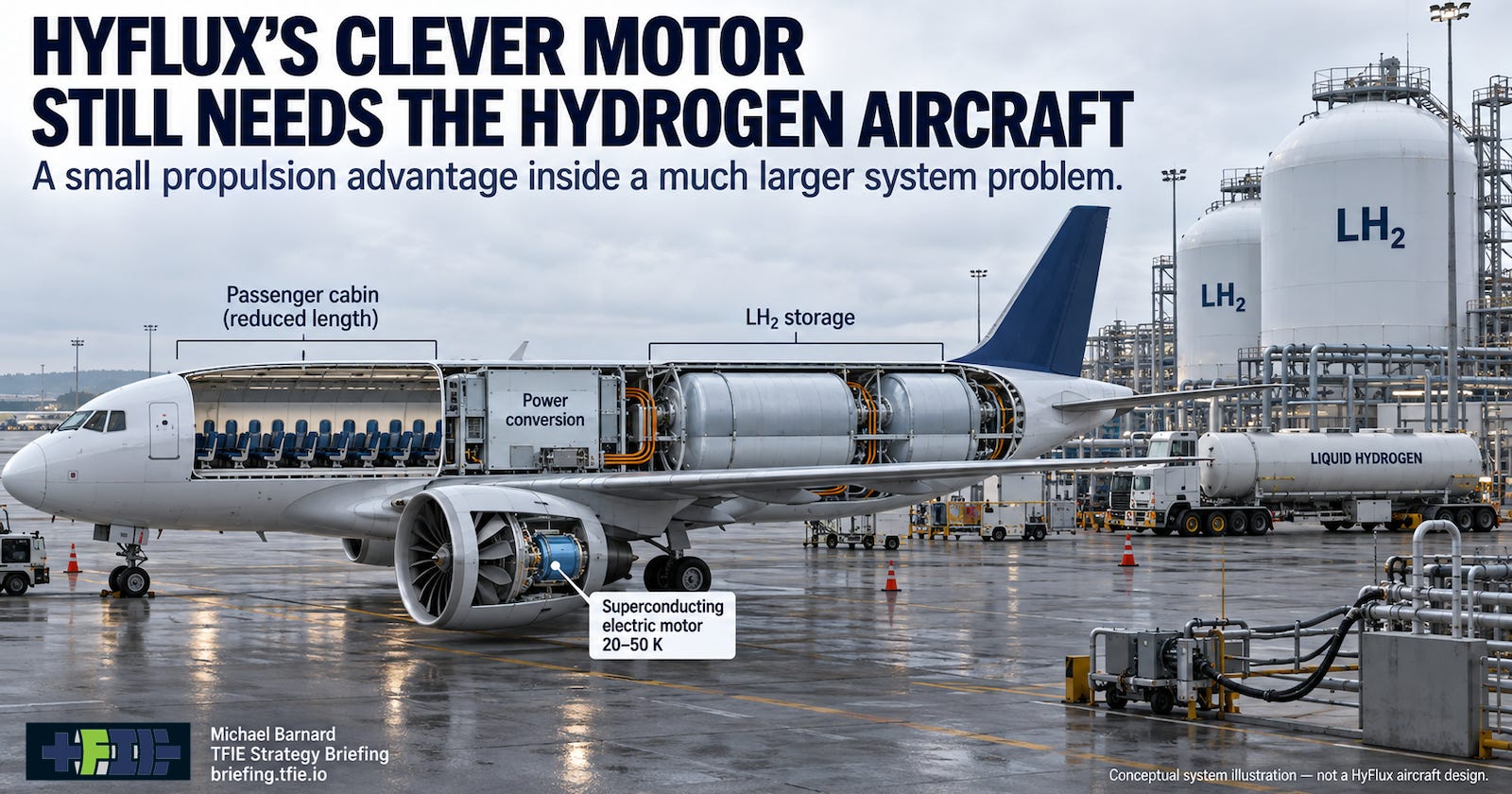
HyFlux has a technically interesting idea wrapped inside an investment proposition I think has a very low probability of reaching its stated aviation ambitions. The small UK company wants to exploit the extreme cold of liquid hydrogen already carried by a hydrogen aircraft to enable fully superconducting electric motors with much higher specific power than conventional machines. That is not pseudoscience: NASA Glenn Research Center’s High-Efficiency Megawatt Motor programme is developing a 1.4 MW partially superconducting machine with a 16 kW/kg target and 99% efficiency, while NASA’s newer cryogenic-machine work treats substantially higher specific power as a serious research objective rather than fantasy. HyFlux’s proposition therefore deserves technical diligence rather than dismissal.
The problem is that HyFlux is not asking investors merely to back an interesting motor; it describes its propulsion approach as the “only feasible solution” for zero-emission aircraft propulsion while its own recent investor communications say the company is moving toward multi-megawatt scale and beginning conversations with suitable investors. My conclusion is much more adverse: HyFlux may eventually build an excellent superconducting motor and still fail to create an important aviation business.
I first assessed hydrogen passenger aviation as a complete system in 2023 and rebuilt that assessment in September 2026 after another three years of airframe design, certification activity and airport-infrastructure research. Some of my earlier objections did not survive better evidence, which is useful because the remaining case is stronger without them. Regulators are developing certification pathways, cryogenic tanks have more viable geometries than simplistic spherical-tank arguments implied, and there is no serious basis for saying that hydrogen passenger aircraft are inherently incapable of flying or being certified. The real question is commercial: can a safety-equipped aircraft preserve a useful passenger, baggage, range and reserve mission after the hydrogen installation is included, move through certification and repeat production, and meet a sufficiently developed hydrogen network at enough airports to sustain scheduled operations? When I put those gates together in a judgmental model and deliberately give several of them generous assumptions, the resulting pathway remains extremely weak, because the aircraft, fuel infrastructure and fleet all have to mature on compatible timelines rather than merely proving that each can exist independently.
HyFlux’s value depends heavily on that larger pathway succeeding, which makes the company unusual from an investment perspective. A startup developing an excellent conventional inverter, controller or electric motor could potentially sell into several expanding electrification markets even if one airframe programme disappeared; HyFlux’s aviation proposition becomes most valuable in a world where commercial liquid-hydrogen aircraft already exist in meaningful numbers. The company is therefore making a second-order bet, not simply that superconductivity works but that an entire fuel and aircraft architecture with weak current commercial prospects becomes important enough to need its particular version of superconducting propulsion. The public story makes that proposition sound deceptively compact—use a very cold fuel to keep a motor superconducting, obtain exceptional power density, then scale toward multi-megawatt flight—but an investor should immediately ask what exactly is being scaled, what support systems belong inside the kilograms used for the headline power-density claim, how an airline handles a propulsion system that prefers to remain tens of degrees above absolute zero, and what has actually been demonstrated between the earlier 100 kW research stage and the multi-megawatt architecture HyFlux now discusses.
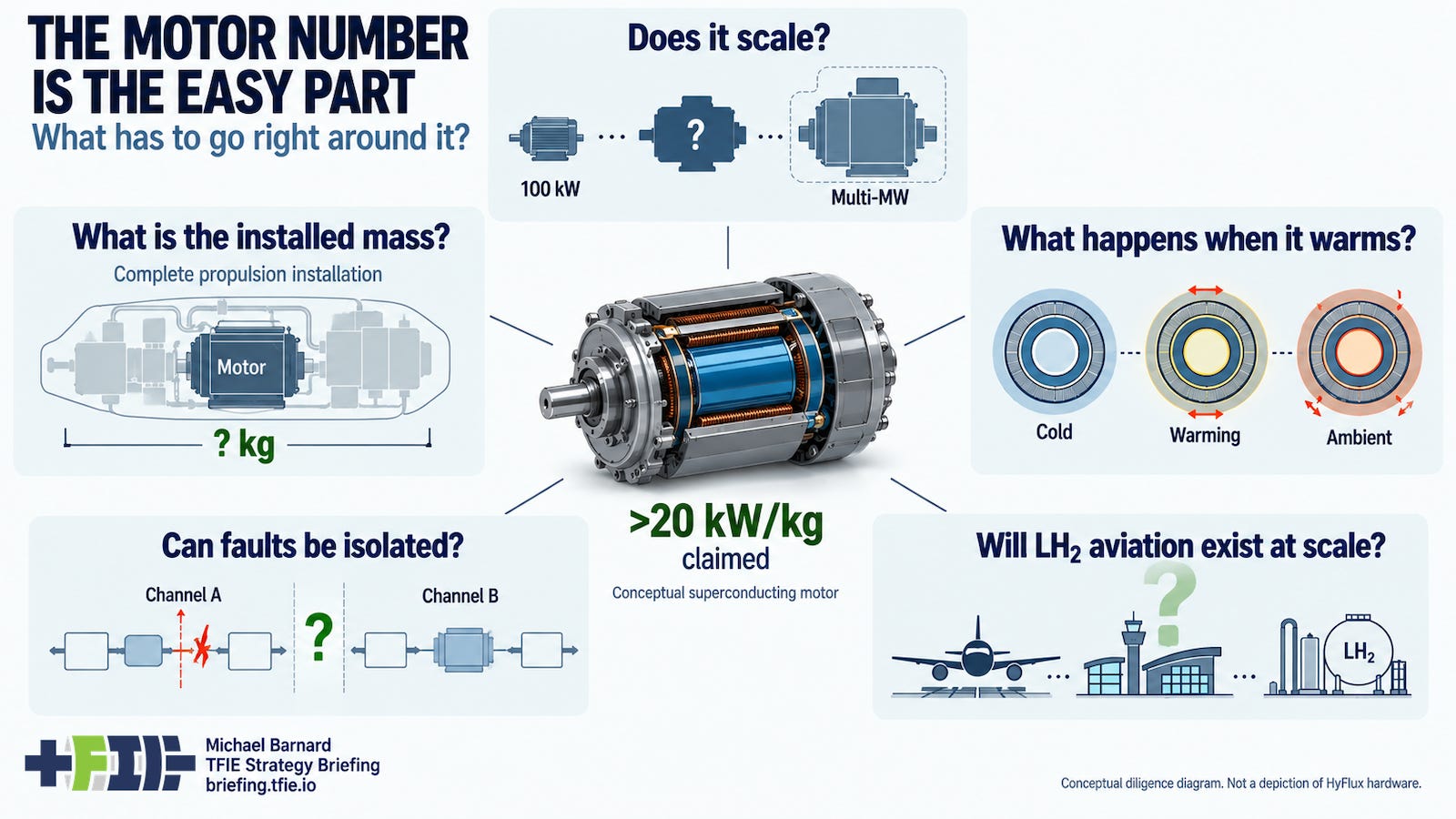
Those questions matter more because the alternatives are not waiting for hydrogen to become ready. My aviation pathway through 2100 does not assume that today’s aircraft and fuel system remain frozen while hydrogen improves: battery-electric aircraft move upward from smaller payloads and ranges, hybrids extend that reach, conventional airframes can consume increasingly expensive sustainable liquid fuels without replacing their fundamental architecture, rail removes some journeys where it works well, and higher fares alter discretionary demand. Hydrogen aviation therefore has to become preferable to an evolving portfolio of alternatives, not merely preferable to fossil kerosene under a sufficiently high carbon price or more electricity-efficient than synthetic e-kerosene. That broader context is why I find HyFlux unlikely to achieve its aviation ambitions even while taking its motor research seriously; too much of the commercial case depends on several conditions outside the company’s control becoming favourable together, while the public record still describes a company working through component and subsystem development rather than one scaling a mature propulsion product.
Below the paywall I start with the motor rather than the company history: what “fully superconducting” actually means, why four coupled technical integrations sit inside a fifth aviation constraint, what HyFlux’s >20 kW/kg claim tells an investor and what it leaves out, how a superconductor can quench and why thermal state becomes an operating and maintenance issue. I then put even a technically successful motor back inside the liquid-hydrogen aircraft and airport system, compare that market with the alternatives developing around it, assess whether HyFlux has the organizational and financial scale to execute the programme, and only then trace the more complicated 100 kW, corporate and IP lineage. The provenance is interesting; the technology and market risks are much bigger.