

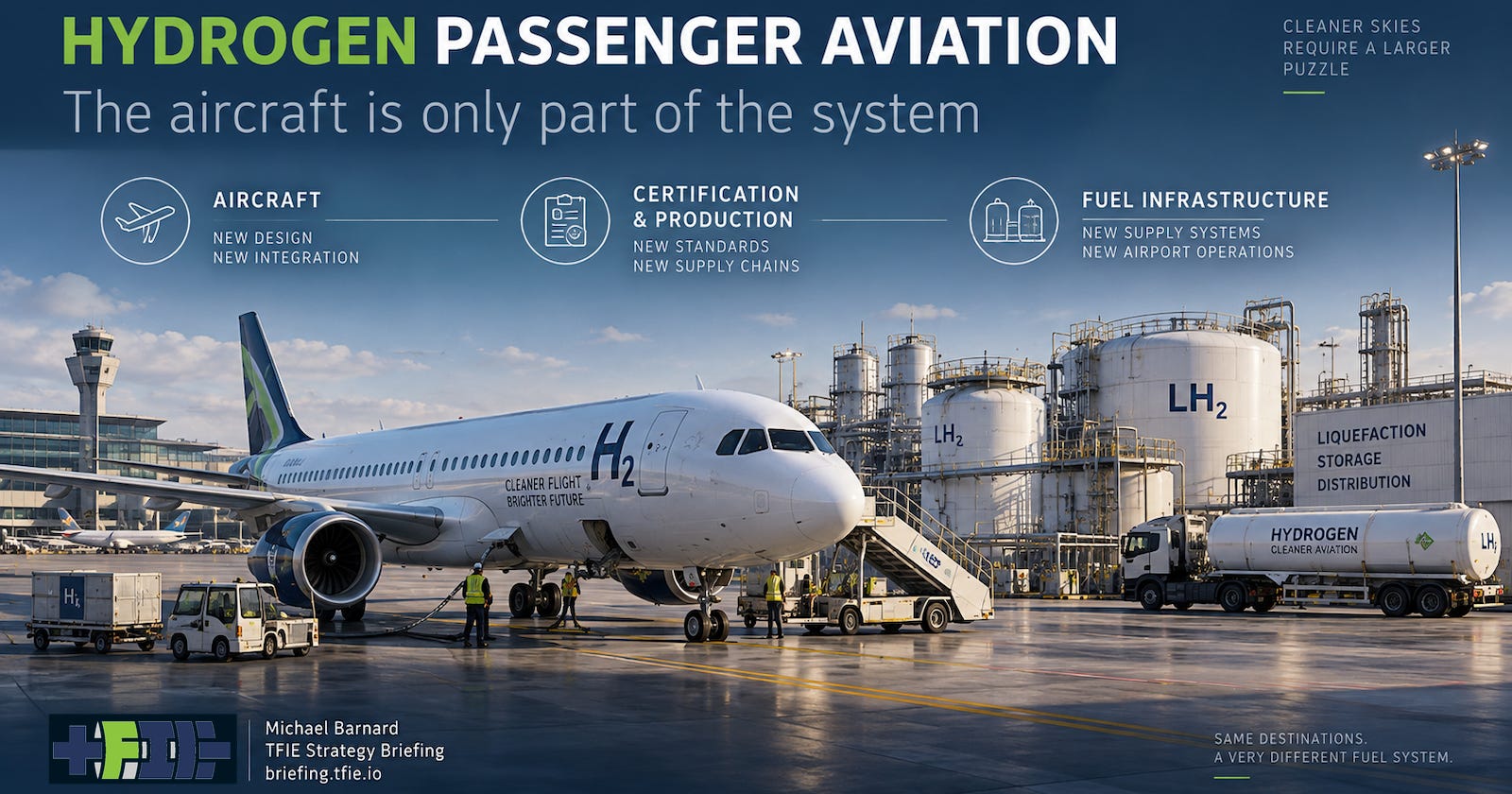
Hydrogen aviation is unusually persistent because almost every part of it can be made to look plausible in isolation. Hydrogen contains a great deal of energy by mass. Fuel cells can power aircraft motors. Cryogenic tanks can be built. Regulators can devise certification pathways. Airports can handle hydrogen safely. The harder question is what happens when all of those individually plausible pieces have to occupy the same passenger aircraft, meet the same safety requirements, serve the same flight schedule and arrive at commercial scale on the same timetable.
In August 2023 I pulled together the arguments against hydrogen passenger aviation in one place. The resulting CleanTechnica article, “No, You Won’t Be Flying In Hydrogen-Powered Passenger Planes”, covered hydrogen production costs, distribution, airport infrastructure, aircraft packaging, safety, certification and the alternatives. The central proposition was a systems one. A hydrogen aircraft could not be assessed by showing that hydrogen contains a lot of energy per kilogram, that a fuel cell works, or that an experimental aircraft can fly. Passenger aviation would require the fuel, aircraft, airports and operating system to work together at commercial scale.
Three years have produced considerably more evidence with which to test that proposition. Airbus slowed and changed its ZEROe programme, but did not abandon it. In March 2025 it reaffirmed its intention to pursue a commercially viable hydrogen aircraft, settling on fuel-cell electric propulsion as its preferred pathway and continuing work on liquid-hydrogen storage and distribution. In July 2026 Airbus and MTU Aero Engines announced plans for a joint venture focused on developing and commercialising a certifiable hydrogen fuel-cell aviation engine. ZeroAvia has made regulatory progress of its own: the FAA published final special conditions in April for its 600 kW electric engine, an important step toward certification of the propulsion system it intends to use initially in much smaller aircraft. That is genuine aviation certification work.
Regulators have moved from general discussions about hydrogen safety into the details as well. The UK Civil Aviation Authority published a hydrogen-specific gap analysis against the CS-25 requirements for large passenger aircraft in 2025. Its current Hydrogen Challenge is working through aircraft turnarounds, cryogenic storage and airside supply, with a new round announced only days ago. Those remain active development topics in September 2026. The European aviation industry has not removed hydrogen from its long-range plans either. Destination 2050 still envisages hydrogen aircraft entering regional service first and a hydrogen single-aisle aircraft of up to 165 passengers and about 2,000 kilometres from around 2040. That remains part of the published pathway.
The newer engineering evidence is more useful than either corporate commitment or roadmap ambition. Researchers are no longer merely observing that liquid hydrogen occupies much more volume than kerosene. They are designing aircraft around that fact, then testing what happens to fuselage geometry, payload, centre of gravity, crash protection and operating range. Airport researchers are doing the equivalent work on the ground, moving from generic references to “hydrogen infrastructure” toward actual pipelines, liquefiers, cryogenic storage, tanker traffic, grid connections and outage buffers. DLR’s work with Hamburg Airport, for example, concludes that increasing demand eventually drives the airport away from truck delivery toward pipeline supply, local liquefaction and substantial storage. That is a much more concrete infrastructure proposition than existed in most aviation roadmaps in 2023.
Some of the language in my 2023 assessment no longer survives that better evidence. Liquid hydrogen does not require a cartoonishly simple choice between spherical tanks and flying wings. There are several possible tank arrangements, each with different penalties. The claim that hydrogen passenger aircraft were simply “uncertifiable” was also too absolute. Regulators are plainly creating ways to assess hydrogen and electric aviation technologies. A useful 2026 assessment therefore has a different task: determine whether a commercially useful medium-haul passenger aircraft can preserve its mission after the hydrogen system and safety provisions are installed, progress through large-aircraft certification and repeat manufacture, and be supplied by enough airports at enough throughput to support scheduled airline operations before 2050.
Three years later, there is enough engineering and regulatory evidence to do something the 2023 assessment could not: put the aircraft, certification programme and airport fuel system on the same quantitative footing. That produces some counterintuitive results. The least-implausible aircraft is not the obvious retrofit, the infrastructure burden becomes industrial at a surprisingly modest flight schedule, and even assumptions deliberately favourable to hydrogen do less to rescue the pathway than might be expected. Behind the paywall, I work through the airframe choices, certification gates and airport-scale fuel requirements, then combine them to see what has to go right by 2050—and which assumptions actually control the outcome.