

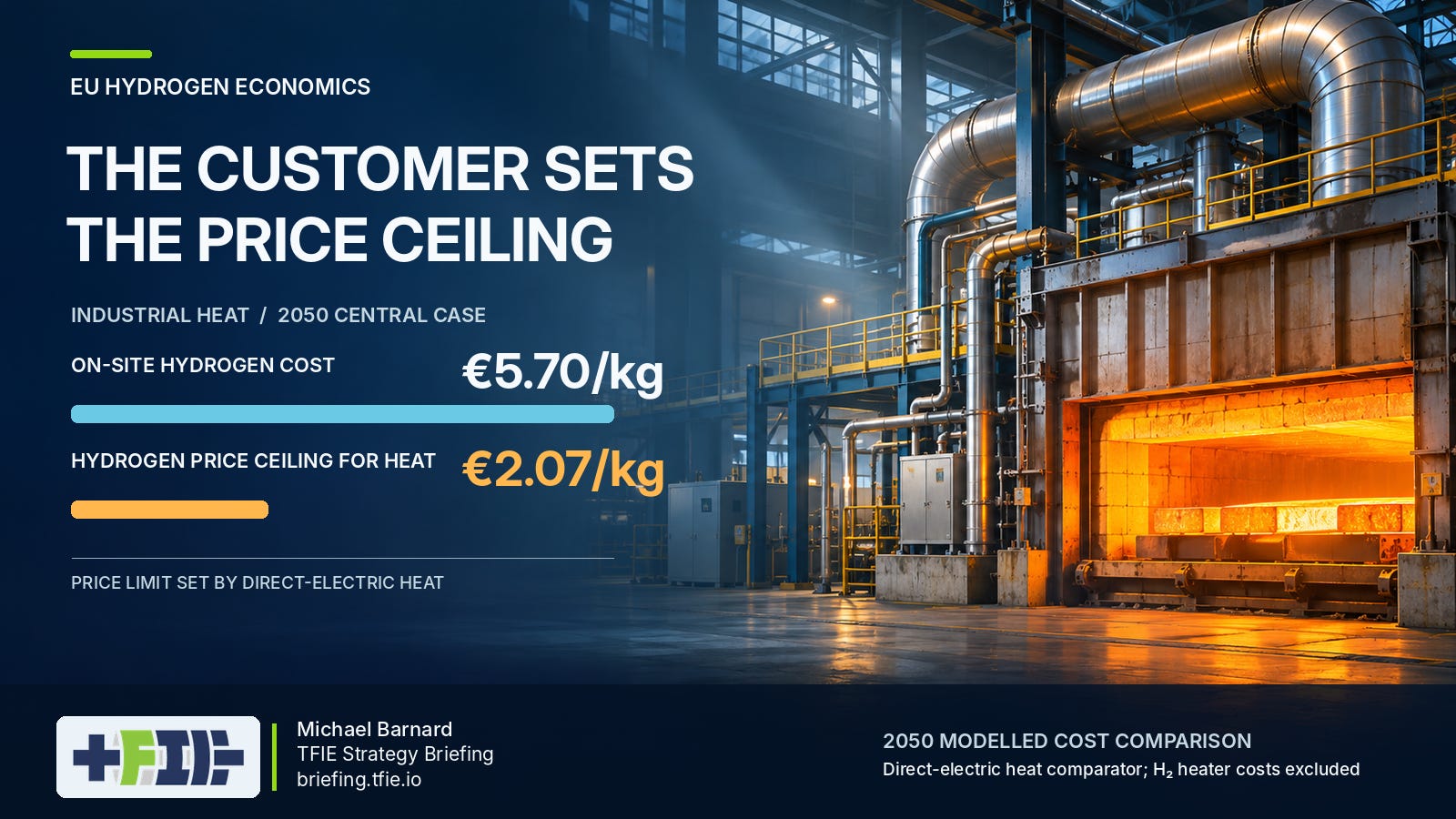
A factory using hydrogen to produce industrial heat needs about 31.9 kg of hydrogen to deliver one MWh of useful heat, assuming 94% heating efficiency. At €5.70/kg, that hydrogen costs approximately €182 before accounting for the equipment that burns it. In the central 2050 case of my European hydrogen model, hydrogen must cost approximately €2.07/kg or less to compete with direct-electric heating. At that price, the hydrogen fuel bill falls to about €66/MWh of useful heat.
The difference is substantial, and it exists even under assumptions favourable to hydrogen. The comparison excludes hydrogen heating equipment and other nonfuel costs. Actual applications will have their own temperature, operating and equipment requirements, but the underlying problem is clear. A hydrogen producer can reduce its costs considerably and still have no competitive market among customers able to use electricity directly.
Hydrogen discussions often start with the cost of electrolysers, electricity prices and the possibility of cheaper production at scale. Those questions matter, but they do not establish what a customer can afford. A chemical manufacturer needs a specified product, a steelmaker needs suitable iron inputs, and an industrial heat customer needs a particular temperature and operating profile. Each can compare hydrogen with other ways of obtaining that output.
The relevant measure is the maximum hydrogen input price at which the hydrogen-based route remains competitive. Start with the cost of delivering the same product or service through an eligible alternative. Subtract the hydrogen route’s costs other than hydrogen, then divide the remaining amount by the kilograms of hydrogen required. The result is a price ceiling, not a forecast of what hydrogen suppliers will charge. If the competing process is cheaper even when hydrogen is free, there is no positive competitive hydrogen price under those assumptions.
The International Energy Agency’s Global Hydrogen Review 2026 has made this customer-side calculation a major part of its analysis. Without policy support, the IEA finds that maximum acceptable hydrogen costs are below US$2/kg for most sector and regional combinations it examines. In some steel comparisons against incumbent production, the acceptable hydrogen price is negative, meaning support is required even if hydrogen itself has no cost.
The IEA uses a 2035 horizon and compares low-emissions pathways primarily with incumbent production. My EU assessment uses 2050 cost cases and includes competitors such as imported green industrial products, direct-electric heat and emerging ironmaking processes. The results are not interchangeable, but they address the same commercial issue: hydrogen supply and demand must be evaluated together.
Consider the production side first. In the central 2050 scenario, I assume electricity costs €60/MWh and electrolysis requires 53 kWh per kilogram of hydrogen. Electricity alone costs €3.18/kg. The model also includes €1,150/kW of electrolyser capital costs, 4,500 annual operating hours, capital recovery, maintenance, stack allowances, water and other expenses. Together these bring on-site hydrogen production to approximately €5.70/kg.
A generic delivered-cost allowance raises that benchmark to €6.95/kg. The model also calculates a separate hub-and-pipeline route at €5.81/kg, using different supply and delivery boundaries. These figures should not be mixed as though they were alternative quotations for the same delivery arrangement. A commercial project must price the specific production site, infrastructure, operating profile and customer connection.
In Why Hydrogen Still Isn’t Cutting Costs Like Solar Or Batteries, I examined why scaling electrolyser equipment does not produce the same cost reductions as manufacturing solar modules or battery cells. Electrolysis plants also require transformers, rectifiers, water treatment, cooling, gas processing, compressors, piping and civil works. Larger installations can share equipment and gain economies of scale, but those benefits do not eliminate electricity costs or guarantee a competitive delivered product.
The customer-side thresholds expose the remaining gap. For European green ammonia synthesis to compete with qualifying imported green ammonia in the TFIE central 2050 case, hydrogen must cost approximately €2.62–€4.00/kg, depending on the supplier and production route. The €5.70/kg central on-site cost is above those thresholds. Ammonia remains necessary for fertilisers and chemical manufacturing, but European ammonia consumption does not guarantee that its hydrogen will be produced in Europe.
Ironmaking presents a wider set of alternatives. Against imported hydrogen-based direct-reduced or hot-briquetted iron, the modelled competitive hydrogen input-price ceiling ranges from €2.28 to €4.45/kg. Against a qualifying European electrochemical iron route, the central threshold is about €1.43/kg. Where sufficiently suitable scrap is available, the hydrogen-based primary iron route can lose even with hydrogen priced at zero.
These are conditional comparisons. Scrap must meet product-quality requirements, electrochemical ironmaking is an emerging technology with uncertain commercial availability, and imported products must satisfy grade, emissions and supply conditions. The next article in this series will examine those industrial sourcing choices in greater depth. For this comparison, their importance is that they establish different prices industrial customers can afford to pay for hydrogen.
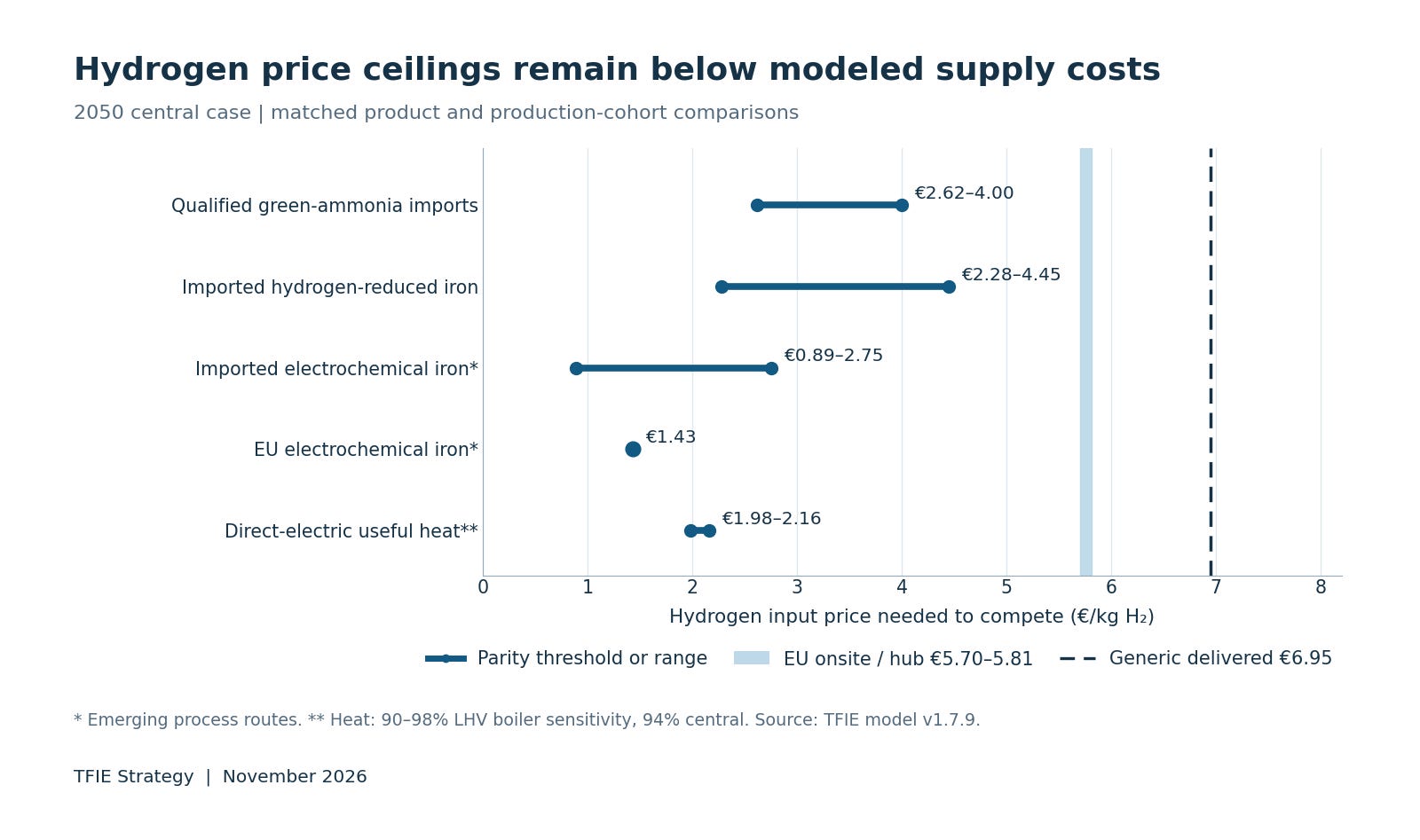
The industrial-heat result illustrates why the distinction is especially consequential for energy uses of hydrogen. A kilogram of hydrogen contains approximately 33.33 kWh of chemical energy on a lower-heating-value basis. After conversion losses, the modelled heating process consumes 31.9 kg to deliver one MWh of useful heat. Electricity can provide suitable heat directly, avoiding the electrolysis step and the costs of handling hydrogen.
A process that genuinely requires hydrogen as a chemical reagent is different from one that merely needs heat. Hydrogen may remain necessary for a particular chemical reaction even when its cost is high. When a suitable direct-electric alternative exists, however, a hydrogen supplier must compete with that process rather than with the fossil fuel historically used at the site.
None of these calculations establishes that hydrogen will always be uncompetitive. The favourable 2050 case in the TFIE model produces hydrogen at approximately €3.46/kg including its specified delivery allowance. That case combines electricity at €28/MWh, lower equipment costs and 4,800 annual operating hours. It can clear some of the industrial price ceilings, although not all of them. Whether a real project can secure cheap power and high utilisation at the same location is a commercial question, not a property of the scenario.
Policy can change the price a customer is willing or required to pay. Carbon pricing raises the cost of emissions-intensive alternatives. Mandates can require purchases that would otherwise be uneconomic. Subsidies, carbon contracts for difference and buyers willing to pay for lower-emissions products can help cover the premium. Those mechanisms may be justified by climate, security or industrial objectives, but they should be assessed separately from the underlying competitive cost.
The distinction is visible in the European Union Agency for the Cooperation of Energy Regulators’ November 13 monitoring report. ACER reports 4.2 GW of committed electrolyser capacity, including operating projects, projects under construction and projects with final investment decisions. Approximately 49% of that capacity is associated with refining, where renewable-fuel obligations and penalties help support purchases. Other sectors have struggled more to absorb or pass through the additional cost.
That is a revealing concentration. Refining already consumes substantial hydrogen volumes, and regulatory obligations provide a reason to substitute lower-emissions supplies. Those purchases can be real and legally required while still depending on a premium over competing production routes. They do not establish that other industries will purchase hydrogen at the same price without comparable obligations or support.
The financing consequences follow directly. A project that can produce hydrogen for €5/kg has not established a business case if its prospective customers can pay only €3/kg. Its developers need a route to bridge that difference through lower costs, a different industrial customer, enforceable policy support or purchasers willing to pay a premium. The duration and reliability of that arrangement matter as much as its initial value.
In Europe’s Banks Are Pricing Hydrogen As A Niche, Not An Economy, I examined how uncertain offtake changes project financing. The price-parity analysis explains part of the underlying problem. Announced production capacity, memoranda of understanding and prospective pipeline connections do not establish that customers can purchase hydrogen at the price required to recover an investment.
A serious assessment should identify the industrial output being supplied, the customer’s eligible alternatives, the maximum affordable hydrogen input price and the delivered cost of supplying that hydrogen over time. If policy support is necessary, it should identify who pays, how much support is required, and whether it lasts long enough to underpin the investment. The costs of electricity connections, distribution and infrastructure utilisation cannot be left outside the comparison.
TFIE Strategy’s European hydrogen research package and interactive dashboard allow readers to examine the industrial route comparisons, production assumptions and modelled sensitivities. The research was submitted independently to the European Commission on 11 November 2026, under feedback reference F33582541. Its purpose is to test the industrial and infrastructure consequences of competing choices, not to treat a hydrogen production target as evidence of demand.
The report is also a demonstration of the value of keeping the analysis executable and the assumptions visible. A different electricity tariff, electrolyser operating profile, industrial technology or product-import cost can change the competitive result. Those changes should be calculated before a company or government commits capital to a production facility or network.
Hydrogen production costs will continue to improve in some markets. That does not guarantee an expanding commercial market. The customer must be able to afford the hydrogen relative to its best eligible alternative, or a deliberate policy intervention must cover the difference. Until that calculation is made, a forecast of cheaper hydrogen is not a forecast of paying demand.
The next article examines whether imported green ammonia and iron can support European manufacturing at lower cost. Subscribe to TFIE Strategy Briefing for the rest of this series and more evidence-led assessments of the energy transition.
Think we need a vastly deeper exploration here of the kind of stockpiling governments at a large state(s) scale need to be doing to make a large scale build out of hydrogen possible a few decades from now, distinct from the other immediate things we do need to be doing now.