

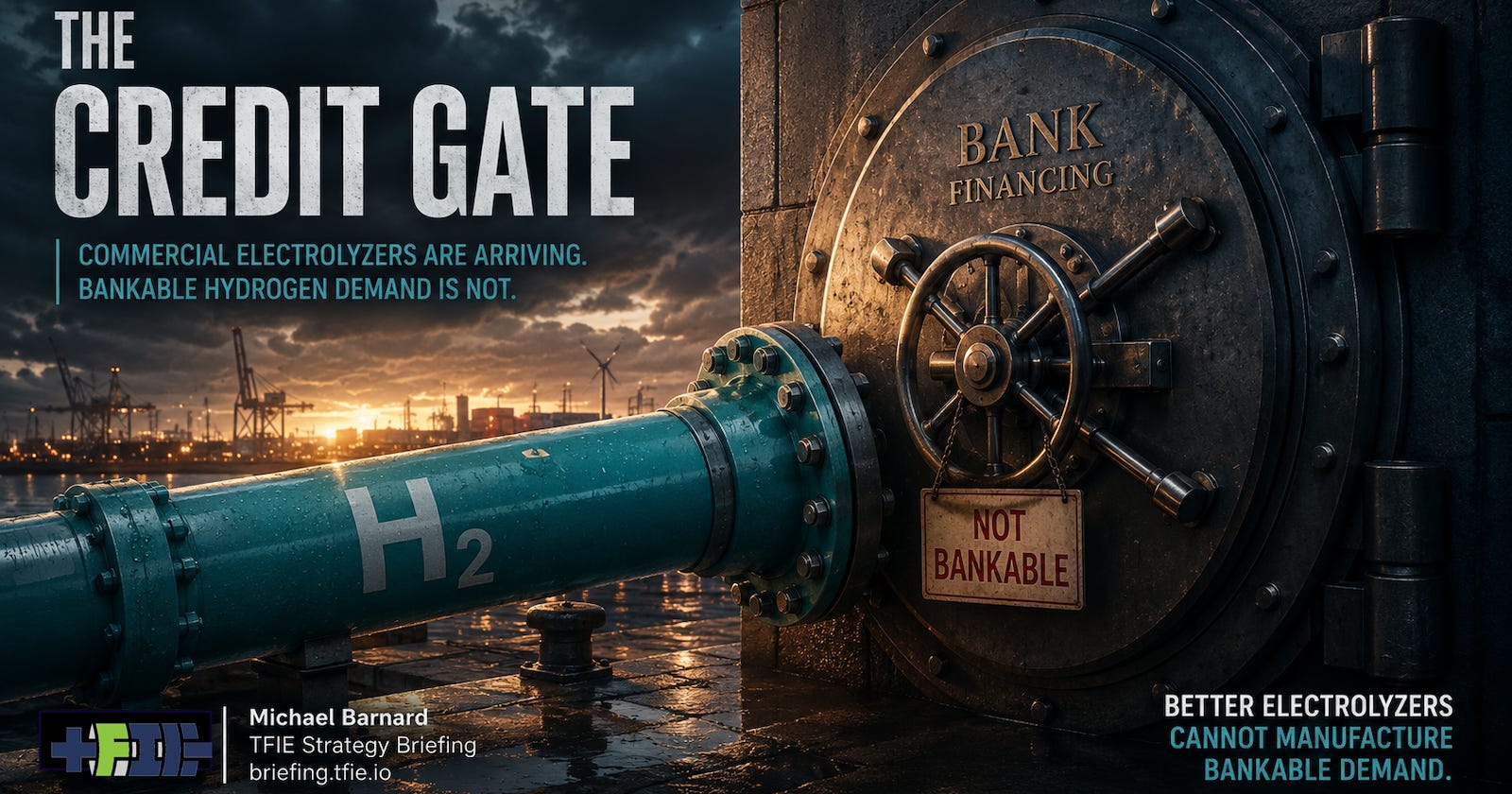
Power to Hydrogen is celebrating an important engineering milestone at the Port of Antwerp-Bruges: its first industrial-scale AEM electrolyzer, a half-megawatt system intended to produce high-purity hydrogen in a real port environment. The company calls it commercial-scale and emphasizes that the hydrogen will go to real customers. There is nothing wrong with celebrating the hardware. Moving anion-exchange-membrane electrolysis out of smaller stacks and into industrial equipment is technically interesting, particularly if P2H2 can deliver the lower capital cost and renewable-following performance it claims.
But “commercial” is doing more work than it first appears. P2H2’s own project description calls Antwerp’s NextGen site a demonstration district. The Port is funding site preparation, utility partners from the Free Electrons program are providing the capital for the electrolyzer build, and P2H2 received a €900,000 European Regional Development Fund grant to support deployment. The hydrogen is expected to serve industrial operations at the port and local refueling. That makes this a legitimate industrial demonstration with useful output. It does not make it evidence that a self-supporting hydrogen market has arrived. Further, the customers is actually customer, Holthausen.
The more revealing commercial signal is coming from banks. Holthausen is an unusually good case because it removes most of the excuses normally attached to hydrogen financing failures. The Dutch family business dates to 1945 and built its name supplying and transporting industrial gases. Its Holthausen Energy Points business has been producing hydrogen for years, operates hydrogen stations in Groningen and Amsterdam, fills cylinders and trailers, has actual customers, and sits beside an established gas-distribution network. This is not a startup arriving at a bank with a slide deck and a projected total addressable market.
When Holthausen wanted to install larger electrolyzers, it went looking for debt. According to regional development agency NOM, a round of discussions with banks produced nothing, and even the company’s then-house bank would not finance the expansion. Holthausen told Triodos why: its hydrogen production and filling-station operations had been losing money for years, and the losses were getting larger. NOM adds another useful detail. Buying hydrogen from elsewhere let the company keep growing revenue, but there was almost nothing left as profit.
That is close to a natural experiment in hydrogen bankability. The lenders could see actual operating history rather than modeled production, projected utilization and hoped-for customers. They were not being asked to take technology risk on an unknown company. They were being asked to accept management’s thesis that larger electrolyzers would turn a loss-making hydrogen operation into a profitable one. Conventional banks, including the incumbent bank, looked at the numbers and declined.
The eventual capital stack tells the rest of the story. Triodos Bank, whose sustainability mission aligned with the project, agreed to finance it but preferred that another investor come in alongside it. NOM then invested and became a shareholder. Holthausen also received support through the Dutch OWE hydrogen subsidy scheme, which NOM explicitly says helped close the cost gap between expensive green hydrogen and cheaper gray hydrogen. In other words, the expansion became financeable after conventional debt was supplemented by mission-aligned lending, public development equity and government subsidy.
Holthausen is particularly exposed to the part of the hydrogen story that has weakened fastest: transportation. It does have a more defensible merchant-gas niche filling high-purity hydrogen cylinders for laboratories and industrial customers, but its stations and production strategy were built in significant part around vehicles. My review of now 181 hydrogen-mobility companies and projects found 65 had failed, dissolved or abandoned hydrogen, while only three survivors occupied somewhat durable commercial niches, all in material handling. Belgium’s own hydrogen refueling network has similarly struggled with a denominator measured in very few vehicles per station. Hydrogen transportation has been contained, not commercialized.
One Dutch company does not prove what every European banker thinks. Fortunately, we do not have to rely on Holthausen alone. The European Commission’s 2025 Innovation Fund knowledge report says hydrogen projects continue to struggle to secure long-term offtake, that customers show little willingness to pay the green premium, and that the absence of a liquid market undermines price discovery. It says the lack of long-term offtake can prevent non-recourse project finance, that some projects unable to obtain support from parent companies or banks turn instead to grants, and that banks often view counterparties across the hydrogen value chain as unacceptably risky.
The IEA’s 2026 Global Hydrogen Review says much the same thing from another direction. New low-emissions hydrogen offtake agreements were roughly flat in 2025 at about 1.7 million tons, and only around 20% of the newly signed volume was backed by firm contractual commitments. Demand, not electrolyzer manufacturing capacity, remains the missing piece. That is the part a lower-cost AEM stack cannot fix.
There is an almost perfect institutional joke hidden in the name European Hydrogen Bank. It is not a commercial bank. It is an EU financing mechanism that pays fixed premiums per kilogram of qualifying hydrogen, with more than €1 billion awarded in the latest auction round. Its purpose is to bridge the gap between what clean hydrogen costs and what customers will pay. Europe has created something called a bank because market finance alone has not been enough to create the market policymakers expected.
The important caveat is that banks are not refusing all hydrogen. In July, the European Investment Bank agreed to lend OMV €450 million toward a €600 million, 140 MW green-hydrogen plant in Austria. The hydrogen will travel through a dedicated 22-kilometer pipeline to OMV’s Schwechat refinery, where it will replace fossil-derived hydrogen already required by the refining process. That is a large hydrogen project with a known industrial user, captive demand, a defined physical connection and a public-policy lender. It is almost the inverse of the speculative hydrogen economy.
That distinction is the one I have been making for years. Hydrogen measured against alternatives shrinks toward applications where the molecule itself is required. It does not disappear. Refineries, ammonia and some chemical processes have real hydrogen demand that must be decarbonized. What keeps failing is the larger idea that cheap clean hydrogen will create a new economy of road vehicles, heating, power generation, generalized energy storage, merchant fuel distribution and entirely new industrial demand.
P2H2 may have built a very good electrolyzer. AEM may reduce capital costs, improve dynamic operation and avoid some of the material constraints of incumbent technologies. Those are worthwhile engineering goals. But no improvement inside the electrolyzer creates a customer willing to pay enough for the hydrogen that comes out of it.
That is why the most important hydrogen signal in Europe may not be another stack leaving a factory or another port calling itself a hydrogen hub. It may be the credit committee saying no to an established industrial-gas family whose hydrogen business it can inspect in detail. Europe’s conventional banks appear to be pricing hydrogen less as a new economy and more as a set of bounded applications that require strong offtake, policy support or both. As always, be very leery of hydrogen headlines as they usually sound a lot better than the reality.
For more transition analysis grounded in what is actually being financed, built and used, subscribe to TFIE Strategy Briefing.