

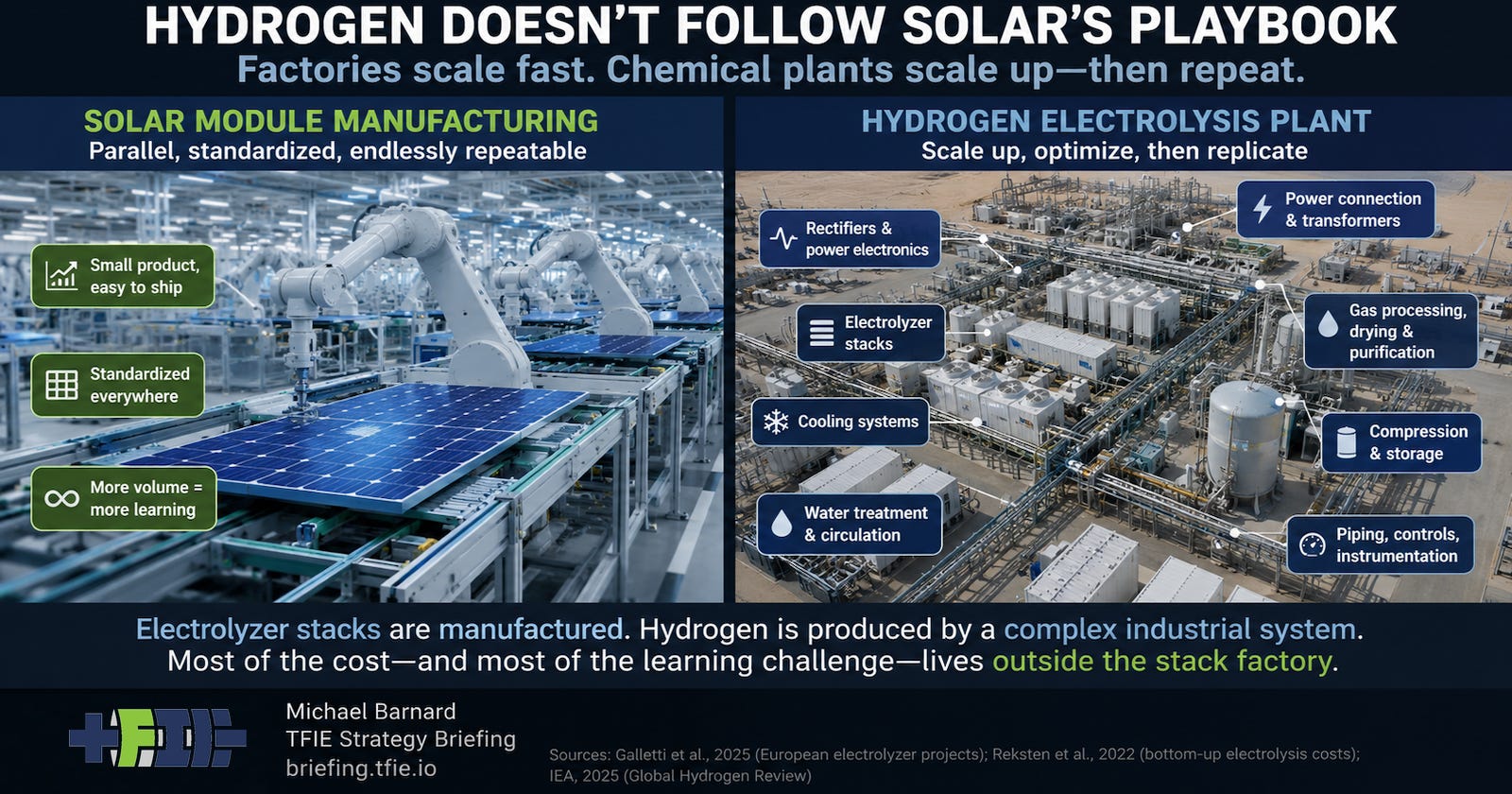
When I wrote Why Hydrogen Isn’t Cutting Costs Like Solar Or Batteries in 2025, the core argument was that electrolyzers and complete hydrogen plants belonged to a very different economic reference class from solar modules and lithium-ion batteries. Solar modules and battery cells are small, standardized products manufactured in enormous numbers through highly repetitive factory processes. Hydrogen production plants combine manufactured electrochemical stacks with transformers, rectifiers, water treatment, gas separation, cooling, compression, piping, controls, high-voltage connections, buildings, civil works and project-specific engineering. Expecting that complete industrial system to follow a solar-like learning curve made little sense then, and newer evidence makes the comparison look weaker still. The numerical treatment of electrolyzer learning in my original article, however, was too generous to hydrogen and included an arithmetic error that is worth correcting because the underlying mechanism turns out to be more interesting than the headline learning rate.
Solar farms and battery installations are not magically free of balance of plant, grid connections, civil works, power electronics, financing or project engineering, and their historical experience curves inevitably capture improvements outside the factory as well. The important difference is that rising solar and battery capacity continues to generate enormous numbers of repeated small manufactured units and highly repetitive installation work. Electrolysis is simultaneously increasing stack size, module size, shared process equipment and complete project size, so a doubling of installed megawatts can represent much less than a doubling of manufactured units. That distinction becomes especially consequential given the International Energy Agency’s finding that the stack represents only around 15–20% of installed electrolyzer investment, with much of the remainder sitting in mature industrial equipment, engineering and construction.
I wrote that PEM electrolyzers appeared to have learning rates of roughly 12–15% per doubling and alkaline systems roughly 10–15%, compared with about 20–24% for solar modules and around 19% for lithium-ion batteries. I then said that moving from about 5 GW of installed electrolysis to 40–60 GW represented three or four doublings and could produce roughly 40–55% capital-cost reduction. The latter figure was wrong: three to 3.6 doublings at learning rates of 10–15% produce about 27–44% cumulative reduction, not 40–55%. More importantly, the learning rates themselves collapsed several different cost-reduction mechanisms into one number. Recent project-level research suggests that a substantial share of what looks like electrolyzer learning, especially for mature alkaline systems, is consistent with conventional economies of building chemical-processing equipment and entire projects at larger scale.
A particularly useful 2025 study by Alberto Galletti and colleagues assembled capital-cost and capacity information for European electrolyzer projects going back to 2005. At first glance its findings look disastrous for my thesis. The raw experience curves show cost reductions of 32.1% for PEM and 22.9% for alkaline electrolysis for each doubling of cumulative installed capacity, figures comparable with or better than the historical curves for solar and batteries. But the researchers also adjusted project costs for estimated project-size economies. After that normalization, the overall rate fell from 23.3% to 13.3%, PEM fell from 32.1% to 17.6%, and alkaline fell from 22.9% to 7.3%, with the residual alkaline relationship no longer statistically significant. The result substantially changes what the raw historical curve should be taken to mean.
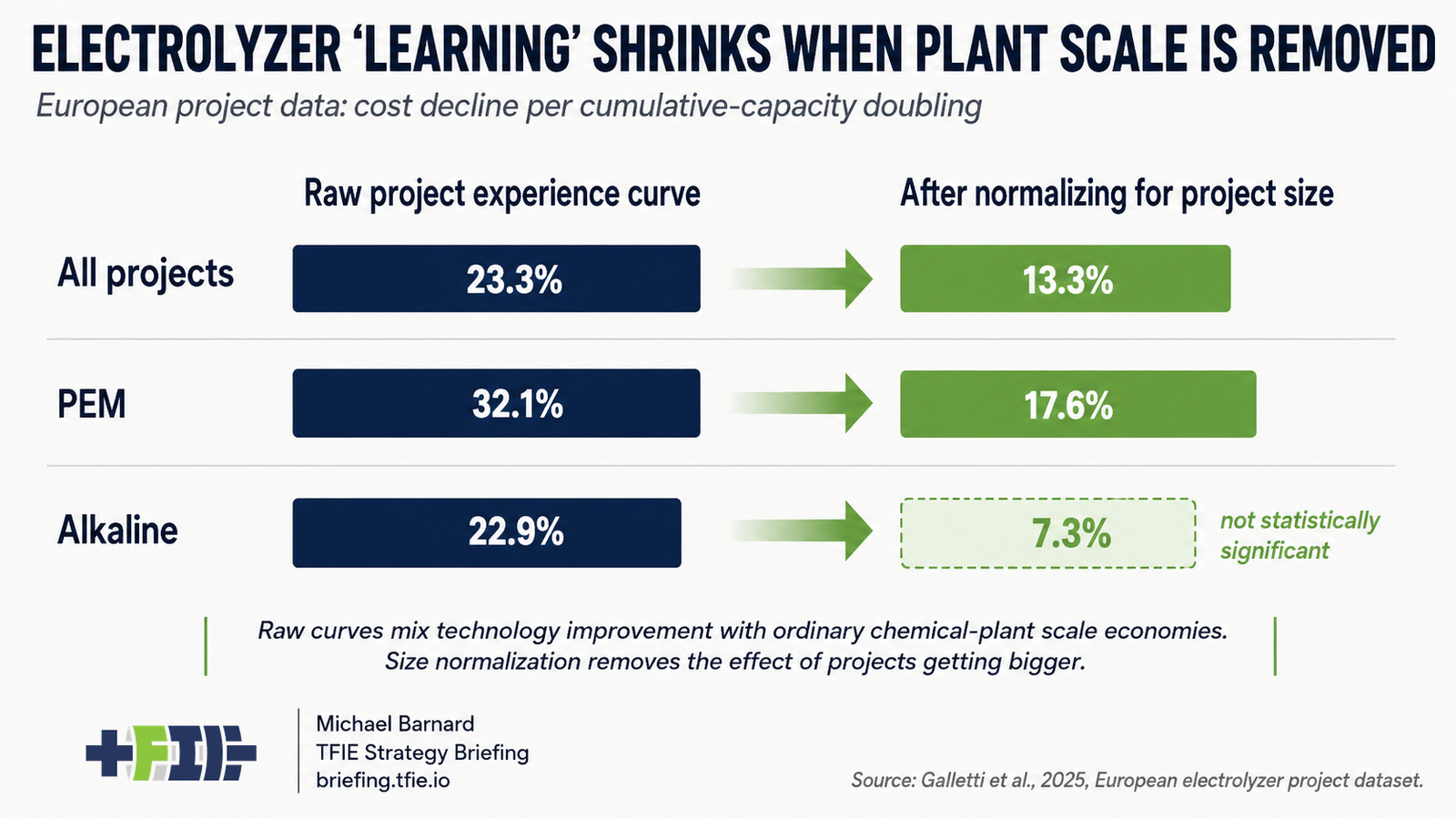
The magnitude of that adjustment is revealing. The project-size relationship used in the analysis comes from conventional chemical-process engineering and implies that specific capital cost falls materially as plants become larger. A curve that initially looks like solar-style technological learning is therefore largely consistent with ordinary chemical-plant scale economies once estimated size effects are accounted for. A 100 MW installation does not require one hundred times the supporting equipment of a 1 MW installation. Larger compressors, separators, water systems, transformers, purification equipment and common auxiliaries cost more in absolute terms but less per unit of throughput, while multiple electrolyzer stacks can share them. The economics improve substantially as projects stop being demonstrations and become industrial plants, but that benefit comes in large part from making equipment and process trains larger and sharing more of the plant rather than from factories repeatedly stamping out an unchanged product more cheaply.
This is closely aligned with a point chemical engineer Paul Martin has made for years about modular chemical-processing plants. The economically sensible sequence is to increase the size of an individual process unit until technical, operational, manufacturing, transport or maintenance constraints make further enlargement unattractive, consolidate multiple units around shared balance-of-plant equipment, and then replicate optimized process trains when still more capacity is required. This is ordinary chemical-engineering practice rather than something peculiar to hydrogen. The important distinction from solar modules and battery cells is that these economies of scale are front-loaded. A project can gain enormously by moving from a small demonstration toward industrial scale, but a mature industrial plant does not receive the same percentage reduction merely because another plant of similar size is built.
The process-engineering literature backs that up. A long-standing study of economies of scale in alkaline electrolyzer systems found that the modular electrolyzers themselves offered limited scale economies, while substantial savings could come from sharing and enlarging common compressors, gas-holding tanks, transformers and other balance-of-plant equipment. Depending on configuration, those scale effects could reduce capital costs substantially, with common larger compressors providing particularly large savings. The mechanism is exactly what chemical-process engineering predicts: make shared equipment bigger until sensible economic scale is reached, then number up the resulting process architecture.
Bottom-up electrolyzer studies show the same pattern inside the equipment. Reksten and colleagues found that plant-size savings become progressively marginal as electrolyzer installations reach industrial scale, while technological improvements continue separately through better designs and performance. A 2024 review of large-scale electrolysis modularization likewise emphasizes that a gigawatt electrolyzer facility cannot be constructed as one gigantic electrochemical machine. It has to be created by numbering up stacks, grouping them into modules, sharing common equipment where economic, and integrating those process trains into a site-wide industrial plant.
Some of the striking cost declines expected as electrolyzer projects grow are therefore perfectly real without being evidence of a persistently high manufacturing learning rate. Early projects can have undersized common equipment, duplicated auxiliaries and fixed engineering spread over relatively little output. Larger facilities can consolidate those functions into equipment closer to economic scale, standardize layouts and spread common systems across more hydrogen production. A newer bottom-up study of PEM balance-of-plant scale-up similarly finds that most modeled balance-of-plant savings occur as installations grow from small projects toward industrial scale, with some of those economies potentially exceeding the savings expected from manufacturing scale-up alone.
The more useful question is what replaces the simplistic learning curve once project-scale effects are stripped out. The answer changes how hydrogen costs should be forecast, where genuine reductions are still available, and where they are not. Behind the paywall, I work through the process-engineering sequence—how stacks and shared equipment scale, when those gains start flattening, why installed gigawatts can exaggerate manufacturing experience, and what a defensible hydrogen-cost model should use instead.