

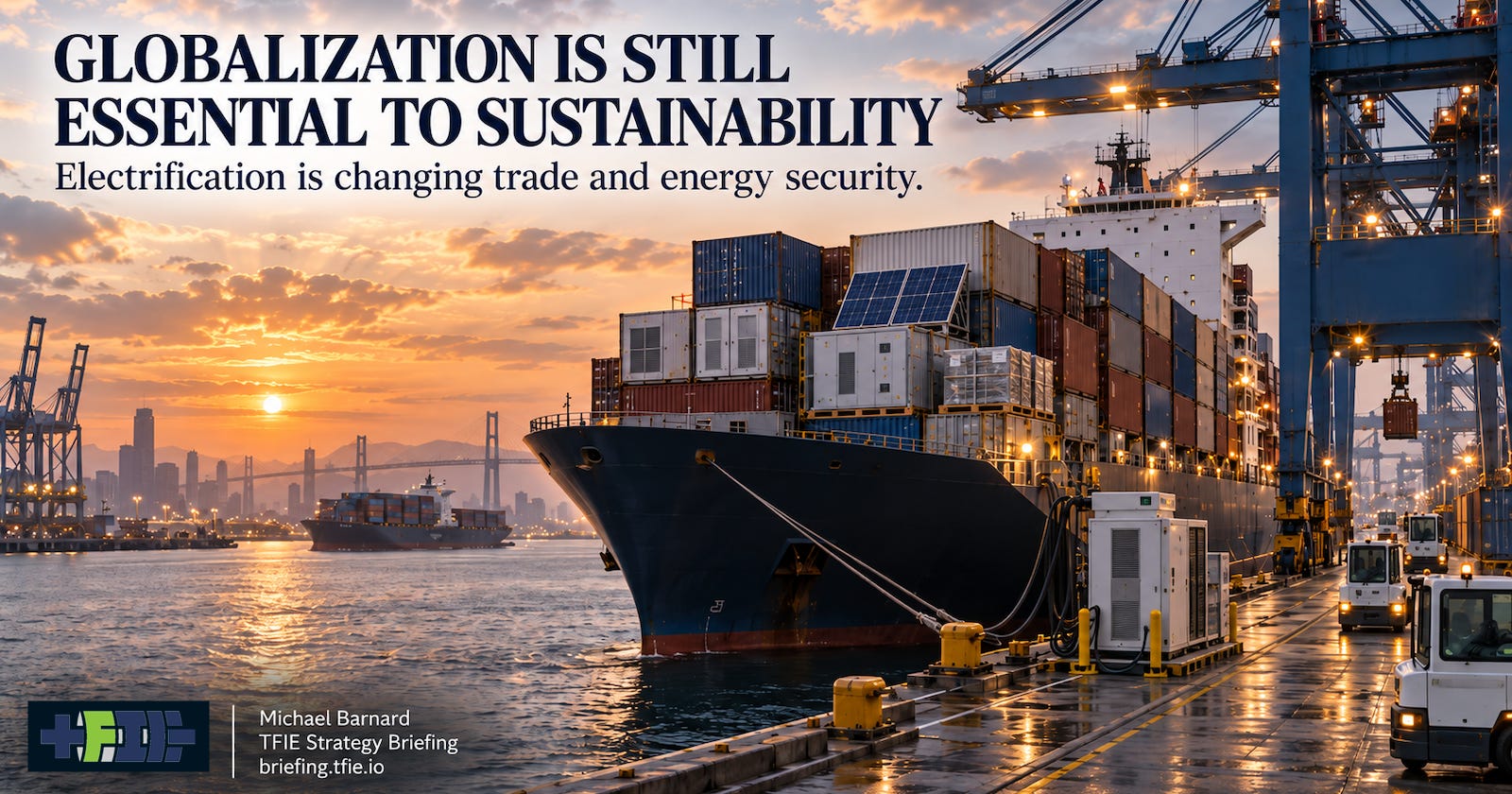
In 2021 I argued that globalization was essential to sustainability. International trade spreads technology, creates manufacturing scale, raises productivity and gives countries access to resources and capabilities they could not efficiently reproduce within their own borders. I also suggested that deeper economic integration would bring a “lovely byproduct of global peace.” That part was too optimistic. Russia invaded Ukraine less than six months later. The pandemic had already demonstrated the fragility of concentrated supply chains, while the years since have brought US-China trade restrictions, export controls, industrial subsidies and a much sharper concern with economic security. Globalization did not abolish geopolitics, and economically efficient concentration does not necessarily produce resilience.
The sustainability argument nevertheless looks stronger to me now, although with a different qualifier. Depending heavily on one unreliable supplier for a continuously consumed commodity is dangerous. An international system with several suppliers, several routes, domestic alternatives and enough redundancy to survive a disruption has a different risk profile. What I have come to call strategic interdependence accepts that countries will depend on one another while paying much more attention to the structure of those dependencies.
Energy makes the distinction unusually clear because electrification changes what crosses borders. Fossil-fuel economies repeatedly purchase things that disappear when used. An LNG cargo is burned and another cargo has to arrive. Oil imported this month contributes nothing to next month’s mobility. Clean-energy trade increasingly moves solar panels, batteries, electric vehicles, transformers, power electronics and other durable equipment that continues producing useful energy services for years after the trade transaction is finished.
The geopolitical reaction has included real attempts to localize supply chains, some of them sensible. China’s dominance of several stages of solar, battery and clean-technology production is an obvious vulnerability. Yet the International Energy Agency’s 2026 technology review finds that international trade in major clean-energy technologies reached an all-time high in the second quarter of 2025 despite higher tariffs and defensive industrial policies. In its stated-policies scenario, the value of net trade in the six clean technologies it models more than doubles from about $290 billion in 2025 to $620 billion in 2035. Emerging economies have also gone from receiving less than 5% of Chinese EV exports in 2020 to nearly 40%.
There are good reasons to make battery cells in Europe, solar modules in India, transformers in North America and wind components in additional regions. Diversity of supply, inventories, alternative shipping routes and some domestic capacity in critical technologies reduce disruption risk. But requiring every country to reproduce every stage of every clean-technology supply chain would throw away much of the manufacturing scale and specialization that made solar panels, batteries and EVs inexpensive enough to spread globally. The relevant question is how concentrated a dependency is, how quickly alternatives can substitute for it and what happens when a supplier or route disappears.
Electricity interconnection shows how far that reasoning has moved into energy-security policy. I explored this recently in As Geopolitics Fragments, Electricity Interconnection Gains Strategic Value. Four years after Russia’s invasion exposed the consequences of European dependence on Russian gas, European countries have not responded by trying to turn themselves into electricity islands. The European Commission’s current grid programme explicitly treats resilience and security of cross-border energy infrastructure as objectives. Its Energy Highways initiative is intended to remove interconnection bottlenecks, improve security of supply, integrate more renewables and reduce fossil-fuel dependence.
Ukraine provides a considerably harder test than normal electricity-market modelling. After Russia invaded in February 2022, Ukraine and Moldova accelerated their synchronization with the Continental European electricity system. ENTSO-E completed the emergency synchronization in March 2022 while Ukrainian grid operators were already working under wartime conditions. Cross-border electrical infrastructure in that case was not merely a mechanism for finding a lower wholesale price. It provided another source of system support while domestic infrastructure was exposed to extraordinary disruption.
Interconnectors themselves can be damaged or attacked. Neighbouring countries can experience similar weather, exports can become politically contentious during shortages and one enormous cable can become another single point of failure. The security value comes from the portfolio around the connection: several routes and counterparties, substantial domestic generation, storage, flexible demand and an internal grid capable of moving electricity where it is required. Strategic energy interdependence does not replace domestic resilience. It broadens the resources available when part of the domestic or international system fails.
The transition from fuel imports to productive-asset imports is already visible at national scale. Pakistan provides an unusually clean example. The State Bank of Pakistan’s 2026 assessment estimates that decentralized solar capacity may have reached roughly 50 GW by the end of 2025. It estimates cumulative foreign-exchange savings from reduced energy imports at about $7.1 billion over six years and calculates that the installed solar base could reduce the country’s 2026 energy-import bill by another $5.2 billion to $7.8 billion. Most strikingly, its staff calculate that the cumulative dollar cost of imported solar panels has now been broadly offset by the foreign exchange saved through lower fuel imports.
Pakistan imported large quantities of manufactured equipment, much of it from China, and that equipment is reducing its requirement to buy fuels abroad. The panels are imported, but the sunlight is Pakistani. Once installed, those foreign-manufactured assets turn a domestic resource into useful electricity without requiring another shipload of fuel.
Electric vehicles produce the same structural change in transport. The IEA estimates that the global EV fleet displaced about 1.7 million barrels of oil per day in 2025. China alone accounted for roughly one million barrels per day of that displacement and is also the world’s largest oil importer. Ethiopia represents a much earlier-stage version of the same logic: its government banned imports of gasoline and diesel vehicles in 2024 explicitly as part of a strategy to promote electric mobility and reduce fuel imports. The IEA reports that Ethiopia’s oil-import bill had exceeded $4 billion in 2022 and that around 100,000 EVs had subsequently been deployed, although charging and maintenance infrastructure remain constraints.
For an oil-importing economy, replacing an internal-combustion vehicle with an imported EV does not eliminate international trade. It changes the trade relationship. Instead of importing a machine and then importing thousands of litres of fuel over its operating life, the country imports more of the capital up front and powers it from an electricity system that can contain increasing shares of domestic wind, solar, hydro or other generation. Batteries and vehicles still have international supply chains and replacement requirements, but they do not create the same continuous dependence on a commodity whose value disappears during combustion.
Africa makes this transition particularly interesting because imported clean technology can help create the market for later industrial development. In Africa’s Solar Boom Is Hiding In The Import Data, I argued that inexpensive solar, falling battery costs, diesel displacement, electricity access and transport electrification were starting to reinforce one another rather than developing as isolated technology markets.
The hardware flows are already material. Sustainable Energy for All estimates that Africa imported more than $12 billion of solar photovoltaic modules, lithium-ion batteries and assembled EVs between 2022 and 2024. Solar-module imports rose from more than $1.2 billion in 2022 to nearly $2 billion in 2023 before easing to $1.6 billion in 2024, with more than 90% coming from China. Battery imports reached an estimated $1.8 billion in 2024, while imports of assembled passenger EVs exceeded $500 million.
That degree of concentration is a vulnerability, but it is not the whole story. Imported equipment creates installation businesses, maintenance capability, financing experience, logistics networks and customers. Solar and batteries can displace diesel generation and improve electricity reliability for mines, telecom sites, farms, warehouses and factories. Electric motorcycles, buses and other vehicles add useful electricity demand and create businesses around charging, financing, maintenance and battery services. As those markets become larger and more predictable, regional assembly and manufacturing become more plausible.
The World Bank’s 2026 work on African electric mobility makes the feedback loop explicit. It argues that electrifying transport can cut petroleum imports and foreign-exchange exposure while vehicle charging can provide anchor demand for solar mini-grids. Higher utilization improves the economics of the electricity asset and can reduce unit electricity costs for surrounding users. At the same time, the mini-grid gives electric motorcycles and other vehicles access to locally generated energy that replaces daily purchases of petroleum.
This is the African flywheel I have been watching. Cheap imported technologies enable deployment. Deployment builds useful electricity demand and local service industries. Better economics support more generation and storage. Electrified transport increases electricity utilization while reducing exposure to fuel imports. Larger markets justify better logistics and eventually more regional assembly and manufacturing. International trade can therefore be part of the process by which countries gain domestic productive capability rather than evidence that they lack it.
None of this implies that African economies should remain overwhelmingly dependent on one external manufacturing country. Supplier diversification, African assembly and manufacturing where scale supports them, stronger regional electricity networks and larger continental markets all improve resilience. But requiring local self-sufficiency before deployment would reverse the sequence that made most successful industrial ecosystems possible. Markets, skills, suppliers and institutions develop partly through doing the work.
That is where my 2021 argument needs its largest correction. Trade can raise the cost of disruption and create substantial benefits from cooperation, but it does not make geopolitical conflict disappear. Dependencies can be weaponized. Companies can optimize supply chains until they become brittle. Governments have legitimate reasons to care about critical suppliers, chokepoints and domestic industrial capability.
The sustainability argument for globalization survives because the physical transition remains international. Excellent renewable resources, hydro reservoirs, critical minerals, manufacturing centres, engineering expertise, capital and demand do not line up conveniently with national boundaries. Building resilience means diversifying those relationships and strengthening domestic capabilities where they matter, not deliberately constricting the networks through which technologies, electricity and knowledge move.
The old global energy system moved enormous quantities of coal, oil and gas from concentrated geological deposits to consumers that had to keep buying them. The emerging system increasingly moves solar modules, batteries, EVs, transformers, power electronics, minerals and electricity. Some of those supply chains are too concentrated today and should become more diverse. But much of what crosses the border now leaves behind productive capacity that can reduce the next import bill.
Globalization is still essential to sustainability. Five years of geopolitical disruption have clarified the condition attached to that claim. A resilient transition requires countries to produce more useful energy from their own resources while maintaining several ways to obtain the technologies and energy they cannot efficiently supply themselves. It means stronger electrical links to reliable neighbours, more diverse industrial supply chains and progressively less dependence on imported fuels that must be purchased again every time they are burned.
Subscribe to TFIE Strategy Briefing for decision-grade analysis of energy, infrastructure, industrial strategy and the transition.